
While therapists can draw upon any number of talk therapy techniques to help their clients, there are times when talk isn’t helpful or can’t be summoned. In such cases, the arts can open a back door to the psyche, drawing from individuals that which they cannot yet put into words, thus catalyzing subsequent therapeutic conversations. Creative arts therapies involve the use of the arts—visual art, music, dance and movement, drama, and poetry—to facilitate therapeutic goals.

According to photographer Marianne Gontarz York, MSW, LCSW, “Eighty percent of sensory stimuli enters through our eyes and goes into our brains where it is retained visually, nonverbally. Most of us think, feel, and recall memories not in words but in imagery. These images become a verbal language when we attempt to communicate what is going on in our mind to someone else.” The creative arts, Gontarz York says, “offer our social work clients a nonverbal way of expressing themselves and communicating their needs. These adjunctive therapies are invaluable in allowing people to express themselves when words cannot.”
In addition to facilitating communication, the arts also help clients forge relationships. “Creative arts therapies are wonderful starting grounds for building a verbal and nonverbal trusting relationship between a client and therapist and in group therapy between members of the group,” says Sally Bailey, MFA, MSW, RDT/BCT, a professor and director of the drama therapy program in the School of Music, Theatre and Dance at Kansas State University. “Working together on a project—whether that is a drama game, a mural, a song, or a group poem—creates connections that gently allow clients to reveal parts of themselves to others for a richer interpersonal knowledge.”
While creative arts therapies aren’t necessarily or entirely nonverbal, they recognize that talking isn’t always the best way to communicate, and, as a result, encourage and facilitate self-expression and active participation without depending entirely on a verbal articulation of issues. “The arts therapies provide a complement to traditional ‘talk therapies’ because they can address the full range of human experience—cognitive, behavioral, and affective domains,” says Nicholas F. Mazza, PhD, dean and Patricia V. Vance professor of social work in the College of Social Work at Florida State University. These approaches, he says, are being increasingly used in social work practice because the evidence for their usefulness has grown and been demonstrated by clinical reports and by qualitative and quantitative studies.
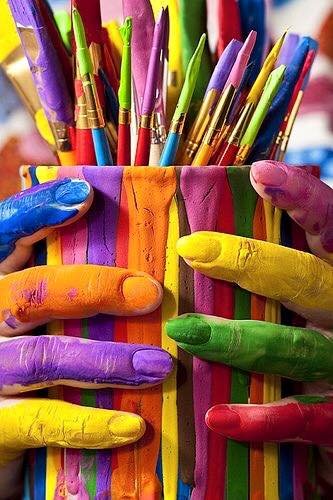
Arts therapies are “old human technology that has been used as long as there’s been art,” observes Shelly Goebl-Parker, MSW, LCSW, ATR-BC, program director of the art therapy counseling program in the department of art and design in the College of Arts and Sciences at Southern Illinois University Edwardsville. Indeed, the healing power of the arts was well known in ancient Rome and Greece.
“The arts have a long history in the practice of psychotherpy going back to the settlement house movement in the late 19th century,” Mazza says. “Through the years, the arts have been incorporated as adjunctive techniques in individual, family, group, and community practice.”
Any of the creative arts modalities may be used as a primary form of therapy or an adjunct to other modalities to improve the physical, cognitive, and psychosocial well-being of individuals with psychiatric disorders, developmental disabilities, neurological diseases, physical disabilities, and medical conditions, and may be practiced in the entire spectrum of therapeutic settings.
 RichardbBrunner