-
Anger Management
Over the years I have facilitated anger management groups. I use a variety of handouts and activities to have a process oriented group interaction. One of the hand outs I use is below. I use it in 1 of 2 ways. I have folks fill it out first and then we discuss or we go through it together and discuss. We explore as a group, learning from each other. ANGER WORDSanger disgust grumpiness rage aggravation dislike hate resentment agitation envy hostility revulsion annoyance exasperation irritation scorn bitterness ferocity jealousy spite contempt frustration loathing torment cruelty fury mean-spiritedness vengefulness destructiveness grouchiness outrage wrathOther:_________________________Prompting Events for Feeling AngerLosing power.Losing status.Losing respect.Being insulted.Not having things turn out the way you expected.Experiencing physical pain.Experiencing emotional pain.Being threatened with physical or emotional pain by someone or something.Having an important or pleasurable activity interrupted, postponed, or stopped.Not obtaining something you want (which another person has).Other:_______________________________Interpretations That Prompt Feelings of AngerExpecting pain.Feeling that you have been treated unfairly.Believing that things should be different.Rigidly thinking “I’m right.”Judging that the situation is illegitimate, wrong, or unfair.Ruminating about the event that set off the anger in the first place, or in the past.Other:____________________________Experiencing the Emotion of AngerFeeling incoherent.Feeling out of control.Feeling extremely emotional.Feeling tightness or rigidity in your body.Feeling your face flush or get hot.Feeling nervous tension, anxiety or discomfort.Feeling like you are going to explode.Muscles tightening. .Teeth clamping together, mouth tightening.Crying; being unable to stop tears.Wanting to hit, bang the wall, throw something, blow up.Other:__________________________Expressing and Acting on AngerFrowning or not smiling; mean or unpleasant facial expression.Gritting or showing your teeth in an unfriendly manner.Grinning.A red or flushed face.Verbally attacking the cause of your anger; criticizing.Physically attacking the cause of your anger.Using obscenities or cursing.U sing a loud voice, yelling, screaming, or shouting.Complaining or bitching; talking about how lousy things are.Clenching your hands or fists.Making aggressive or threatening gestures.Pounding on something, throwing things, breaking things.Walking heavily or stomping; slamming doors, walking out.Brooding or withdrawing from contract with others.Other:_____________________Aftereffects of AngerNarrowing of attention.Attending only to the situation making you angry.Ruminating about the situation making you angry and not being able to think of anything else.Remembering and ruminating about other situations that have made you angry in the past.Imagining future situations that will make you angry.Depersonalization, dissociative experience, numbness.Intense shame, fear, or other negative emotions.Other:______________________
 -
snow covered branches

-
Icelandic elves
From the BBC: Plans to build a new road in Iceland ran into trouble recently when campaigners warned that it would disturb elves living in its path. Construction work had to be stopped while a solution was found.
From his desk at the Icelandic highways department in Reykjavik, Petur Matthiasson smiles at me warmly from behind his glasses, but firmly.
“Let’s get this straight before we start – I do not believe in elves,” he says.
I raise my eyebrows slightly and incline my head towards his computer screen which is displaying the plans for a new road in a neighboring town. There are two yellow circles marked on the plans, one that reads Elf Church and another that reads Elf Chapel. Petur sighs.
“Ok,” he acknowledges wearily. “But it’s not every day in Iceland that we divert roads for elves. It’s just in this case we were warned that elves were living in some of the rocks in the path of the road – well, we have to respect that belief.” He grins shyly and picks up his car keys.

“Come on, I’ll show you where the elves live,” he says indulgently. Read More here
-
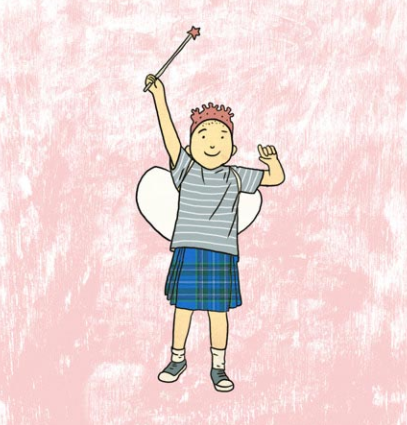
Queen of the Scottish Fairies
Rutu Modan, an illustrator and comic book creator, is a chosen artist of the Israel Cultural Excellence Foundation. She has done comic strips for the Israeli newpapers Yedioth Acharonot and Ma’ariv and illustrations for The New Yorker, Le Monde, The New York Times and many other publications. Her first graphic novel, Exit Wounds, has been published. Ms. Modan, usually based in Tel Aviv, is currently in Sheffield, England.
-
Another
Another world is not only possible, she is on her way. On a quiet day, I can hear her breathing. Arundhati Roy

-
Injury
Currently recovering from an injury and will start posting again in a week or so.

-
Depression and the inflammatory process
Most people feel down, tired and inactive when they’re injured or ill. This “sickness behavior” is caused by the activation of the body’s immune response. It’s the brain’s way of conserving energy so the body can heal.
This immune response can also occur in people with depression. This has prompted some researchers and clinicians to hypothesise that depression is actually a side effect of the inflammatory process.
But while there may be a connection between inflammation and depression, one doesn’t necessarily lead to the other. So it’s too simplistic to say depression is a physical, rather than a psychiatric, illness.
The inflammation hypothesis
University of California clinical psychologist and researcher George Slavich is one of the key recent proponents of depression as a physical illness. He hypothesises that social threats and adversity trigger the production of pro-inflammatory “cytokines”. These are messenger molecules of the immune system that play a critical role in orchestrating the host’s response to injury and infection.
This inflammatory process, Slavich argues, can initiate profound behavioral changes, including the induction of depression.

The idea that the activation of the immune response may trigger depression in some people is by no means a new one. Early descriptions of post-influenza depression appeared in the 19th century in the writings of English physician Daniel Tuke.
But it was not until the 1988 seminal paper, published by veterinarian Benjamin Hart, that the phenomenon of acute “sickness behavior” caught the interest of the scientific community.
Hart described his detailed observations of the “behavior of sick animals”. During acute infection, and in response to fever, the animals sought sleep, lost their appetite, showed a reduction in activity, grooming and social interactions, as well as showing signs of “depression”.
Just like the immune response itself, these changes reflect an evolved survival strategy that shifts priorities toward energy conservation and recovery.
Putting the theory into practice
Cytokine-induced sickness behavior has subsequently been studied as an example of communication between the immune system and the brain.
The behavioral changes during sickness resemble those associated with depression, so it didn’t take long for researchers to make a connection between the phenomenon of sickness behavior and mental disorders.
Such speculation was strengthened by research showing that depressive states can be experimentally induced by administering cytokines and other immunogenic agents (such as vaccines) that cause an inflammatory response.
Depression is frequently associated with inflammatory illnesses such as heart disease and rheumatoid arthritis. It’s also a side effect of treatment with cytokines to enhance the immune system.
Over recent decades, researchers have made progress in understanding how inflammation may impact on the activity of signalling pathways to and from the brain, as well as on the functioning of key neural systems involved in mood regulation.
But there’s not always a link
From the available evidence it’s clear, however, that not everyone who suffers from depression has evidence of inflammation. And not all people with high levels of inflammation develop depression.
 Trajectories of depression depend on a complex interplay of a spectrum of additional risk and resilience factors, which may be present to varying degrees and in a different combination in any individual at different times. These factors include the person’s:
- genetic vulnerabilities affecting the intensity of our inflammatory response
- other medical conditions
- acquired hyper-vigilance in the stress response systems due to early life trauma, current adversities, or physical stressors
- coping strategies, including social support
- health behaviors, such as sleep, diet and exercise.
Implications for treatment
In line with the notion that inflammation drives depression, some researchers have already trialled the effectiveness of anti-inflammatory therapy as a treatment for depression.
While some recipients (such as those with high levels of inflammation) showed benefit from the treatment, others without increased inflammation did not. This supports the general hypothesis.
However, in our desire to find more effective treatments for depression, we should not forget that the immune response, including inflammation, has a specific purpose. It protects us from infection, disease and injury.
Cytokines act at many different levels, and often in subtle ways, to fulfill their numerous roles in the orchestration of the immune response. Undermining their vital role could have negative consequences.
Mind versus body
The recent enthusiasm to embrace inflammation as the major culprit in psychiatric conditions ignores the reality that “depression” is not a single condition. Some depressive states, such as melancholia, are diseases; some are reactions to the environment; some are existential; and some normal.
Such separate states have differing contributions of biological, social and psychological causes. So any attempt to invoke a single all-explanatory “cause” should be rejected. Where living organisms are concerned it is almost never that simple.
In the end, we cannot escape the reality that changes must occur at the level of the brain, in regions responsible for mood regulation, for “depression” to be experienced.
-
Emotional Intelligence
I often work with groups using lists. In movement therapy as well as psychotherapy, educational and process oriented groups lists are a great structure for groups to explore thoughts, and/or feelings. Here is a list that often comes up in groups ten suggestions about feelings.
1. Become emotionally literate. Label your feelings, rather than labeling people or situations.
Use three word sentences beginning with “I feel”.
Start labeling feelings; stop labeling people & situations
“I feel impatient.” vs “This is ridiculous.” I feel hurt and bitter”. vs. “You are an insensitive jerk.”
“I feel afraid.” vs. “You are driving like an idiot.”
2. Distinguish between thoughts and feelings.
Thoughts: I feel like…& I feel as if…. & I feel that
Feelings: I feel: (feeling word)
3. Take more responsibility for your feelings.
“I feel jealous.” vs. “You are making me jealous.”
Analyze your own feelings rather than the action or motives of other people. Let your feelings help you identify your unmet emotional needs.
4. Use your feelings to help make decisions
“How will I feel if I do this?” “How will I feel if I don’t?”
“How do I feel?” “What would help me feel better?”
Ask others “How do you feel?” and “What would help you feel better?”
5. Use feelings to set and achieve goals
– Set feeling goals. Think about how you want to feel or how you want others to feel. (your employees, your clients, your students, your children, your partner)
– Get feedback and track progress towards the feeling goals by periodically measuring feelings from 0-10. For example, ask clients, students, teenagers how much they feel respected from 0 to 10.
6. Feel energized, not angry.
Use what others call “anger” to help feel energized to take productive action.
7. Validate other people’s feelings.
Show empathy, understanding, and acceptance of other people’s feelings.
8. Use feelings to help show respect for others.
How will you feel if I do this? How will you feel if I don’t? Then listen and take their feelings into consideration.
9. Don’t advise, command, control, criticize, judge or lecture to others.
Instead, try to just listen with empathy and non-judgment.
10. Avoid people who invalidate you.
While this is not always possible, at least try to spend less time with them, or try not to let them have psychological power over you. -
Bebe
-
ice covered branches



 RichardbBrunner