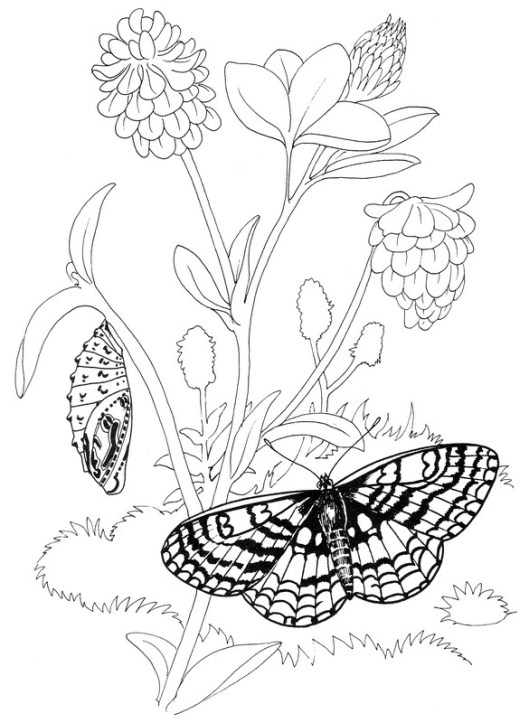
Posted by RichardB | Filed under Coloring Pages
≈ Comments Off on Chalcedon Checkerspot Coloring Page

23 Saturday May 2020
Posted by RichardB | Filed under Coloring Pages
≈ Comments Off on Chalcedon Checkerspot Coloring Page
23 Saturday May 2020
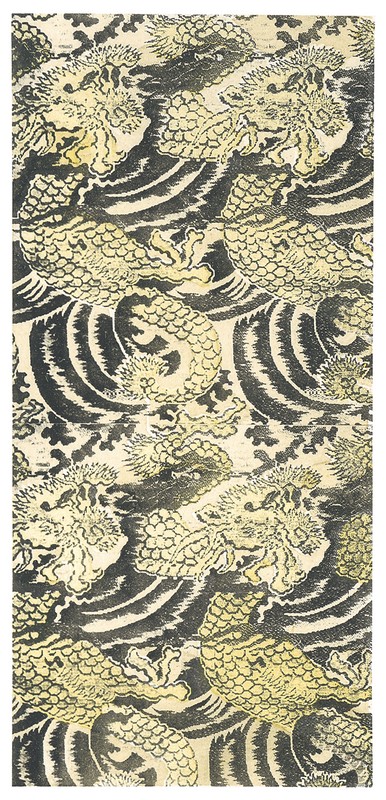
Posted by RichardB | Filed under Japanese Textile Designs
≈ Comments Off on Japanese Textile Designs 113
22 Friday May 2020
21 Thursday May 2020
 Brain scans revealed artists have more grey matter in parts of their brains
Artists have structurally different brains compared with non-artists, a study has found.
Participants’ brain scans revealed that artists had increased neural matter in areas relating to fine motor movements and visual imagery.
The research, published in NeuroImage, suggests that an artist’s talent could be innate.
But training and environmental upbringing also play crucial roles in their ability, the authors report.
As in many areas of science, the exact interplay of nature and nurture remains unclear.
Lead author Rebecca Chamberlain from KU Leuven, Belgium, said she was interested in finding out how artists saw the world differently.
“The people who are better at drawing really seem to have more developed structures in regions of the brain that control for fine motor performance and what we call procedural memory,” she explained.
In their small study, researchers peered into the brains of 21 art students and compared them to 23 non-artists using a scanning method called voxel-based morphometry.
 One artist who has practiced for many years is Alice Shirley – here is a detail of her Giant Lobster
These detailed scans revealed that the artist group had significantly more grey matter in an area of the brain called the precuneus in the parietal lobe.
“This region is involved in a range of functions but potentially in things that could be linked to creativity, like visual imagery – being able to manipulate visual images in your brain, combine them and deconstruct them” .
Alice Shirley – artist
“I had a very arty family. My mother was an art historian and my dad a photographer.
“I grew up surrounded by art and was encouraged to draw from a very young age, and I liked it so I did more of it. It was a combination of encouragement and enthusiasm that made me interested in pursuing art.
“It’s just in the blood.”
Participants also completed drawing tasks and the team looked at the relationship between their performance in this task and their grey and white matter.
A changing brain
Those better at drawing had increased grey and white matter in the cerebellum and also in the supplementary motor area – both areas that are involved with fine motor control and performance of routine actions.
Grey matter is largely composed of nerve cells, while white matter is responsible for communication between the grey matter regions.
But it is still not clear what this increase of neural matter might mean. From looking at related studies of other creative people, such as musicians, it suggests that these individuals have enhanced processing in these areas, Dr Chamberlain added.
“It falls into line with evidence that focus of expertise really does change the brain. The brain is incredibly flexible in response to training and there are huge individual differences that we are only beginning to tap into.”

Another author of the paper, Chris McManus from University College London, said it was difficult to distinguish what aspect of artistic talent was innate or learnt.
“We would need to do further studies where we look at teenagers and see how they develop in their drawing as they grow older – but I think [this study] has given us a handle on how we could begin to look at this.”
Commenting on the small sample size, Prof McManus said: “Since the results were statistically significant then clearly there was the power to find something, which almost by definition means it was large enough.
“And also of interest is that other people have also had hints at effects in similar locations. Obviously in an ideal world we’d like 1000 subjects, but that isn’t realistic. It’s always a compromise between cost, practicality and interest.”
No ‘right’ side
Ellen Winner of Boston College, US, who was not involved with the study, commented that it was very interesting research.
She said it should help “put to rest the facile claims that artists use ‘the right side of their brain’ given that increased grey and white matter were found in the art group in both left and right structures of the brain”.
“Only a prospective study could get at the question of innate structural brain differences that predispose people to become visual artists, and this kind of study has not been done as it would be very difficult and very expensive to carry out.”
21 Thursday May 2020
Posted in Meditation, mindfulness
≈ Comments Off on Meditation for as short as 8 weeks can change your brain
20 Wednesday May 2020
19 Tuesday May 2020
Tags
19 Tuesday May 2020
Posted in Art Therapy, emotions, mindfulness, positive, Therapy, Wellness
≈ Comments Off on Water colors
Tags
cognitive processes, drama therapy cards, emotional expression, feelings cards, mindfulness practice, movement cards, paint, yoga asana cards
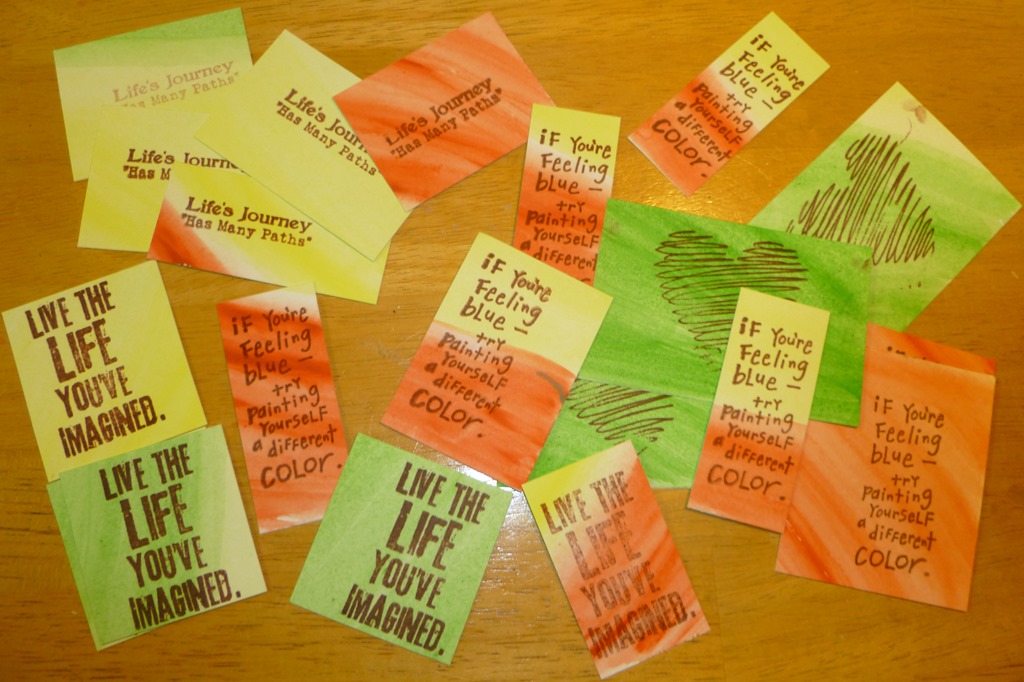
One Creative Therapy Tool that I use is to paint. Some times 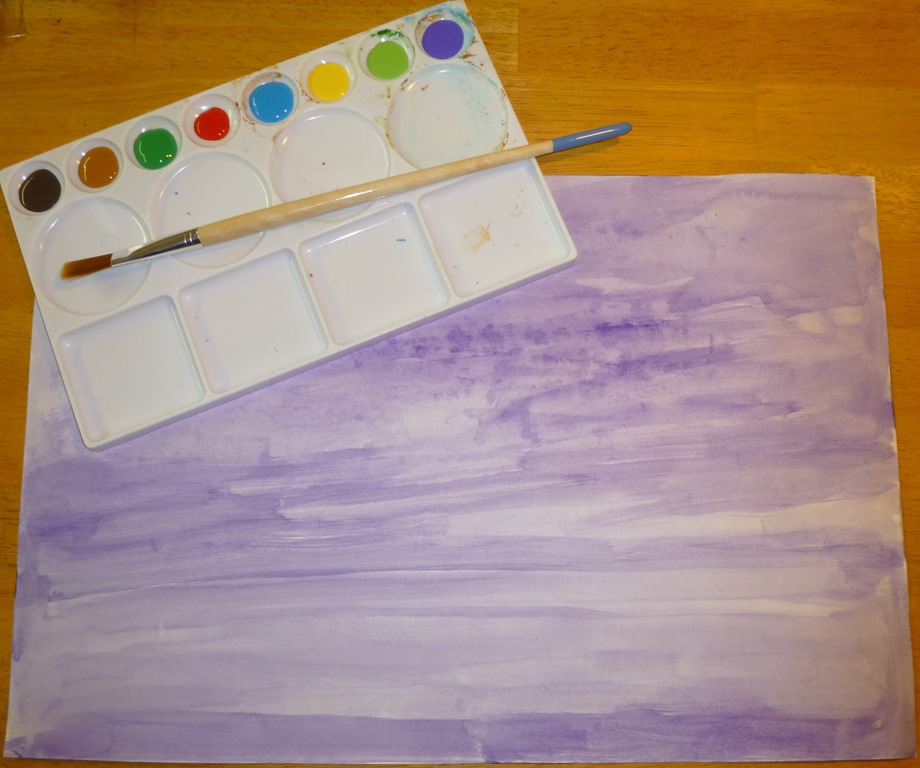 pictures of actual ‘things’ like trees or boats; but I usually paint shapes. Lately I have been using water colors to paint shades and gradients of color. Colors shifting from one type of purple(for instance) to a deeper purple.
There is a lot going on in the simple act of painting color that involves cognitive processes, emotional expression, mindfulness practice, amongst others. There is the hand eye coordination, and the movement of the body 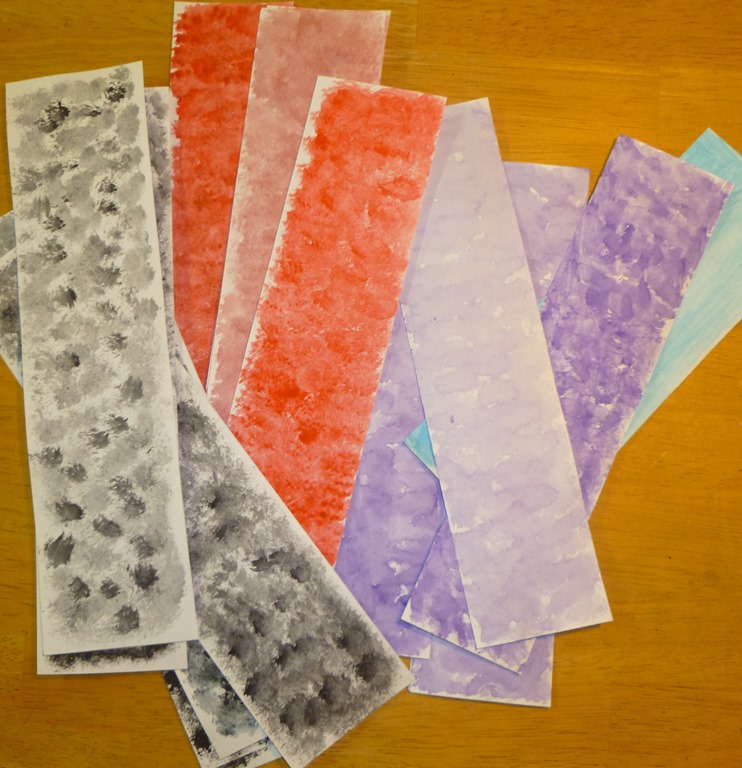 (hand,arm shoulder), to apply the paint to the brush, water and paper. There is the picking and choosing of colors that I want to use; sometimes I pick a color that has a pleasing effect on how I feel, and sometimes that choice changes how I feel. The act of painting requires focus and at least a little concentration being in the here and now.
I have been turning my gradient paintings in to therapy cards. I work a lot with groups providing therapy and often participants have difficulty expressing their feelings and/or thoughts. The cards provide an avenue for people to share/start a conversation. I have created affirmation cards, feelings cards, drama therapy cards, movement cards, yoga asana cards, and many others.
(click image for larger size)
18 Monday May 2020
Tags
Mojo Ruiz de Luzuriaga, known professionally as Mo’Ju and previously as Mojo Juju, is an ARIA Award-nominated Australian musician, best-known for her 2018 album Native Tongue and the lead single of the same title. The single won the Best Independent Single category in the 2019 AIR Awards. She plays guitar and piano, writes songs and sings, and has created music in a number of genres.
I have a 16,000 plus digital audio collection and I use Media Monkey to manage my files. One feature of Media Monkey is you can sort your collection based on the number of times played. This playlist is based on the top music and/or music video files I played/listened/streamed from my server in 2019. Complete Playlist HERE
17 Sunday May 2020
Tags
17 Sunday May 2020
16 Saturday May 2020

Posted by RichardB | Filed under Coloring Pages
≈ Comments Off on Eastern Bluebird Coloring Page
16 Saturday May 2020
Posted by RichardB | Filed under Seguy Art Deco Designs
≈ Comments Off on Seguy Art Deco Designs 111
15 Friday May 2020
14 Thursday May 2020
Tags
Adopting a wider perspective includes working cooperatively with others. Crises that are global by nature, such as problems related to climate change or the modern economic structure, call for coordinated and concerted efforts among many people, with a sense of responsibility and commitment – this is more encompassing than any individual or personal issue. Dalai Lama

14 Thursday May 2020
Posted in culture, discovery, Science, Uncategorized
≈ Comments Off on Fairy tales started long ago
They have been told as bedtime stories by generations of parents, but fairy tales such as Little Red Riding Hood may be even older than was previously thought.
A study by anthropologists has explored the origins of folk tales and traced the relationship between variants of the stories recounted by cultures around the world.
The researchers adopted techniques used by biologists to create the taxonomic tree of life, which shows how every species comes from a common ancestor.
Dr Jamie Tehrani, a cultural anthropologist at Durham University, studied 35 versions of Little Red Riding Hood from around the world.
Whilst the European version tells the story of a little girl who is tricked by a wolf masquerading as her grandmother, in the Chinese version a tiger replaces the wolf.
Contrary to the view that the tale originated in France shortly before Charles Perrault produced the first written version in the 17th century, Dr Tehrani found that the varients shared a common ancestor dating back more than 2,600 years.
He said: “Over time these folk tales have been subtly changed and have evolved just like an biological organism. Because many of them were not written down until much later, they have been misremembered or reinvented through hundreds of generations.
“By looking at how these folk tales have spread and changed it tells us something about human psychology and what sort of things we find memorable.
“The oldest tale we found was an Aesopic fable that dated from about the sixth century BC, so the last common ancestor of all these tales certainly predated this. We are looking at a very ancient tale that evolved over time.”
Dr Tehrani, who will present his work on Tuesday at the British Science Festival in Guildford, Surrey, identified 70 variables in plot and characters between different versions of Little Red Riding Hood.
He found that the stories could be grouped into distinct families according to how they evolved over time.
The original ancestor is thought to be similar to another tale, The Wolf and the Kids, in which a wolf pretends to be a nanny goat to gain entry to a house full of young goats.
Stories in Africa are closely related to this original tale, whilst stories from Japan, Korea, China and Burma form a sister group. Tales told in Iran and Nigeria were the closest relations of the modern European version.
Perrault’s French version was retold by the Brothers Grimm in the 19th century. Dr Tehrani said: “We don’t know very much about the processes of transmission of these stories from culture to culture, but it is possible that they may being passed along trade routes or with the movement of people.”
Professor Jack Zipes, a retired professor of German at the University of Minnesota who is an expert on fairy tales and their origins, described the work as “exciting”. He believes folk tales may have helped people to pass on tips for survival to new generations.
He said: “Little Red Riding Hood is about violation or rape, and I suspect that humans were just as violent in 600BC as they are today, so they will have exchanged tales about all types of violent acts.
“I have tried to show that tales relevant to our adaptation to the environment and survival are stored in our brains and we consistently use them for all kinds of reference points.”
13 Wednesday May 2020
Posted in free, Nelson Mandela, Uncategorized
≈ Comments Off on To be free
12 Tuesday May 2020
Posted in Art Therapy, Wellness
≈ Comments Off on Art and Asthma
The fear and anxiety associated with an asthma attack can last long after the attack has subsided. Now research, published online in the Journal of Allergy & Clinical Immunology, reports that the art therapy showed benefits both during the therapy and for months afterward. “Asthma impacts not only a child’s physical well-being but also has a considerable effect on a child’s quality of life and psychological development,” said Anya Beebe, MA, an art therapist at National Jewish Health. “Our study shows that art therapy for children with severe, chronic asthma is clearly beneficial. Our results were striking and persisted for months after treatment stopped.”
In art therapy, patients create artwork that helps express their feelings about an illness, a trauma or medical concerns. The artwork can then serve as a starting point for discussions about these issues. Researchers believe that creating art helps participants establish distance between themselves and their medical concerns. They learn to understand that they have a personal identity outside of their illness. It is believed to be particularly effective with children because they often do not have the adult capabilities to verbally articulate their emotions, perceptions, or beliefs, and often can more comfortably convey ideas in ways other than talking.
You can read more at the National Jewish Health website.
12 Tuesday May 2020
Posted in Acceptance, Addiction, photo, quote, Wellness
≈ Comments Off on Acceptance
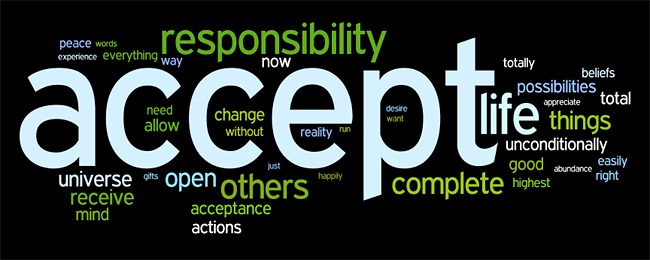
Acceptance is outcomes without attachments, guilt, shame, remorse, self pity, resentment, fear, anger, etc. These are the tools of the disease of addiction. To maintain Recovery One must maintain a state of Acceptance.
11 Monday May 2020
Tags
Carnatic Music 2.0 is an experimental project founded by Mahesh Raghvan that attempts to present Carnatic compositions in a modern style, by fusing them with elements of Dubstep, Drum and Bass, and Electronic Dance Music. The objective of this project is to present Carnatic Music Fusion in a way that would appeal to the young and modern audiences of today.
I have a 16,000 plus digital audio collection and I use Media Monkey to manage my files. One feature of Media Monkey is you can sort your collection based on the number of times played. This playlist is based on the top music and/or music video files I played/listened/streamed from my server in 2019. Complete Playlist HERE


 RichardbBrunner