• Home
  • Music
  • About
  • Contact
  • CreativeTherapyTools.com

RichardbBrunner

~ creative arts therapist

RichardbBrunner

Category Archives: Coping Skills

Addiction: One Perspective

31 Wednesday Aug 2022

Posted by RichardB in Addiction, Coping Skills

≈ Comments Off on Addiction: One Perspective

Tags

perspective

Whether consciously acknowledged or not, we live in an almost constant state of anxiety. We are concerned with what we may lose, or what we may not gain. We also live in grief and regret over what we have left behind or at least feel we may have indeed lost. We thus attach ourselves to the very things that we cannot, ultimately, control, the past and the future. In truth, there is only today, this moment, and this breath with which we are, and can be, connected. The past is gone, and the future has not yet happened. We are here, now.

From a Buddhist perspective, addiction might be considered the archetype of attachment. Addiction is, in fact, a collection of attachments. It is attachment to fear, attachment to loss, and attachment to longing, emptiness, and a lack of a sense of purpose. Whether we choose alcohol, drugs, sex, food, pornography, exercise or even shopping, we are simply employing the means serving the compulsion to fill a space and dampen our pain. The means does not matter; that is simply a gesture. The compulsion is the crux of it, and that compulsion is not so much to drink, or do drugs, or to spend; that compulsion, ultimately, is to fill that space.

And just what is that space? We might look upon it as the “God-shaped hole.” The wisdom teachings suggest that in identifying with a self, a “me”, we divorce ourselves from the true nature of our existence. From a psychological perspective, this division presents itself as inauthenticity, and the internal conflict that condition engenders promotes internal strife. In our attempt to reconcile this sense of inauthenticity, we cling even more desperately to establishing a sense of “me-ness” and can, in some cases, become morbidly self-destructive in our attempts to soothe the pain of failure in that reconciliation.

Addiction generally begins as an interest. As soon as we express an interest in something, we are expressing a preference. In expressing a preference, we are dividing our attention and creating an attachment to something in the world around us. As that interest turns into a fascination, our attachment deepens. Our attention becomes more and more exclusive, and we become increasingly imbalanced; emotionally, intellectually, and spiritually.

Fascination may then flower into obsession, and we become a slave to our attachment. We are no longer ourselves, and rather than ‘losing our mind’, which would be the skillful means by which to escape our attachment, we are trapped inside the mind.

With obsession, our attachment becomes even more intensified, and our exclusion even more narrow. As we become slaves to our attachment, our mind, and our behavior, we lose the ability to exercise free will and, in that light, move from obsession to compulsion; from place of being driven, to a place of need.

At this point we fail the First Noble Truth; our attachment has become so involved that we have invited suffering. We are no longer willful, but, rather, subject to and at the sufferance of the will of our attachments. When we find ourselves in a place that we cannot live without exercising this attachment, whatever it may be, we have fallen into a state of addiction.

Within the context of addiction, people often feel that they do not have a choice. Nothing could be further from the truth. We always have a choice. When confronting someone who themselves is confronting an addiction, saying to them, “Stopping your behavior is your choice.” is, however, often met with profound resistance for their failure to see that choice.

The key to getting a grasp on this is recognizing that choice is a constant state; it is not a single moment in time. If the choice not to be addicted were a single choice point, then all we would ultimately do is move our attachment from something socially defined as negative (say, drinking or being promiscuous) to something that is socially defined as positive (not drinking or being chaste). In fact, we would become addicted, or at the very least attached, to not being addicted.

Buddha spoke of the Middle Way. Within the context of choice that suggests that if we are present in the moment, our choices are constant. We do not, then, go right or left, say yes or no, think good or bad, or see black or white; rather, we are aware that both opportunities are presenting themselves, we recognize this and acknowledge it, then choose neither.

When we lose the Middle Way and fall off our balancing point, we create our pain. We create our sense of emptiness, and our anxiety around loss. We deceive ourselves into believing that we are less than whom and what we are by virtue of attaching ourselves to things, objects, situations, emotions, and anxieties that take us away from ourselves. This is the engine of addiction.

Coming back to the present moment brings us back to our constancy of choice. We find ourselves in the Middle Way, on the balancing point and we are able to see both choices. Seeing both sides in balance and in perspective then gives us the opportunity to exercise compassion. Most importantly, it gives us the opportunity to exercise compassion toward ourselves. We are able to see the left and the right, and we are also able to see the left in the right and the right in the left.

Our frustration with the world and sense of victimhood thus becomes transformed into the recognition that we must set an intention in our lives. Our depression finds an antidote for itself in the gratitude that we can express simply for being alive. We begin to see outside ourselves with a clear vision and recognize that the things outside ourselves are, in fact, quite outside ourselves. In letting go of our attachments we also let go of the things that influence us and draw us into a state of mind where we feel less than we are, where we feel that something is missing, where we need to fill the space, or dampen the pain, or simply make it go away.

Coming back to the breath as a marker for the present moment and exercising the constancy of choice in that moment and every moment also gives us an opportunity to break free of the bonds of this supreme state of attachment and begin to climb out of the pit of suffering into which we have gotten ourselves.

Handout: Unhelpful Thinking Styles

24 Wednesday Aug 2022

Posted by RichardB in Coping Skills, Handout

≈ Comments Off on Handout: Unhelpful Thinking Styles

Tags

handout, Thinking

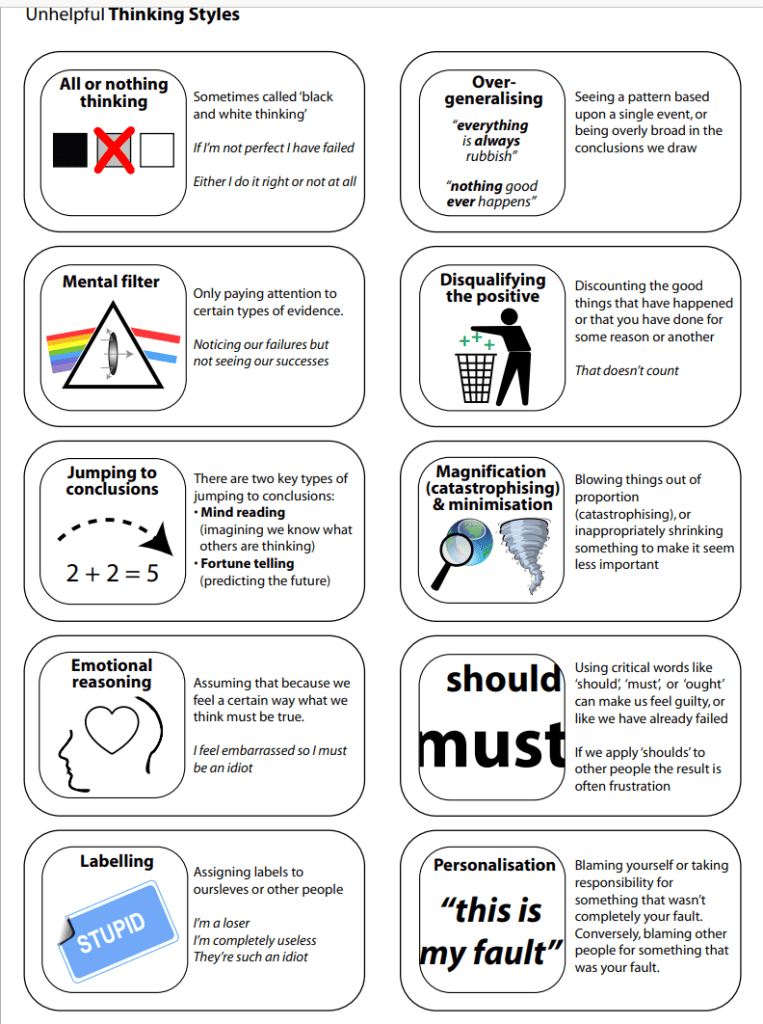
Another handout to start the conversation in groups. If the group I am working with engages easily I will just use one copy. I have people, one at a time read a thinking style and we talk about it.

If the group does not engage easily I past out copies to everyone and they circle one or two and we discuss.

At the end of group (and most groups I do) I ask if this handout was useful or not, if there is anything that can be done to make it better.

Positive Statements Handout

11 Thursday Aug 2022

Posted by RichardB in Coping Skills, Handout

≈ Comments Off on Positive Statements Handout

Tags

Group Therapy, handout, Self Esteem

About 75% of Psycho-educational groups I have facilitated over the decades have basicly been coping skills. This handout is for a self esteem group and usually generated engagement.

To begin I ask folks to fill out this handout and than we talk about it. Having a handout helps to facilitate interactions with clients, encouraging them to share …. which in ideal situations leads to a more open discussion, moving away from the handout but staying with the theme. If we have all shared and a new discussion does not evolve I ask the group what other questions should we ask …. and than we ask.

Positive Statements about you

1. I like myself because:

2. I’m an expert at:

3. I feel good about:

4. My friends would tell you I have a great:

5. My favorite place is:

6. I’m loved by:

7. People say I am a good:

8. I’ve been told I have:

Watch “This could be why you’re depressed or anxious | Johann Hari” on YouTube

08 Friday Jul 2022

Posted by RichardB in Coping Skills

≈ Comments Off on Watch “This could be why you’re depressed or anxious | Johann Hari” on YouTube

Tags

anxious, coping skill, depression

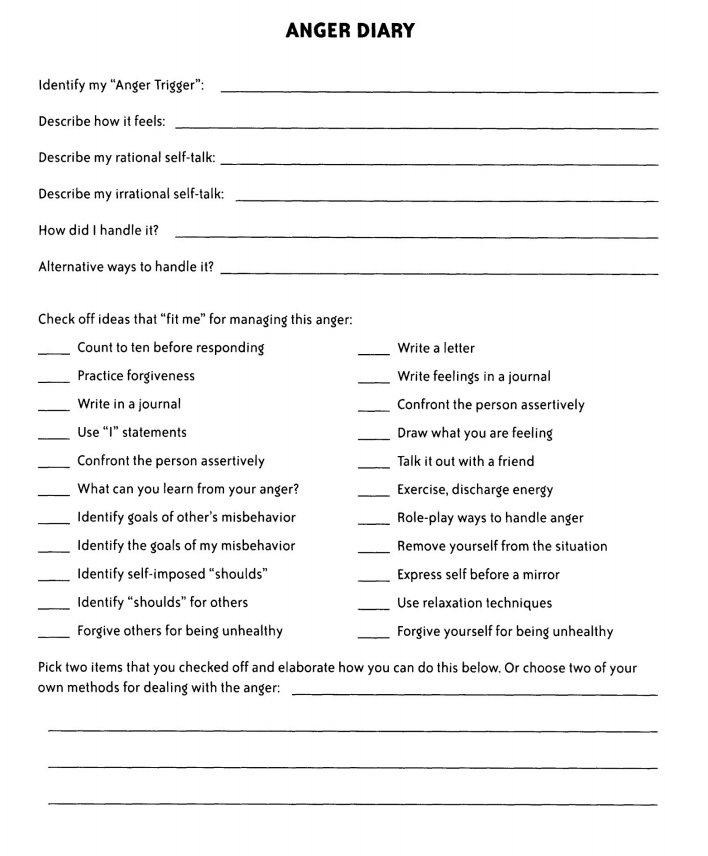
Anger Diary Handout

30 Thursday Jun 2022

Posted by RichardB in Coping Skills, Handout

≈ Comments Off on Anger Diary Handout

Tags

anger, handout

I spent years leading an anger management group and this handout was one I used when groups had difficulty engaging.

As in all groups at the end I asked people if this handout was useful or not and what could be done to make it better. Most said that it was somewhat useful. This handout was not my first choice in working with groups.

Manage stress handout

23 Thursday Jun 2022

Posted by RichardB in Coping Skills, Handout, Stress

≈ Comments Off on Manage stress handout

Tags

Anxiety, handout

If your methods of coping with stress aren’t contributing to your greater emotional and physical health, it’s time to find healthier ones. There are many healthy ways to manage and cope with stress, but they all require change. You can either change the situation or change your reaction. When deciding which option to choose, it’s helpful to think of the four As: avoid, alter, adapt, or accept.

Since everyone has a unique response to stress, there is no “one size fits all” solution to managing it. No single method works for everyone or in every situation, so experiment with different techniques and strategies. Focus on what makes you feel calm and in control.

Dealing with Stressful Situations: The Four A’s

Change the situation: Avoid the stressor. Alter the stressor.Change your reaction: Adapt to the stressor. Accept the stressor.

1. Avoid unnecessary stress

Not all stress can be avoided, and it’s not healthy to avoid a situation that needs to be addressed.

Learn how to say “no” – Know your limits and stick to them.

Avoid people who stress you out –Limit the amount of time you spend with people that cause you stress. 

Take control of your environment – If the evening news makes you anxious, turn the TV off.

Avoid hot-button topics –If you repeatedly argue about the same subject with the same people, stop bringing it up or excuse yourself when it’s the topic of discussion.

Pare down your to-do list –If you’ve got too much on your plate, distinguish between the “shoulds” and the “musts.”

2. Alter the situation

If you can’t avoid a stressful situation, try to alter it. Figure out what you can do to change things so the problem doesn’t present itself in the future.

Express your feelings instead of bottling them up. If something or someone is bothering you, communicate your concerns in an open and respectful way.

Be willing to compromise. When you ask someone to change their behavior, be willing to do the same.

Be more assertive. Deal with problems head on, doing your best to anticipate and prevent them.

Manage your time better. Plan ahead and make sure you don’t overextend yourself.

3. Adapt to the stressor

If you can’t change the stressor, change yourself. You can adapt to stressful situations and regain your sense of control by changing your expectations and attitude.

Reframe problems. Try to view stressful situations from a more positive perspective.

Look at the big picture. Will it matter in a month, or a year?

Adjust your standards. Set reasonable standards for yourself and others, and learn to be okay with “good enough.”

Focus on the positive. When stress is getting you down, take a moment to reflect on all the things you appreciate in your life, including your own positive qualities and gifts.

4. Accept what you can’t change

Some sources of stress are unavoidable, in such cases; the best way to cope with stress is to accept things as they are. Acceptance may be difficult, but in the long run, it’s easier than railing against a situation you can’t change.

Don’t try to control the uncontrollable. Focus on the things you can control such as the way you choose to react to problems.

Look for the upside. As the saying goes, “What doesn’t kill us makes us stronger.” When facing major challenges, try to look at them as opportunities for personal growth.

Share your feelings. Talk to a trusted friend or make an appointment with a therapist.

Learn to forgive. Accept the fact that we live in an imperfect world and that people make mistakes.

5. Make time for fun & relaxation

You can reduce stress in your life by nurturing yourself. If you regularly make time for healthy fun and relaxation, you’ll be in a better place to handle life’s stressors.

Healthy ways to relax and recharge

Go for a walk. Spend time in nature. Call a good friend. Exercise. Write in your journal. Take a long bath. Light scented candlesPlay with a pet. Work in your garden. Get a massage. Curl up with a good book. Listen to music. Watch a comedy

Nurturing yourself is a necessity, not a luxury.

Set aside relaxation time. Include rest and relaxation in your daily schedule..

Connect with others. Spend time with positive people who enhance your life.

Do something you enjoy every day. Make time for leisure activities that bring you joy, whether it be stargazing, playing the piano, or working on your bike.

Keep your sense of humor. This includes the ability to laugh at yourself.

6. Adopt a healthy lifestyle

You can increase your resistance to stress by strengthening your physical health. 

Exercise regularly. Physical activity plays a key role in reducing and preventing the effects of stress.

Eat a healthy diet. Well-nourished bodies are better prepared to cope with stress, so be mindful of what you eat.

Reduce caffeine and sugar. The temporary “highs” caffeine and sugar provide often end in with a crash in mood and energy. By reducing the amount of coffee, soft drinks, chocolate, and sugar snacks in your diet, you’ll feel more relaxed and you’ll sleep better.

Avoid alcohol, cigarettes, and drugs. Self-medicating with alcohol or drugs may provide an easy escape from stress, but the relief is only temporary.

Get enough sleep. Adequate sleep fuels your mind, as well as your body. Feeling tired will increase your stress because it may cause you to think irrationally.

Setting boundaries

16 Thursday Jun 2022

Posted by RichardB in Coping Skills

≈ Comments Off on Setting boundaries

Tags

boundaries, handout

Setting boundaries is an essential skill in life, especially for people in recovery. Addicts often grow up in dysfunctional homes, where boundaries were either too rigid (leading to suppressed emotions or distant relationships) or too enmeshed (depriving them of a sense of personal identity). Later in life, their interpersonal relationships may continue to be defined by old roles and patterns, increasing the risk of depression, anxiety and addictive or compulsive behaviors.

As part of recovery, addicts learn how to set boundaries and to respect other people’s boundaries in return. In the addiction field, treatment providers often refer to this process as embracing the authentic self. While it may sound like psychobabble, it is really a process of discovering who you want to be, how you want to interact with other people, and taking responsibility for the consequences of your choices.

Why are boundaries important? They keep you safe from being manipulated, abused or taken advantage of, while also protecting other people from harm you may consciously or unconsciously inflict. They prevent both parties in a relationship from blurring the lines between self and others, which can lead to enmeshment and codependency. With healthy boundaries in place, you can begin to tune in to your inner voice and trust your own thoughts and feelings, and then communicate those to other people.

Distinguishing Healthy and Unhealthy Boundaries

Without a healthy role model, it can be difficult to know what healthy boundaries look like. First, let’s cover what healthy boundaries are not. They are not threats or attempts to control or manipulate others into doing what you want. They are not rigid rules or “walls” designed to keep people out or shield you from expressing your emotions.

Healthy boundaries are simply a delineation of what type of treatment is acceptable to you, and what consequences will result from violating a boundary. People with healthy boundaries share their thoughts and feelings, take care of their own needs, and are able to say no when necessary.

By contrast, people with weak boundaries often:

• Sacrifice their personal values, plans or goals to please others

• Allow others to define who they are and make decisions for them

• Expect others to fulfill all their needs

• Feel guilty when they say no

• Hesitate to share their opinions or assert themselves if they are being treated unfairly

• Frequently feel used, threatened, victimized or mistreated by others

• Frequently offer unsolicited advice, or feel pressured to follow someone else’s advice

• Take responsibility for other people’s feelings

• Tell others how to think, feel or act

A Boundary-Setting Roadmap

Every individual is called upon to set their own boundaries. What works for some may seem either too intrusive or too distant to others. When laying out your boundaries, work through the following steps:

Create a Personal Bill of Rights. Before you can start setting boundaries, you have to recognize your right to have your own feelings, values and beliefs and to express to others how you want to be treated. For some, this requires a colossal leap in self-worth.

Identify Your Emotions. Our parents always admonish us to “think before you act.” When you have a strong response, take a time-out to identify the underlying emotion and figure out what you want to convey. Doing so allows you to interact with other people in an honest, direct way rather than blaming or lashing out.

Set Limits. Once you have a few guidelines in place for how you expect to be treated, practice setting limits with people in a clear, direct way. Examples of healthy boundaries are: “I choose to be around sober people” or “I’ll be happy to talk with you when your voice is calm.”

Assert Your Needs. If you feel that your boundaries are being violated, speak up. This doesn’t mean lashing out or blaming others, but rather assertively communicating your needs. Ask for what you want and say no, politely yet firmly, if something isn’t right for you.

Listen to Your Instincts. If a situation feels uncomfortable or inappropriate, chances are a boundary is being pushed. By tuning into your instincts, you’re more likely to respond in ways that are true to your authentic self.

Defend Your Boundaries. Once you set boundaries, expect that they will be tested. Before this happens, set consequences that you are willing and able to enforce (e.g., “If you continue this behavior, I will…”). Know that by setting limits, you may disappoint the other person, especially if they have weak boundaries themselves. While you should always act with dignity and respect, you can’t control other people’s feelings and behaviors.

If someone continually violates your boundaries, you may need to minimize contact with them, or if they are toxic to your recovery, cut ties altogether. By choosing not to let people violate your boundaries, you stop being the victim, stop blaming others and start reclaiming responsibility for your own life.

Respect Other People’s Boundaries. Just as important as honoring your own boundaries is respecting other people’s, even if they are different from yours. If they don’t have defined boundaries, show them the respect you know they deserve anyway.

Newer posts →

instagram

Follow RichardbBrunner on WordPress.com
  • Tumblr
  • YouTube

Blog at WordPress.com.

Privacy & Cookies: This site uses cookies. By continuing to use this website, you agree to their use.
To find out more, including how to control cookies, see here: Cookie Policy
  • Subscribe Subscribed
    RichardbBrunner
    Join 484 other subscribers

    Have a WordPress.com account? Log in now.

  • RichardbBrunner
    View site in Reader
    Manage subscriptionsSign upLog in
    Report this content
    Collapse this bar
Loading Comments...