• Home
  • Music
  • About
  • Contact
  • CreativeTherapyTools.com

RichardbBrunner

~ creative arts therapist

RichardbBrunner

Category Archives: Creative Therapy Tools

Handout: Anger Words

03 Wednesday Jul 2024

Posted by RichardB in Creative Therapy Tools, Handout

≈ Comments Off on Handout: Anger Words

Tags

angry, groups, handout

Anger groups are usually straight forward …. OK, no group is like that. They each have their own dynamics which are dependent on many factors.

I used to work as a float at a hospital and would walk onto a unit to facilitate a group of (usually) adults with a mix of diagnoses none of whom I had ever met before. In those situations I usually keep it very basic and thus very safe.

The list of words below was generated over a few years of asking folks in groups,’what are your angry words’. I have not included the usual assortment of curse words but there were quite a few favorites in the uncensored list.

If a group is not very talkative, this list is a good way to start the conversation. I might ask folks to circle 6 words that most express their typical (or specific) anger. We then share, or if in a larger group have folks share with a partner.


ANGER WORDS
anger disgust grumpiness rage
aggravation dislike hate resentment


agitation envy hostility revulsion
annoyance exasperation irritation scorn
bitterness ferocity jealousy spite
contempt frustration loathing torment


cruelty fury mean-spiritedness vengefulness
destructiveness grouchiness outrage wrath
add your own …..

angry

Honesty Handout: Lies

23 Wednesday Aug 2023

Posted by RichardB in Creative Therapy Tools

≈ Comments Off on Honesty Handout: Lies

Tags

handout, Honesty

1. Figure out why you lie and who you lie to. We’ve all lied at one time or another, to different people, to ourselves, and for different reasons. But coming up with a systematic plan for becoming more honest will be difficult unless you try to define those reasons and those people for yourself.

Lies to make ourselves look better might include exaggerations, embellishments, and flat-out tall-tales we tell to others, and ourselves, to make ourselves feel better about our inadequacies. When you’re unhappy about something, it’s much easier to fill it in with lies than tell the truth.
o We lie to peers we think are better than us, because we want them to respect us as we respect them. Unfortunately, being dishonest is disrespectful in the long run. Give people more credit for their ability to empathize and understand you on a deeper level.
Lies that avoid embarrassment might include lies told to cover up bad behaviors, transgressions, or any activity we’re not proud of. If your mom found a pack of cigarettes in your jacket, you might lie and say that they’re your friend’s to avoid punishment.
We lie to authoritative figures to avoid embarrassment and punishment, including ourselves. When we’ve done something we feel guilty about, lies are told to eliminate the guilt, avoid the punishments, and get back to the objectionable behavior we’re forced to lie about. It’s a vicious cycle.

2. Anticipate behaviors that will make you feel guilty. To break the chain of embarrassment and lying, it’s important to learn to anticipate things that you’ll likely feel guilty about in the future, and avoid those behaviors. When you lie, you’re covering up some uncomfortable truth that’s more easily couched in a lie. You can either get comfortable with the truth, or abandon the behavior that makes you embarrassed.
If you smoke cigarettes, you won’t have to lie if everyone knows it’s true. Own up to it. If a behavior is un-own-upable, it’s probably best to avoid it. It would be humiliating for your wife to find out that you had an inappropriate relationship with a coworker, but you won’t have to lie if you don’t do it.

3. Avoid situations in which you’ll have to lie for others. Be wary when someone tells you something in confidence that you know that you should share with someone else (e.g., knowledge of a crime, a lie, or a harmful act against another). Hearing such information puts you in a difficult position, especially when the truth eventually emerges and reveals to the affected person that you knew all along.
If someone begins a sentence with “Don’t tell so-and-so about this, okay?” be prepared to offer your own disclaimer: “If it’s something that I’d want to know about were I them, then please don’t tell me. I don’t want to be responsible for anyone’s secrets but my own.”

Handout: Characteristics of people in your life

16 Wednesday Aug 2023

Posted by RichardB in Creative Therapy Tools

≈ Comments Off on Handout: Characteristics of people in your life

Tags

characteristics, handout, Mens group, process

Here is a simple and potentially deep handout. It developed out of a process conversation in Mens group when I asked who was the first person to turn you onto drugs or alcohol. From that question and conversation came the next which was what character traits did that person have. After many Mens groups it eventually developed into the handout below. Sometimes I combine who first turned you on with other people who had an influence. Sometimes I add: what characteristics does a person in recovery have, or what are your characteristics?

Ideally this is a conversation, but if your group is not open to sharing than I hand out a sheet with the questions and folks write out their answers and than we share.

The Handout: List four people in your life that have had an influence, affect, change. Two positive and two negative. What aspects stood out in their characteristics; (respectful, kind, stingy, generous, loner, peple person, ect).

Meditation can change you| Big Think

14 Wednesday Dec 2022

Posted by RichardB in Creative Therapy Tools, Meditation, mindfulness

≈ Comments Off on Meditation can change you| Big Think

Tags

meditation, mindfulness

There are a lot of misconceptions when it comes to what mindfulness is and what meditation can do for those who practice it. In this video, professors, neuroscientists, psychologists, composers, authors, and a former Buddhist monk share their experiences, explain the science behind meditation, and discuss the benefits of learning to be in the moment. “Mindfulness allows us to shift our relationship to our experience,” explains psychologist Daniel Goleman. The science shows that long-term meditators have higher levels of gamma waves in their brains even when they are not meditating. The effect of this altered response is yet unknown, though it shows that there are lasting cognitive effects. “I think we’re looking at meditation as the next big public health revolution,” says ABC News anchor Dan Harris. “Meditation is going to join the pantheon of no-brainers like exercise, brushing your teeth and taking the meds that your doctor prescribes to you.” Closing out the video is a guided meditation experience led by author Damien Echols that can be practiced anywhere and repeated as many times as you’d like.

Positive Traits Handout

23 Wednesday Nov 2022

Posted by RichardB in Addiction, Creative Therapy Tools, groups, Handout, positive

≈ Comments Off on Positive Traits Handout

Tags

handout, positive traits, Self Esteem

This handout is a quick way to start the conversation in groups. I have folks circle the 10 traits that they (think/feel) have. Than I ask them to put them in a numbered order (1 to 10), best to worst. One day someone suggested that they had way more negative traits so…. I started asking folks (after they shared the positive traits) to write their negative traits on the back and share.

Most of the people that I worked with for the last 10 years were men between 20 and 35. Most had started using intoxicants as teens with cannabis and moved onto oxie and later stronger opioids and/or fentanyl. Most had felony possession charges and/or were on probation.

I kept a lose record of what people chose as their top 3 positive traits: 1. Hardworking, 2. Reliable, 3. Strong. One last thing, I usually asked folks at the end of group would their loved ones and/or family (however they chose to define that) agree with their list of positive traits. Most said (hell) no.

Watch “How Your Brain Can Turn Anxiety into Calmness” on YouTube

29 Friday Jul 2022

Posted by RichardB in Creative Therapy Tools, Therapy

≈ Comments Off on Watch “How Your Brain Can Turn Anxiety into Calmness” on YouTube

Tags

Anxiety, calm, Stress

Habit myths

12 Thursday May 2022

Posted by RichardB in Creative Therapy Tools, Handout

≈ Comments Off on Habit myths

Tags

habits, myths

DESPITE our best intentions for the new year, the reality is that gym memberships will lapse, chocolate will replace carrots and Candy Crush will edge out Moby Dick.

It’s not (only) that we’re undisciplined slugs. It’s that much of what we know — or think we know — about habits is wrong. Here’s a primer that might help keep you off the couch and on the treadmill.

MYTH 1 We fail to change our habits — or start good new ones — because we lack willpower.

Not really, said Wendy Wood, a professor of psychology and business at the University of Southern California. Willpower, she said, is more about looking at those yummy chocolate chip cookies and refusing them. A good habit ensures you’re rarely around those chocolate chip cookies in the first place.

To create or change a habit, you might consider thinking much more about altering your environment and patterns of living than work on steeling your mind, Professor Wood said, because “behavior is very much a product of environment.”

Habits — at least good ones — exist so we don’t have to resist temptation all the time. Imagine if every morning you had a debate with yourself about eating cake or cereal for breakfast. Instead, most of us form the habit of eating something relatively healthy for breakfast, which bypasses the lure of the cake altogether.

That’s why it’s sometimes easiest to start or break a habit during a major transition. This may sound counterintuitive, but a new house, job or relationship breaks old patterns, said Gretchen Rubin, author of the forthcoming book, “Better Than Before: Mastering the Habits of Our Everyday Lives.”

“People say wait a few days to get settled, but don’t,” she said. “Start right away.”

MYTH 2 We fall back on bad habits when stressed. In fact, good habits persist even in times of high anxiety, Professor Wood said. A study of which Professor Wood was one of the co-authors found that students who already had unhealthy diets would eat junk food when stressed, but those who already had the habit of eating well — or of reading a newspaper or of going to the gym — were just as likely to do that.

MYTH 3 It takes about 21 days to break or make a habit.

That number seems to have cropped up in the 1960s and somehow became “fact” with no real proof. But in 2009, researchers in Britain decided to take a deeper look by studying how long it took participants to learn new habits, such as eating fruit daily or going jogging. The average was 66 days.

But individuals’ times varied greatly, from 18 days to 245 days, depending on temperament and, of course, the task involved. It will most likely take far less time to get into the habit of eating an apple every afternoon than of practicing the piano for an hour a day.

MYTH 4 You need positive thinking to break or make a habit.

“We find positive fantasy is not helpful and may even be hurtful when trying to reach a desired future or fulfill a wish,” said Gabriele Oettingen, a professor of psychology at New York University and the University of Hamburg.

Over years of research, she discovered that people need to pair optimistic daydreams about the future with identifying and imagining the obstacles that prevent them from reaching that goal — something she calls mental contrasting.

Say you want to stop being a procrastinator. The first step is easy. Imagine how it will feel if your work is completed with plenty of time to spare, if you can sleep instead of pulling an all-nighter, said Professor Oettingen, author of “Rethinking Positive Thinking.”

But don’t just resolve to stop procrastinating. The second step is to identify what holds you back from changing yourself. Is it fear that you won’t succeed? Is it the adrenaline rush of frantically working at the last minute? Is it because of negative feelings toward a boss or teacher?

The mental contrasting needs to be in the right order. It’s important to “experience our dreams, then switch gears and mentally face reality,” Professor Oettingen said.

Doing it the opposite way — imagining the obstacles and then fantasizing about changing habits — doesn’t seem to work as well, research shows.

MYTH 5 Doing things by rote, or habit, isn’t good in most cases. It’s better to be mindful of everything we do.

Research shows that most people repeat about 40 percent of their activities almost every day.

“We only have so much room in our brain,” said Ian Newby-Clark, an associate professor of psychology at the University of Guelph in Canada. “It would be incredibly taxing if we had to mindfully plan every step of our day.” Habits free us up so we can think about other things.

And while some habits are objectively bad — smoking, say, or being consistently late — most are subjective. “Habits are only good or bad to the extent they’re consistent or inconsistent with your goals,” Professor Wood of U.S.C. said. It’s a bad habit when “it starts interfering with other goals you have.”

For example, many people said their resolution this year was to cut down the time they spend online.

But why? Because it’s an inherently bad thing to do? Or is it an obstacle to spending more time reading books or riding a bike or learning to knit?

After thinking about it, you may choose to spend less time on your computer or phone. Or you might decide it’s not so terrible in limited doses and shed the habit of feeling guilty about it.

MYTH 6 Everything in moderation.

“There’s a real difference among people about how easily they adapt to habits,” Ms. Rubin said. Some see habits as liberating; some see them as a trap. Some prefer to make a huge change all at once; others proceed step by step.

“I’m in the small minority that loves habits,” Ms. Rubin said, adding that she tends to find it easier to abstain from certain things altogether. For example, she eats no carbohydrates.

“People said I was doomed to failure, but it’s not true,” she said. But, she noted, “it’s a mistake to think the abstainer is more disciplined. For me it’s easier to be an abstainer than have to deliberate each time whether I can eat something or not. Others would go nuts if they abstain.”

That’s why you shouldn’t listen to people who tell you you’re doing it wrong if it works for you, she said.

Also, people shouldn’t fear that their habit will dissolve if they don’t practice it daily.

“If you lapse once or twice, you’re not ruined,” Professor Wood said. “That’s a misconception.”

And that leads to …

MYTH 7 Shame and guilt keep you on track.

No. People need to be kinder to themselves, showing self-compassion if they lapse, Ms. Rubin said. But it’s a fine balance between treating yourself kindly and making endless rationalizations and excuses.

“I might mindfully make an exception,” she said, such as choosing to eat a traditional Christmas cake every year. “But I’m not making excuses in the moment: I’ll hurt the hostesses’ feelings. You only live once. It’s the holidays.”

One last piece of advice: If you want to be in better shape, get a dog. Professor Wood said studies show dog owners have lower body mass indexes. But here’s the catch: That’s only true if you walk ’em.

Image

Handout: Self-esteem Barometer

13 Wednesday Apr 2022

Tags

handouts, Self Esteem

Posted by RichardB | Filed under Creative Therapy Tools, Handout

≈ Comments Off on Handout: Self-esteem Barometer

Handout: How I see myself

10 Thursday Feb 2022

Posted by RichardB in Creative Therapy Tools, Handout

≈ Comments Off on Handout: How I see myself

Tags

handouts, Psycho-educational

I have spent many years working with groups in a therapeutic setting and the last 17 years have been mostly psycho-educational. The manner that I facilitate groups in this process starts with a lot of direction, as the clients/patients open to sharing so do the boundaries (meaning less direction). Below is an image of a handout I have used.

One day a client mentioned that how others see him is totally different than how he sees himself. So, I added another part (asking folks to write on the back of the page): “how do you think others see you positively/negatively.

At the end of groups, I often ask what was it like doing this activity (useful, annoying, stupid, ect). Folks nearly always reported for this handout that it was useful. The addition of how others see us opened a whole new conversation level about the perceptions of others.

Halting Legacies of Trauma | Brian Dias | TEDxEmory

17 Tuesday Nov 2020

Posted by RichardB in Creative Therapy Tools, trauma

≈ Comments Off on Halting Legacies of Trauma | Brian Dias | TEDxEmory

Tags

healing, trauma

Brian Dias is a researcher in the field of neurobiology and an active participant in scientific innovation and education. Dr. Dias grew up in India and received his PhD from the University of Texas at Austin. Over the years, he has investigated the neurobiology underlying depression, anxiety, PTSD, and anti-social behavior. Currently, Dr. Dias and his team are studying how mammalian neurobiology, physiology and reproductive biology are impacted by stress, and how legacies of stress perpetuate across generations. Among other outlets, Dr. Dias’ work has been featured in Nature, on the BBC, in a list of the 10 Most Important Discoveries of 2014 published by La Recherche Magazine. Most recently, Dr. Dias was quoted in articles about the legacy of trauma (BBC) and the neurobiology of family separation (BrainFacts). In 2017, Dr. Dias received a CIFAR Azrieli Global Scholar Award from the Canadian Institute for Advanced Research (CIFAR) and is currently an Associate Fellow in CIFAR’s Child & Brain Development Program. In addition to research, Dr. Dias is interested in scientific innovation and education. This talk was given at a TEDx event using the TED conference format but independently organized by a local community.

Marijuana Addiction in the Age of Legal Weed

03 Tuesday Nov 2020

Posted by RichardB in Addiction, Creative Therapy Tools, Marijuana, Research

≈ Comments Off on Marijuana Addiction in the Age of Legal Weed

Tags

research

Generation X writer Neal Pollack thought he had it all: a good writing career, a strong marriage, even a lucrative 3-day run on “Jeopardy”! That brought him national attention. Like many in his generation, he also smoked a lot of marijuana. He had discovered that food, music and even his beloved yoga was much better when he smoked. In 2014, as several states in the country legalized pot, Pollack scored a writing gig for a marijuana site that provided free weed. He saw his drug use as harmless and joked about it often in his writing. But as more states, including California, began to legalize the drug, Pollack’s life began to fall apart, in part because of his drug use. Both of his parents died and he soon found himself spiraling out of control, sometimes in public. By 2018, Pollack admitted publicly he had a marijuana addiction and set about to conquer it, through honesty . . . and humor. Pollack’s new book, Pothead, is about coming to terms with his marijuana problems just as the country increased its recreational availability. The book is a cautionary and timely tale for those who think the drug isn’t dangerous and can’t cause serious addictive problems. Join us for a special evening program as Pollack discusses his story with Los Angeles novelist Bucky Sinister.

Why Do We Get Addicted

08 Tuesday Sep 2020

Posted by RichardB in Addiction, Creative Therapy Tools

≈ Comments Off on Why Do We Get Addicted

Think about an experience that makes you feel good. It could be successfully completing a project at work, eating a warm chocolate chip cookie or taking a swig of whiskey. It could be a puff of a cigarette or a shopping trip. A dose of Vicodin or a hit of heroin.

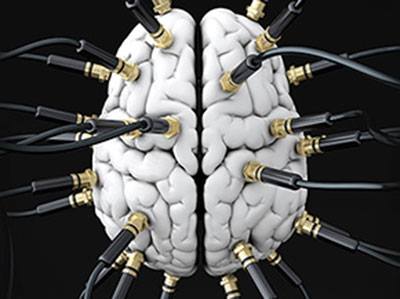
Those experiences don’t automatically lead to addiction. So what makes a particular habit or substance an addiction? What propels some people to seek out these experiences, even if they are costly or detrimental to their health and relationships? Brain-0010.jpg

“Addiction is a biopsychosocial disorder. It’s a combination of your genetics, your neurobiology and how that interacts with psychological and social factors,” said Maureen Boyle, a public health advisor and director of the science policy branch at the National Institute on Drug Abuse. That means it’s a lot like any other chronic disorder, such as type 2 diabetes, cancer and heart disease. And just like other chronic diseases, addiction is both preventable and treatable, Boyle said, but added that if left untreated, it can last a lifetime. [Do Smokers’ Lungs Heal After They Quit?]

The mutual mechanism

Though everyone’s path to addiction is different — whether he or she tries a drug or a behavior because it’s what that person’s parents or peer do, or just out of curiosity — what’s common across all substance and behavioral addictions is their stunning ability to increase levels of an important chemical in the brain called dopamine, Boyle told Live Science.

Dopamine is a molecule that ferries messages across the brain’s reward center. It’s what gives people the feeling of pleasure and reinforces behaviors critical for survival, such as eating food and having sex.

When someone uses a drug or engages in a pleasurable experience, the same natural reward circuitry is activated. “The problem with drugs is that they do the job better than natural rewards,” said Dr. Hitoshi Morikawa, an associate professor of neuroscience at the University of Texas at Austin.

Different drugs tap into the dopamine reward system in different ways. Marijuana and heroin have a chemical structure similar to another neurotransmitter and can trick some brain cells into activating neurons that use dopamine. Cocaine and amphetamines, on the other hand, prolong the effect of dopamine on its target neurons, disrupting normal communication in the brain.

How quickly each drug can get into the brain, and how powerfully it activates neural circuits, determines how addictive it will be, Morikawa told Live Science. Some modes of use, like injecting or snorting a drug, make the drug’s effects almost immediate. “That’s why heroin, for example, is the last drug you want to take,” he said. “It’s very addictive.”

From experimenting to getting hooked

As individuals continue with addictive habits or substances, the brain adapts. It tries to reestablish a balance between the dopamine surges and normal levels of the substance in the brain, Morikawa said. To do this, neurons begin to produce less dopamine or simply reduce the number of dopamine receptors. The result is that the individual needs to continue to use drugs, or practice a particular behavior, to bring dopamine levels back to “normal.” Individuals may also need to take greater amounts of drugs to achieve a high; this is called tolerance.

Without dopamine creating feelings of pleasure in the brain, individuals also become more sensitive to negative emotions such as stress, anxiety or depression, Morikawa said. Sometimes, people with addiction may even feel physically ill, which often compels them to use drugs again to relieve these symptoms of withdrawal. [Booze Snooze: Why Does Alcohol Make You Sleepy, Then Alert?]

Eventually, the desire for the drug becomes more important than the actual pleasure it provides. And because dopamine plays a key role in learning and memory, it hardwires the need for the addictive substance or experience into the brain, along with any environmental cues associated with it — people, places, things and situations associated with past use. These memories become so entwined that even walking into a bar years later, or talking to the same friends an individual had previously binged with, may then trigger an alcoholic’s cravings, Morikawa said.

Brain-imaging studies of people with addiction reveal other striking changes as well. For example, people with alcohol-, cocaine- or opioid-use disorders show a loss in neurons and impaired activity in their prefrontal cortex, according to a 2011 review of studies published in the journal Nature Reviews Neuroscience. This erodes their ability to make sound decisions and regulate their impulses.

Risk factors

Some people are more susceptible to these extreme neurobiological changes than others, and therefore more susceptible to addiction. Not everyone who tries a cigarette or gets morphine after a surgery becomes addicted to drugs. Similarly, not everyone who gambles becomes addicted to gambling. Many factors influence the development of addictions, Boyle said, from genetics, to poor social support networks, to the experience of trauma or other co-occurring mental illnesses.

One of the biggest risk factors is age. “The younger someone is, the more vulnerable they are to addiction,” Boyle said. In fact, a federal study from 2014 found that the majority (74 percent) of 18- to 30-year-olds admitted to treatment programs had started using drugs at age 17 or younger.

Additionally, like most behavioral and mental health disorders, there are many genes that add to a person’s level of risk or provide some protection against addiction, Boyle said. But unlike the way in which doctors can predict a person’s risk of breast cancer by looking for mutations in a certain gene, nobody knows enough to be able to single out any gene or predict the likelihood of inheriting traits that could lead to addiction, she said.

Addiction Hijacks the Brain

01 Tuesday Sep 2020

Posted by RichardB in Addiction, Creative Therapy Tools

≈ Comments Off on Addiction Hijacks the Brain

You’ve probably heard of the brain’s reward network. It’s activated by basic needs — including food, water and sex — and releases a surge of the feel-good neurotransmitter dopamine when those needs are met. But it can also be hijacked by drugs, which lead to a greater dopamine release than those basic needs. Brain-0020.jpg

But the reward network isn’t the only brain network altered by drug use. A new review concluded that drug addiction affects six main brain networks: the reward, habit, salience, executive, memory and self-directed networks.

In 2016, a total of 20.1 million people ages 12 and older in the U.S. had a substance-use disorder, according to the National Survey on Drug Use and Health, an annual survey on drug use. And drug addiction, regardless of the substance used, had surprisingly similar effects on the addicted brain, said the new review, published yesterday (June 6) in the journal Neuron.

The review looked at more than 100 studies and review papers on drug addiction, all of which studied a type of brain scan called functional magnetic resonance imaging (fMRI).

More than half of the studies out there look at the effects of drug use on the reward network, said Anna Zilverstand, lead author of the new review and an assistant professor of psychiatry at the Icahn School of Medicine at Mount Sinai in New York City. [7 Ways Alcohol Affects Your Health]

“Because we showed that the effects are very distributed across the six different networks … [we can conclude that] an approach that only looks at one of these networks isn’t really justified,” Zilverstand told Live Science. “This [finding] will hopefully lead other researchers to look beyond the reward network.”

For example, the memory network is pretty much ignored in research on substance-use disorders, Zilverstand said. This network allows humans to learn non-habit-based things, such as a new physics concept or a history lesson. Some research has suggested that in people with substance-use disorders, stress shifts the person’s learning and memory away from the memory network to the habit network, which drives automatic behavior, such as seeking and taking drugs.

Another less-studied network is the self-directed network, which is involved in self-awareness and self-reflection, the review said. In people with addictions, this network has been associated with increasing craving.

Two other networks are involved in substance-use disorders: The executive network is normally responsible for goal-maintaining and execution, but drugs can alter this network as well, reducing a person’s ability to inhibit their actions. The salience network picks up important cues in a person’s environment and redirects the individual’s attention to them. (In people with drug addiction, attention is redirected toward drugs, increasing craving and drug-seeking.)

Which comes first, the brain activity or the drug use?

“For me, the most surprising [finding] was how consistent the effects were across addictions,” Zilverstand said. What’s more, “the fact that the effects are quite independent of the specific drug use points to them being something general that might actually precede drug use rather than be a consequence of drug use.”

Zilverstand said she hopes that more studies will look at whether some people have abnormal brain activity in these six networks naturally and if that activity just gets exacerbated if they begin drug use. It’s important to know if some of these traits precede drug use; if that’s the case, it might be possible to identify people who are prone to addiction and intervene before an addiction begins, she said.

Some research has pointed toward this possibility already. For example, studies have shown that some people have “difficulties … inhibiting impulsiveness before drug use,” Zilverstand said. “Some of these impairments precede drug use, and they may become worse with more drug use, but they exist before the problem escalates.”

The good news, however, is that activity in four of these networks — executive, reward, memory and salience — moves back toward “normal” once drug use ends. “We know that four of the networks (partially — not fully) recover but not yet what happens to the other two networks,” Zilverstand said in an email.

Zilverstand added that she’s particularly excited about an ongoing study called the Adolescent Brain Cognitive Development (ABCD) Study, which is tracking 10,000 children across the U.S. from around ages 9 or 10 to age 20 (the children are now around 13). Some of these individuals will inevitably become addicted to drugs, most likely marijuana or alcohol, Zilverstand said.

“We’ll be able to see if the effects that we found [in the review] exist in youth who have not yet abused drugs,” she said, and she predicted that researchers will be able to find a lot of the effects identified in the review in the six brain networks.

The authors noted that because some regions of the brain are very small — for example, the amygdala, which is found toward the center of the brain — the studies can’t identify strong signals from those areas on brain scans. So, it’s possible that drugs affect additional networks in the brain that are hidden because of the limitations of our technologies, Zilverstand said.

“We don’t want to conclude that [those effects] don’t exist,” she said.

Drugs and the Brain

25 Tuesday Aug 2020

Posted by RichardB in brain, Creative Therapy Tools, drugs

≈ Comments Off on Drugs and the Brain

Tags

brain

The human brain is the most complex organ in the body. This three-pound mass of gray and white matter sits at the center of all human activity—you need it to drive a car, to enjoy a meal, to breathe, to create an artistic masterpiece, and to enjoy everyday activities. In brief, the brain regulates your body’s basic functions; enables you to interpret and respond to everything you experience; and shapes your thoughts, emotions, and behavior.

The brain is made up of many parts that all work together as a team. Different parts of the brain are responsible for coordinating and performing specific functions. Drugs can alter important brain areas that are necessary for life-sustaining functions and can drive the compulsive drug abuse that marks addiction. Brain areas affected by drug abuse include:

  • The brain stem, which controls basic functions critical to life, such as heart rate, breathing, and sleeping.
  • The cerebral cortex, which is divided into areas that control specific functions. Different areas process information from our senses, enabling us to see, feel, hear, and taste. The front part of the cortex, the frontal cortex or forebrain, is the thinking center of the brain; it powers our ability to think, plan, solve problems, and make decisions.
  • The limbic system, which contains the brain’s reward circuit. It links together a number of brain structures that control and regulate our ability to feel pleasure. Feeling pleasure motivates us to repeat behaviors that are critical to our existence. The limbic system is activated by healthy, life-sustaining activities such as eating and socializing—but it is also activated by drugs of abuse. In addition, the limbic system is responsible for our perception of other emotions, both positive and negative, which explains the mood-altering properties of many drugs.

How do the parts of the brain communicate?

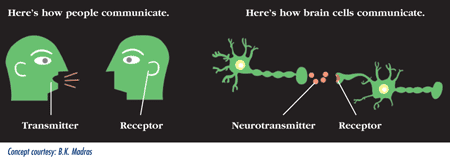
The brain is a communications center consisting of billions of neurons, or nerve cells. Networks of neurons pass messages back and forth among different structures within the brain, the spinal cord, and nerves in the rest of the body (the peripheral nervous system). These nerve networks coordinate and regulate everything we feel, think, and do.

  • Neuron to Neuron
    Each nerve cell in the brain sends and receives messages in the form of electrical and chemical signals. Once a cell receives and processes a message, it sends it on to other neurons.
  • Neurotransmitters – The Brain’s Chemical Messengers
    The messages are typically carried between neurons by chemicals called neurotransmitters.
  • Receptors – The Brain’s Chemical Receivers
    The neurotransmitter attaches to a specialized site on the receiving neuron called a receptor. A neurotransmitter and its receptor operate like a “key and lock,” an exquisitely specific mechanism that ensures that each receptor will forward the appropriate message only after interacting with the right kind of neurotransmitter.
  • Transporters – The Brain’s Chemical Recyclers
    Located on the neuron that releases the neurotransmitter, transporters recycle these neurotransmitters (that is, bring them back into the neuron that released them), thereby shutting off the signal between neurons.

soa_013.gif

To send a message, a brain cell (neuron) releases a chemical (neurotransmitter) into the space (synapse) between it and the next cell. The neurotransmitter crosses the synapse and attaches to proteins (receptors) on the receiving brain cell. This causes changes in the receiving cell—the message is delivered.

How do drugs work in the brain?

Drugs are chemicals that affect the brain by tapping into its communication system and interfering with the way neurons normally send, receive, and process information. Some drugs, such as marijuana and heroin, can activate neurons because their chemical structure mimics that of a natural neurotransmitter. This similarity in structure “fools” receptors and allows the drugs to attach onto and activate the neurons. Although these drugs mimic the brain’s own chemicals, they don’t activate neurons in the same way as a natural neurotransmitter, and they lead to abnormal messages being transmitted through the network.

Other drugs, such as amphetamine or cocaine, can cause the neurons to release abnormally large amounts of natural neurotransmitters or prevent the normal recycling of these brain chemicals. This disruption produces a greatly amplified message, ultimately disrupting communication channels.

How do drugs work in the brain to produce pleasure?

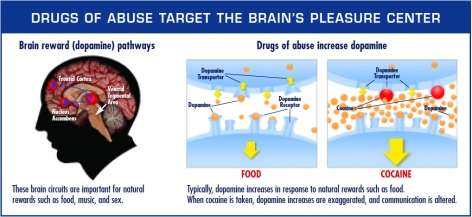
Most drugs of abuse directly or indirectly target the brain’s reward system by flooding the circuit with dopamine. Dopamine is a neurotransmitter present in regions of the brain that regulate movement, emotion, motivation, and feelings of pleasure. When activated at normal levels, this system rewards our natural behaviors. Overstimulating the system with drugs, however, produces euphoric effects, which strongly reinforce the behavior of drug use—teaching the user to repeat it.

Most drugs of abuse target the brain’s reward system by flooding it with dopamine.

soa_014_large

How does stimulation of the brain’s pleasure circuit teach us to keep taking drugs?

Our brains are wired to ensure that we will repeat life-sustaining activities by associating those activities with pleasure or reward. Whenever this reward circuit is activated, the brain notes that something important is happening that needs to be remembered, and teaches us to do it again and again without thinking about it. Because drugs of abuse stimulate the same circuit, we learn to abuse drugs in the same way.

Why are drugs more addictive than natural rewards?

When some drugs of abuse are taken, they can release 2 to 10 times the amount of dopamine that natural rewards such as eating and sex do.15 In some cases, this occurs almost immediately (as when drugs are smoked or injected), and the effects can last much longer than those produced by natural rewards. The resulting effects on the brain’s pleasure circuit dwarf those produced by naturally rewarding behaviors.16,17The effect of such a powerful reward strongly motivates people to take drugs again and again. This is why scientists sometimes say that drug abuse is something we learn to do very, very well.

Long-term drug abuse impairs brain functioning.

What happens to your brain if you keep taking drugs?

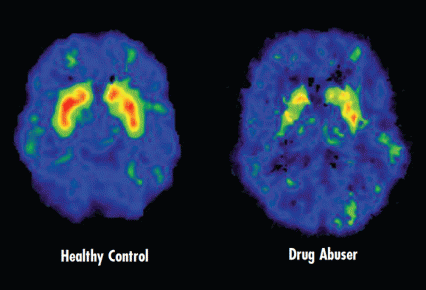
For the brain, the difference between normal rewards and drug rewards can be described as the difference between someone whispering into your ear and someone shouting into a microphone. Just as we turn down the volume on a radio that is too loud, the brain adjusts to the overwhelming surges in dopamine (and other neurotransmitters) by producing less dopamine or by reducing the number of receptors that can receive signals. As a result, dopamine’s impact on the reward circuit of the brain of someone who abuses drugs can become abnormally low, and that person’s ability to experience anypleasure is reduced.

This is why a person who abuses drugs eventually feels flat, lifeless, and depressed, and is unable to enjoy things that were previously pleasurable. Now, the person needs to keep taking drugs again and again just to try and bring his or her dopamine function back up to normal—which only makes the problem worse, like a vicious cycle. Also, the person will often need to take larger amounts of the drug to produce the familiar dopamine high—an effect known as tolerance.

Decreased Dopamine Transporters in a Methamphetamine Abuser18

soa_015.gif

How does long-term drug taking affect brain circuits?

We know that the same sort of mechanisms involved in the development of tolerance can eventually lead to profound changes in neurons and brain circuits, with the potential to severely compromise the long-term health of the brain. For example, glutamate is another neurotransmitter that influences the reward circuit and the ability to learn. When the optimal concentration of glutamate is altered by drug abuse, the brain attempts to compensate for this change, which can cause impairment in cognitive function. Similarly, long-term drug abuse can trigger adaptations in habit or non-conscious memory systems. Conditioning is one example of this type of learning, in which cues in a person’s daily routine or environment become associated with the drug experience and can trigger uncontrollable cravings whenever the person is exposed to these cues, even if the drug itself is not available. This learned “reflex” is extremely durable and can affect a person who once used drugs even after many years of abstinence.

What other brain changes occur with abuse?

Chronic exposure to drugs of abuse disrupts the way critical brain structures interact to control and inhibit behaviors related to drug use. Just as continued abuse may lead to tolerance or the need for higher drug dosages to produce an effect, it may also lead to addiction, which can drive a user to seek out and take drugs compulsively. Drug addiction erodes a person’s self-control and ability to make sound decisions, while producing intense impulses to take drugs.

Ten Percent of American Adults Report Being in Recovery

18 Tuesday Aug 2020

Posted by RichardB in Creative Therapy Tools

≈ Comments Off on Ten Percent of American Adults Report Being in Recovery

Tags

recovery

Data Shows More Than 23 Million Adults Living in U.S. Once Had  Drug or Alcohol Problems, But No Longer Do

Survey data released by the Partnership for Drug-Free Kids and The New York State Office of Alcoholism and Substance Abuse Services (OASAS) show that 10 percent of all American adults, ages 18 and older, consider themselves to be in recovery from drug or alcohol abuse problems. These nationally representative findings indicate that there are 23.5 million American adults who are overcoming an involvement with drugs or alcohol that they once considered to be problematic. 10501634_10152483771078046_6376046067124349017_n.jpg

According to the new survey funded by OASAS, 10 percent of adults surveyed said yes to the question, “Did you once have a problem with drugs or alcohol, but no longer do?” – one simple way of describing recovery from drug and alcohol abuse or addiction.

“The OASAS study is an important contribution to the public’s understanding of recovery, as it represents the actual voices of millions of Americans whose lives have improved because they are living free of alcohol and other drug problems,” said Steve Pasierb, President and CEO of the Partnership for Drug-Free Kids. “This new learning provides a big reason – more than 23 million reasons – for all those who are struggling with their own, or a loved one’s substance use disorder, to have hope and know that they are not alone. These findings serve as a reminder that addiction is a treatable disease and recovery can be a reality. We are just scratching the surface here and more research is needed in this area, but we are proud to collaborate with New York OASAS in this meaningful process.”

“This research marks a vitally important step for those who are struggling with addiction by offering clear evidence to support what many know experientially – that millions of Americans have found a path to recovery,” said New York State Office of Alcoholism and Substance Abuse Services (OASAS) Commissioner Arlene González-Sánchez. “It is my hope that this new evidence will strengthen and inspire individuals and those that provide treatment and recovery services to help the broader community understand that treatment does work and recovery is possible.” 

Other self-reported findings from the new data conclude that: 

  • More males say they are in recovery than females (12 percent vs. 7 percent).
  • More adults ages 35-44 report being in recovery, compared to younger adults (18-34) and adults who are 55 years of age or older.
  • The Midwest has a higher prevalence of adults (14 percent) who say they are in recovery compared to adults in the South (7 percent). In other regions of the country, the percentage of adults[1] who say they are in recovery is 11 percent for the West and 9 percent for the Northeast.

The study also found no significant difference between parents and adults without children who say they are in recovery. This demonstrates that parents are as likely as non-parents to be in recovery. 

“This new research also supports findings from a groundbreaking survey done for Faces and Voices of Recovery by Peter Hart Associates that provided the initial evidence that there was a large population in recovery in the United States,” said Tom Hedrick, Senior Program Officer and one of the founding members of the Partnership for Drug-Free Kids. “Those 2004 findings concluded that ‘38 percent of adults have a family member or close friend (or both) who is in recovery from addiction to alcohol or other drugs.”

Drug addiction is complex

11 Tuesday Aug 2020

Posted by RichardB in Addiction, Creative Therapy Tools

≈ Comments Off on Drug addiction is complex

Tags

research

We’re told studies have proven that drugs like heroin and cocaine instantly hook a user. But it isn’t that simple – little-known experiments over 30 years ago tell a very different tale.

Drugs are scary. The words “heroin” and “cocaine” make people flinch. It’s not just the associations with crime and harmful health effects, but also the notion that these substances can undermine the identities of those who take them. One try, we’re told, is enough to get us hooked. This, it would seem, is confirmed by animal experiments. 0312ILIN03-web.jpg

Many studies have shown rats and monkeys will neglect food and drink in favour of pressing levers to obtain morphine (the lab form of heroin). With the right experimental set up, some rats will self-administer drugs until they die. At first glance it looks like a simple case of the laboratory animals losing control of their actions to the drugs they need. It’s easy to see in this a frightening scientific fable about the power of these drugs to rob us of our free will.

But there is more to the real scientific story, even if it isn’t widely talked about. The results of a set of little-known experiments carried out more than 30 years ago paint a very different picture, and illustrate how easy it is for neuroscience to be twisted to pander to popular anxieties. The vital missing evidence is a series of studies carried out in the late 1970s in what has become known as “Rat Park”. Canadian psychologist Bruce Alexander, at the Simon Fraser University in British Columbia, Canada, suspected that the preference of rats to morphine over water in previous experiments might be affected by their housing conditions.

To test his hypothesis he built an enclosure measuring 95 square feet (8.8 square metres) for a colony of rats of both sexes. Not only was this around 200 times the area of standard rodent cages, but Rat Park had decorated walls, running wheels and nesting areas. Inhabitants had access to a plentiful supply of food, perhaps most importantly the rats lived in it together.

Rats are smart, social creatures. Living in a small cage on their own is a form of sensory deprivation. Rat Park was what neuroscientists would call an enriched environment, or – if you prefer to look at it this way – a non-deprived one. In Alexander’s tests, rats reared in cages drank as much as 20 times more morphine than those brought up in Rat Park. 

Inhabitants of Rat Park could be induced to drink more of the morphine if it was mixed with sugar, but a control experiment suggested that this was because they liked the sugar, rather than because the sugar allowed them to ignore the bitter taste of the morphine long enough to get addicted. When naloxone, which blocks the effects of morphine, was added to the morphine-sugar mix, the rats’ consumption didn’t drop. In fact, their consumption increased, suggesting they were actively trying to avoid the effects of morphine, but would put up with it in order to get sugar.

‘Woefully incomplete’

The results are catastrophic for the simplistic idea that one use of a drug inevitably hooks the user by rewiring their brain. When Alexander’s rats were given something better to do than sit in a bare cage they turned their noses up at morphine because they preferred playing with their friends and exploring their surroundings to getting high.

Further support for his emphasis on living conditions came from another set of tests his team carried out in which rats brought up in ordinary cages were forced to consume morphine for 57 days in a row. If anything should create the conditions for chemical rewiring of their brains, this should be it. But once these rats were moved to Rat Park they chose water over morphine when given the choice, although they did exhibit some minor withdrawal symptoms.

You can read more about Rat Park in the original scientific report. A good summary is in this comic by Stuart McMillen. The results aren’t widely cited in the scientific literature, and the studies were discontinued after a few years because they couldn’t attract funding. There have been criticisms of the study’s design and the few attempts that have been made to replicate the results have been mixed.

Nonetheless the research does demonstrate that the standard “exposure model” of addiction is woefully incomplete. It takes far more than the simple experience of a drug – even drugs as powerful as cocaine and heroin – to make you an addict. The alternatives you have to drug use, which will be influenced by your social and physical environment, play important roles as well as the brute pleasure delivered via the chemical assault on your reward circuits

It suggests that even addictions can be thought of using the same theories we use to think about other choices, there isn’t a special exception for drug-related choices. Rat Park also suggests that when stories about the effects of drugs on the brain are promoted to the neglect of the discussion of the personal and social contexts of addiction, science is servicing our collective anxieties rather than informing us

Self-Control Can Drain Your Memory

04 Tuesday Aug 2020

Posted by RichardB in Creative Therapy Tools

≈ 1 Comment

Tags

self control

The human body has a finite amount of resources, and scientists are always discovering more about how these resources are shared, depleted, and replenished. Now a new study suggests that the areas in your brain responsible for self-control and forming memories are closely linked – in other words, if you’re concentrating hard on staying disciplined, you’re probably becoming less adept at remembering what’s happening.

Researchers Yu-Chin Chiu and Tobias Egner from Duke University in the US asked a group of volunteers to recognise a series of faces, both with and without the inclusion of a self-control test in the middle. They found that having to exercise self-control had a negative impact on the participants’ ability to recall which pictures they’d previously seen. The same experiment was then repeated with a new set of volunteers and brain-scanning fMRI (functional magnetic resonance imaging) equipment on hand.

The pair discovered that one area of the brain – the ventrolateral prefrontal cortex – was activated frequently during the self-control test and predicted the strength of the volunteers’ memory later on. The findings suggest that self-control and memory compete for the same resources inside the brain, and support the theory that inhibiting ourselves can also cause us to forget more easily. Brain-0001.jpg

“The control demands of response inhibition divert attention away from stimulus encoding, thereby weakening memory traces for inhibitory cues,” the researchers conclude in The Journal of Neurosience. “These findings shed new light on the relation between the control process of response inhibition and the cognitive domains of perception, attention, and memory.”

The self-control test used was a traditional Go/No-Go task: these tasks work by asking participants to view a series of items and push a button only when certain criteria are met – in the case of this experiment, when the face shown is male rather than female. The theory is that those who are able to hold back from a button push when necessary are those with the strongest self-control (or “response inhibition”, as neuroscientists like to call it). The participants were not told in advance that they would need to remember the faces they were shown.

“The scans revealed that responding to a cue and inhibiting a response produced overlapping activation patterns in brain regions within the right frontal and parietal lobes, a network that has previously been implicated in response inhibition,” Mo Costrandi reports for The Guardian. “Crucially, ‘no-go’ trials produced greater activation of this network than ‘Go’ trials, and activity in one specific brain region (the ventrolateral prefrontal cortex) predicted the strength of the participants’ memory, such that the greater the observed network activation, the more likely the participants were to forget that face later on.”

The researchers admit their theory is still “speculative” for now, but if further study confirms the link, they believe their discovery could be used to treat people who have problems with self-control: those suffering from ADHD (Attention Deficit Hyperactivity Disorder), for example, or some form of addiction.

One scenario put forward by the pair is having to suddenly cancel a lane change on the motorway because a car is already in the spot you want to move into. If they’re right, the act of having to control and inhibit your actions would make it less likely that you would remember the details of the incident – such as the make and model of the car that was blocking your path.

Addiction: Is Love All You Need?

28 Tuesday Jul 2020

Posted by RichardB in Addiction, Creative Therapy Tools

≈ Comments Off on Addiction: Is Love All You Need?

If anything deserves to be called “the establishment view,” it is what Johann Hari — in his new book on addiction and the war on drugs, Chasing the Scream: The First and Last Days of the War on Drugs — calls the pharmaceutical model of addiction.

The pharmaceutical model says that addiction is about chemicals. Addiction is a chronic incurable disease of the brain. The brain’s pleasure centers are hijacked.

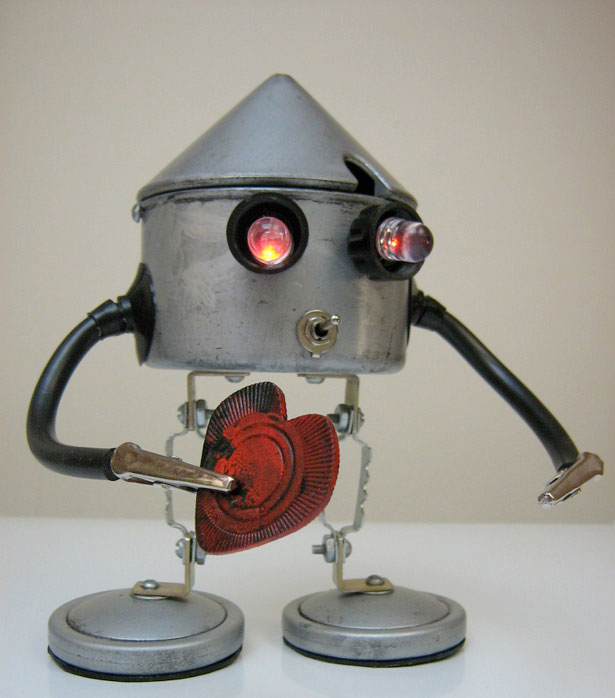
The pharmaceutical model may be the conventional wisdom, but it is certainly not without controversy. Researchers such as Gene Heyman and Bruce K. Alexander have long questioned whether the data support this picture. heartbot.jpg

As Hari reminds us, heroin use was rampant among U.S. soldiers stationed in Vietnam during that conflict. According to one study he cites, 20 percent of these American servicemen were heroin users. Over 85 percent of these users gave up heroin when they got home, the book says; they simply stopped taking the drug.

How do we reconcile this fact with the idea that the drug hijacks the brain and takes over? If that’s true, you wouldn’t expect a change of scenery (coming home from Vietnam) all by itself to break the neuro-chemical stranglehold. Alternatively, you might speculate that perhaps these heroin users were not really addicted. That the fact that they stopped proves this. But then we face a new problem: If the addiction is a chemical effect of the drug, then why weren’t they addicted?

Indeed, as Heyman claims in his book, there is good evidence that most addicts in the general population, as a matter of fact, eventually stop using drugs. They stop because they get to a point where they want or need or find that they are able to stop. They decide to stop. Now, this doesn’t fit very well with the conventional wisdom. You can’t simply decide to give up other diseases like diabetes or heart disease!

Or consider the fact that, as Hari explains, actual chemical dependence seems to be only a small part of drug addiction. If addiction were just about chemicals, then you would expect that the availability of nicotine patches — which can deliver smokers every bit of the nicotine they would get from a cigarette — would, in one fell swoop, eliminate the feeling that one needs to smoke. But not so. Only 17.7 percent of smokers using nicotine patches, according to Hari, break their addiction to smoking.

Hari also describes a fascinating reverse case. At some point in the 70s, heroin interdiction in Vancouver was so effective that there was virtually no heroin on the streets. This didn’t stop dealers from selling white powder and calling it heroin, and it didn’t stop addicts from hustling to get their hands on this powder so that they could shoot up. If it is the chemical itself that drives addiction and controls the addict, then you would have expected that Vancouver’s junkies, deprived of real heroin, would have been weened of their dependence.

That this didn’t happen is striking evidence — assuming the anecdote, originally reported by Alexander, is true — that not only is the chemical itself not sufficient to explain addiction, it isn’t even necessary.

Data like these suggest that addictions, although they no doubt interact with neural chemistry, can’t adequately be understood alone in neuro-chemical terms. And this is because it is people, not brains, that get hooked. To understand the actions of addicts, you need to look at their lives as a whole. When doctors claim, as they do, that addiction is a disease of the brain, they are saying something that is either trivially true (that the brain plays a role in addiction) or something entirely false (that the brain is the whole story).

It is true, as the old commercial made vivid, that a rat in a cage will forego water to self-administer morphine every time — and will continue to do so until it is dead. But, maybe, it’s not the morphine that best explains this but, rather, the fact that the sorry rat is locked up exposed, in complete isolation from its fellows, in an otherwise empty cage.

This observation led Alexander to wonder: Would a rat in a richer environment — one including not only water and morphine, but also other rats and good food and interesting landscapes — take the same self-destructive course of action? Or, rather, would this other rat find itself so totally dominated by the rewards that the drug alone provides? To investigate this, Alexander designed “rat parks” that were much larger, interesting and hospitable environments in which communities of rats were placed. He found that happy rats in happy rat parks behaved more like casual human drinkers than liked crazed addicts, in that they limited themselves to small amounts of morphine.

This result is striking — and it certainly corresponds to my own personal experience of addiction. I have known addicts, but I have known many more drug users who were not addicted.

Now, Hari is convinced that Alexander has unlocked the true essence of addiction. Addiction is caused by isolation. And the cure for addiction, it follows, is love. We need to give the addict back his or her feeling of connection to others.

This is a beautiful idea — and I like beautiful ideas. I also think that it gets something right. Addicts are disconnected and isolated. But we need to be careful in drawing a too-speedy conclusion. The fact that being isolated is a cause of addiction doesn’t yet clarify how sociality, love, friendship, isolation, etc., function in the lives of addicts. In particular, it doesn’t mean that you can fix addiction with love.

One reason love might not be all you need is that it could be that the wounds that lead us to turn to drugs, to really give ourselves over to drugs, might have their roots in our early lives. It’s hard to simply “get over” early childhood trauma. (Hari also celebrates the work of Mate Gabor, a clinician who argues, in ways that some thinkers worry might be a bit reductive, that the sources of addiction lie in trauma.)

But there is a deeper reason to worry that love couldn’t suffice. Whatever its causes, addiction would seem to be — something like this is Heyman’s view — a disorder of one’s ability to connect to others and value the things that human beings tend usually to value (such as food, exercise, sex, family, work). The remarkable and striking thing about many addicts is that they opt for self-medication over encounter — they turn inward and shut out the world.

It might be right, as Hari claims, that we would fix addiction if we could restore in the addict a sense of connection with the world around him or her, and with other people. But that’s not a prescription as much as it is a statement of the problem. Addicts are shut off.

Creativity: The science behind the madness

21 Tuesday Jul 2020

Posted by RichardB in Creative Therapy Tools, Creativity

≈ Comments Off on Creativity: The science behind the madness

Tags

Creativity

TEDx: What causes opioid addiction?

14 Tuesday Jul 2020

Posted by RichardB in Addiction, Creative Therapy Tools

≈ Comments Off on TEDx: What causes opioid addiction?

Tags

opioid

← Older posts

instagram

Follow RichardbBrunner on WordPress.com
  • Tumblr
  • YouTube

Create a free website or blog at WordPress.com.

Privacy & Cookies: This site uses cookies. By continuing to use this website, you agree to their use.
To find out more, including how to control cookies, see here: Cookie Policy
  • Subscribe Subscribed
    • RichardbBrunner
    • Join 491 other subscribers
    • Already have a WordPress.com account? Log in now.
    • RichardbBrunner
    • Subscribe Subscribed
    • Sign up
    • Log in
    • Report this content
    • View site in Reader
    • Manage subscriptions
    • Collapse this bar
 

Loading Comments...