Jarabe De Palo – Dejame Vivir
29 Monday Apr 2019
Posted in Music
≈ Comments Off on Jarabe De Palo – Dejame Vivir

29 Monday Apr 2019
Posted in Music
≈ Comments Off on Jarabe De Palo – Dejame Vivir
28 Sunday Apr 2019
Tags

27 Saturday Apr 2019
Tags
This week, at the Visa pour l‘Image international festival of photojournalism in Perpignan, France, Reuters is launching a grant program which seeks to recruit and develop a diverse new generation of photojournalists to tell original human stories from around the world.
Reuters is offering up to eight $5,000 USD grants to passionate photojournalists or photojournalism students who are interested in working on photo assignments and projects to advance their abilities and tell new stories. READ MORE HERE
27 Saturday Apr 2019
Posted in quote
≈ Comments Off on Not everything
Tags
Not everything that is faced can be changed, but nothing can be changed until it is faced. James Baldwin

26 Friday Apr 2019
26 Friday Apr 2019
Posted in art
≈ Comments Off on Writing a poem with clients
Writing a poem for the first time can be intimidating, but there are many possible ways to get started. In this post I’ll talk about just one of them, which is a list poem.
Defining a Poem
The first step when introducing poetry to clients is to define poetry. Show what a poem looks like on a page. Explain that a poem is usually short, and that each line has a fixed length. It uses carefully-chosen language to express a feeling, and sometimes uses rhythm, rhyme, or repetition.
 Writing a List Poem
A list poem is a poem in which each line begins the same way. List poems are wonderful for beginning writers especially, because the start of each line is provided, creating a comfortable way in (at least I have this part that I can write, and know I’m spelling it correctly). A list poem can be simple and powerful. One client, who struggles with depression, wrote a poem in which each line begins, “I love” followed by one thing that makes her feel happy.
5 Tips for Writing a Successful List Poem:
Read poems together as a group, to get clients familiar with the sounds and rhythms of it. After reading a poem, ask if there is any line that clients like or find interesting. Ask why they like it, what makes it stand out. Keep your ear open for things clients say—does something sound like a list poem? “Every morning I…” “I want to read…” “If I had a million dollars I’d…” “I love the way…” The possibilities are endless.
When clients are ready to begin writing, here are some tips to keep in mind:
1. Be specific
Help clients bring their poems to life by including specific details. In other words, show, don’t tell. “I wake up early,” becomes, “I wake up at 3:00 am every morning to go to work.” Instead of “I cook Chinese food” help the client write, “I cook catfish with spicy sauce.”
2. Five senses
Can you see this poem? Can you hear it? Smell it? Feel it? Taste it? Is this poem bringing a world to life? If not, think about describing with the five senses.
3. Order
Pay attention to the order of the list. Does it have a beginning? A middle? An end? Does it need an additional line to bring it to a close?
4. Word Choice
Think about word choice. Could another word be more effective? Sometimes beginning writers want to use the word “beautiful,” but write “nice” instead because it is easier to spell. Help the writer actualize the poem in her mind.
5. Edit
Don’t be afraid to edit. ‘Make it Messy’ is a good mantra for first drafts. They should have crossed out parts and additions. Are any items in the list extraneous? Are there unnecessary repetitions? Help students build the confidence to edit themselves.
25 Thursday Apr 2019
Posted in Dawn
≈ Comments Off on Dawn will come
24 Wednesday Apr 2019
Posted in art, mindfulness, Wellness
≈ Comments Off on What is Mindfulness ?
Tags
Mindfulness is a concentrated state of awareness that can help us see and respond to situations with clarity and without getting carried away by emotions or the constant chatter in our heads. Mindfulness enables us to:
· Better manage tension and stress
· Enhance objectivity, mental focus
· Communicate and make decisions more effectively
· Improve productivity
· Quiet’s noise in the mind

Meditation
 Meditation is the tool we use to cultivate mindfulness. With meditation, you intentionally pay attention to a particular object as a way to strengthen concentration. There are thousands of meditative techniques: Tai Chi, yoga, focusing on the breath and using a mantra are all examples. People often think that meditating “correctly” means clearing all thought from the mind. This is a myth. The mind never stops thinking – it’s when we get caught up in our thoughts that we lose mindfulness. By witnessing thoughts, allowing them to pass, and returning to your chosen object of focus, you can actually build the muscle of concentration. Think of meditation as a fitness routine for the mind.
Are there other benefits to mindfulness?
In addition to boosting brain power, numerous research studies have shown significant physical benefits including:
· Reduced blood pressure
· Lowered cholesterol levels
· Enhanced immune function
· Reduced headache, migraine, back pain
· Improved respiratory function
Mindfulness does not require a particular set of beliefs in order to learn and practice – it is a quality of mind, accessible and available to all.
Mindfulness allows us to live every moment fully without the filters of bias, judgment or emotional reaction.
Mindfulness helps the body cope with physical challenges such as headaches, back pain and even heart disease.
Mindfulness keeps us from reacting too quickly – it helps increase the gap between impulse and action.
24 Wednesday Apr 2019
“When I started to recover in hospital, one of my early frustrations was that I found I wanted to draw.
Drawing does for me what others find in meditation, prayer or gardening. It is my way of connecting to the world; it is not just making images but drinking in and praising what’s around me.
Returning to the world as I did after my stroke, you look at it with fresh eyes. You want to absorb all you see. That meant being able to draw again and art aided my recovery and charted it.” Read more: http://www.dailymail.co.uk/home/event/article-2442555/BBCs-Andrew-Marr-Knowing-I-able-draw-realise-I-going-OK.html#ixzz2gwenGqUy
23 Tuesday Apr 2019

22 Monday Apr 2019
Posted in Japanese Textile Designs, Music
≈ Comments Off on Riff Cohen – A Paris
Tags
22 Monday Apr 2019
Posted in Depression, mindfulness, YouTube
≈ Comments Off on The mindful way through depression
Tags
21 Sunday Apr 2019
Tags

20 Saturday Apr 2019
Tags
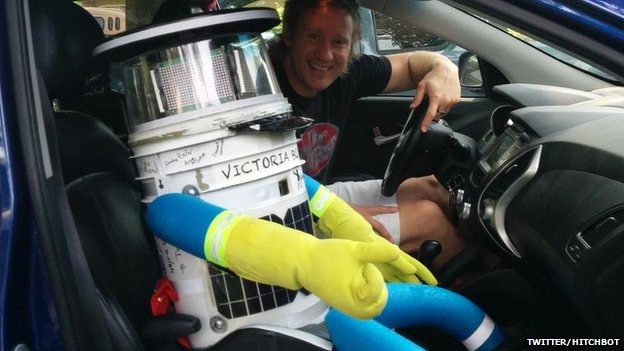
A robot sent out to travel across Canada by hitch-hiking has completed its 6,000km (3,728-mile) trip – apparently in one piece.
HitchBOT reached Canada’s Pacific coast at Victoria, British Columbia nearly three weeks after leaving Halifax in Nova Scotia, far away on the Atlantic coast, the Canadian Broadcasting Corporation reports. “I’m on a boat,” one of HitchBOT’s last tweets says. “Well, a ferry to be exact. Victoria, I’m on my way.” An arrival event is due to be held on Thursday. Read more at the BBC
20 Saturday Apr 2019
Tags
“Don’t look for your dreams to come true; look to become true to your dreams.” Michael Beckwith

19 Friday Apr 2019
Posted in dogs
≈ Comments Off on Seeing-eye dogs help blind dog
On a rough day, Kiaya collapsed on the cold living room floor, unable to make it to her queen-sized dog bed.
Within minutes, her two “brothers” snuggled up on each side of her.
The sight brought tears to pet owner Jessica VanHusen’s eyes. That’s because life hasn’t been easy for the 10-year-old Akita, who lost both of her eyes to glaucoma over the course of 15 months.
Not only can the 100-pound dog not see, she also has a hard time walking — that is, without help from her “seeing eye dogs.”
The special needs dog didn’t have too much trouble adjusting to her new normal with 8-year-old Cass and 2-year-old Keller by her side. Without any commands, the dogs decided on their own to be her guides.
“The boys both respect her fully,” VanHusen told CBS News. “[They] allow her to eat first, they lean her up against the side of the car when we are traveling to stabilize her.”
Wherever Kiaya is, “middle-child” Cass is not far behind.
The dog has been by Kiaya’s side ever since her first eye was removed in July 2013. He would constantly follow her around in their backyard, standing next to her “blind side.”
“He became more attentive to her needs, leaning on her and cuddling,” VanHusen explained. “He even cleans her ears and face, where her eyes used to be.”
It took Keller a little longer. At less than 2 years old, the dog wasn’t fully attentive at first, VanHusen said, but he’s getting there.
“It’s amazing to watch,” Blue Pearl Veterinary Partners Ophthalmologist Dr. Gwen Sila, who performed Kiaya’s surgeries, said in a news release. “It’s clear the other dogs are trying to protect her. Their sense of loyalty is really remarkable.”
VanHusen said she has never considered training the pair to be service dogs. For now, they’ll just continue to take care of their sister, Kiaya, who turns 11 next month.
“She may be a special needs dog, but to us she’s just special,” VanHusen said. “When we ask her where her eyeballs went, she replies: ‘They’re in the garbage, I didn’t need them anymore.'”
With her brothers stepping in to assist her, that statement couldn’t be more true.
19 Friday Apr 2019
18 Thursday Apr 2019
Tags
I am clearing a space—
Here, where the trees stand back.
I am making a circle so open
The moon will fall in love
And stroke these grasses with her silver.—Morgan Farley
17 Wednesday Apr 2019
Posted in Awareness, creative, creative arts therapy, Meditation, Mental Health, mindfulness
≈ Comments Off on Mindfulness: Reason Mind, Emotion Mind, and Wise Mind
Tags
 I have been practicing meditation since the mid-70’s and started a mindfulness meditation practice in the mid-90’s. Mindfulness has to do with the quality of awareness that we bring to what we are doing and experiencing, to being in the here and now. It has to do with learning to focus on being in the present, to focusing our attention on what we are doing and what is happening in the present.
Many of us are distracted by images, thoughts and feelings of the past, perhaps dissociating, worrying about the future, negative moods and anxieties about the present. It’s hard to put these thing away and concentrate on the task at hand.
I started teaching mindfulness to patients a few years ago and often used the following as a hand out:
Mindfulness has to do with states of mind. Reason Mind, Emotion Mind, and Wise Mind. Reason Mind is your rational, thinking, logical mind. It plans and evaluates things logically. It is your “cool” part. Reasonable Mind can be very beneficial. It is easier to be in Reasonable Mind when you feel good. It is much harder to be in Reasonable Mind when you don’t feel good.
You Would Use Your Reasonable Mind To:
Build a bridge
Figure out how to double a recipe
Balance your checkbook
Figure out the fastest way from point “A” to point “B”
Emotion Mind describes times when emotions are what influence or control your thinking and behavior. Emotional Mind can also be very beneficial. Emotions are what motivate us to action. Emotions are what keep us attached to others and building relationships.
Emotion Mind can be aggravated by:
Illness, Lack Of Sleep, Tiredness, Drugs, Alcohol, Hungry, Overeating, Poor nutrition and/or lack of exercise, Environmental stress and threats, not taking your meds.
Both Emotion and Reasonable Mind Are Equally Important And Valuable
Reasonable mind gives you a way to solve your problems.
Emotion mind gives you a reason (motivation) to want to solve them.
Wise Mind is the integration of emotional and reasonable mind. Wise mind is that part of each person that can know and experience truth. It is where the person knows something to be true or valid. It is where the person knows something in a centered (balanced) way. It is almost always quiet and calm in this part of the mind.
Everyone Has A Wise Mind!
Some people have simply never experienced it.
No one is in Wise Mind all of the time.
Wise Mind – An Analogy for Wise Mind is like a deep well in the ground. The water is at the bottom of the well. The entire underground is an ocean called Wise Mind. But on the way down, there are often trap doors that stop progress. Sometimes the trap doors are so cleverly built that you actually believe that there is no water at the bottom of the well. The trap door may look like the bottom of the well. Perhaps it is locked and you need a key. Perhaps it is nailed shut and you need a hammer. Perhaps it is glued shut and you need a chisel.
17 Wednesday Apr 2019



 RichardbBrunner