
Snow behind bush branches
17 Sunday Mar 2019

17 Sunday Mar 2019
16 Saturday Mar 2019
 I read this article a few years ago and it keeps popping up. From the SMU News, Southern Methodist University in Dallas Texas, USA.
DALLAS (SMUNews) — Researchers from Southern Methodist University have described two seismic events that they believe may offer the first evidence of a previously undetected form of matter passing through the earth.
This form of matter — known as “strange quark matter” — is so dense that a ton-sized nugget would be about the size of a red blood cell. Physicists have suspected since 1984 that this very heavy form of matter might exist, but no one has yet found evidence of it.
In 1984, Harvard physicist and Nobel Laureate Sheldon L. Glashow suggested that one way such matter might be found would be if a physicist teamed up with a seismologist to search for traces of the matter that might have passed through the earth at supersonic speed. In 1993, SMU physicist Vidgor Teplitz asked Eugene Herrin, a seismologist in the Department of Geological Sciences in SMU’s Dedman College, to collaborate with him on the project. The two were assisted by David Anderson, a senior systems analyst in the Department of Geological Sciences, and Ileana Tibuleac, then a Ph.D. student in the Department of Geological Sciences.
In a paper submitted to the Bulletin of the Seismological Society of America and published online at http://xxx.lanl.gov/ (subject area: astrophysics), the SMU researchers describe how they found evidence of strange quark matter by searching through more than a million records of seismic events collected by the U.S. Geological Survey from 1990 to 1993 that were not associated with traditional seismic events such as earthquakes. These records of so-called “unassociated events” were collected from seismic stations set up around the world to monitor earthquakes and nuclear testing.
In a paper previously published in 1995 (available online at http://cornell.mirror.aps.org/abstract/PRD/v53/i12/p6762_1), Herrin and Teplitz had determined that it would be feasible to search for seismic events that might indicate passage of strange quark matter (also known as nuclearites) through the earth because such events would have a distinct seismic signal — a straight line. This would be caused by the large ratio of speed to the speed of sound in the earth. Herrin estimates that strange quark matter might pass through the earth at 250 miles per second, 40 times the speed of seismic waves. The team also determined that the minimum requirement for detection of a nuclearite would be detection of its signal by seven monitoring stations.
In their new paper, the SMU researchers describe two seismic events with the linear pattern they were looking for. One event occurred on Oct. 22, 1993, when something entered the Earth off Antarctica and left it south of India .73 of a second later. The other occurred on Nov. 24, 1993, when an object entered south of Australia and exited the Earth near Antarctica .15 of a second later. The first event was recorded at seven monitoring stations in India, Australia, Bolivia and Turkey, and the second event was recorded at nine monitoring stations in Australia and Bolivia.
“We can’t prove that this was strange quark matter, but that is the only explanation that has been offered so far,” Herrin said.
The SMU team is now trying to determine where the heavy quark matter may have come from. In April 2002, two different teams of scientists reported that they had identified collapsed stars that might be composed of ultradense strange quark matter. Scientists believe that chunks of strange quark matter might be created when stars made of strange quark matter collide.
Unfortunately, Herrin notes, seismologists may not be able to find any more events that suggest the passage of strange quark matter through the Earth. In 1993 the U.S. Geological Survey stopped collecting data from “unassociated events” such as those that the SMU team used in its research.
Related materials:
15 Friday Mar 2019
Bamboo Adobe
I sit along in the dark bamboo grove,
Playing the zither and whistling long.
In this deep wood no one would know –
Only the bright moon comes to shine.
Wang Wei tr. Liu Wu-chi
14 Thursday Mar 2019
Posted in Flowers
≈ Comments Off on like flowers
The most precious gift we can offer others is our presence. When mindfulness embraces those we love, they will bloom like flowers.Thich Nhat Hanh

13 Wednesday Mar 2019
Tags
You know you should do it. And you know why: Exercising — simply put, moving instead of sitting — is critical for safeguarding your health and setting a good example for your kids. So why does it seem so hard to get yourself moving?
The truth is: You can. But knowing how and why to exercise isn’t enough. You need to develop the right mind-set to get and stay motivated.
“Change is hard!” says certified health behavior coach Shelly Hoefs, fitness supervisor at the Mutch Women’s Center for Health Enrichment in Sioux Falls, S.D. “When we try to start exercising, we think of all the excuses for not doing it and all the things that have gotten in the way before. Getting fit starts to seem overwhelming. And that makes it feel stressful. Before long, we don’t want to do it anymore.”
Here are five steps to get you moving in the right direction — and keep you going.

What you need to get you up off the couch is a reason that’s important to you. At first, that may be some external factor, says Cal Hanson, director of the Sanford Wellness Center in Sioux Falls, S.D. It could be a number on the scale that surprises you or your doctor’s recommendation that you need to move more to stay healthy.
There are all kinds of benefits to getting fit. Which matters most to you? Something as simple as taking a walk after dinner every night helps to:
Plus, by becoming active, you’re being a good role model for your children.
These benefits may get you started, but they may not cut it when it comes to keeping you moving day after day, Hanson says. To keep up your motivation to exercise over time, you also need to find your internal motivators. Maybe taking a yoga class leaves you feeling more energized or less stressed. Maybe a run or walk every day helps you let go of stress. Hanson says these are the kind of rewards that are meaningful to you on a personal level and that can help keep you motivated.
CDC guidelines call for adults to do 2 1/2 hours of moderate-intensity aerobic exercise a week. That’s a 30-minute walk five days a week. If you kick it up a notch — jogging or running, for example – it can be 15 minutes a day, five days a week.
You can aim for these exercise guidelines, but don’t try to meet them at the start. “People lose their motivation to exercise when they try to do too much too soon,” says Hanson.
So instead of walking for 30 minutes a day right off the bat, start out doing 15 minutes a day, two or three days a week.
Set weekly goals, gradually adding more time and intensity. At the end of each week, take a look at how you did. If you reached your goal, celebrate! “And if you didn’t reach your goal,” Hanson says, “think about what went wrong and how you’re going to respond differently next time.”
You don’t have to go to the gym to get a good workout. It’s all about moving more — however you do it. For some people, going to the gym provides structure that helps them focus and a sense of accomplishment when they’re done. For others, it’s a chore — one they wind up avoiding as often as they can.
What else can you do? Almost anything that gets you — and your family — moving:
If you think about it, you’re surrounded by opportunities to get more active. Find the ones that you get excited about. You’re more likely to keep doing them if you’re having fun.
For busy parents, a major obstacle to getting fit is lack of time. If you wait for time to open up, chances are you won’t be able to squeeze in a walk or a dance class very often. To avoid getting sidetracked by the daily demands of life, try these tips:
If you plan ahead for potholes on the road to fitness, you’re more likely to stay on course, Bartell says. “When you think through solutions to problems in advance, you’re less likely to give up when a pothole comes along.”
You’ve set a reasonable fitness goal. You’ve prepared for potential problems. Yet somehow you still didn’t make it to the gym today as you had planned. Don’t let that be your downfall.
“For many people, this is a slippery slope,” Hanson says. “It reminds them of times when they failed before, and they begin to think of themselves as exercise failures.”
When this happens, it’s time for an attitude adjustment so you don’t completely lose your motivation to exercise. If you miss the gym on Monday, that doesn’t mean your whole week is shot, Hanson says. It simply means you need to hit the gym on Tuesday or take the dog for an extra-long walk tonight.
Knowing how to exercise isn’t just a matter of learning how to use your body to hold a yoga pose or swing a racquet. It also involves learning how to use your mind to propel yourself into action and stick with a fitness routine.
“Start thinking of yourself as someone who exercises,” says Hoefs. “Eventually, that will become your identity”.

12 Tuesday Mar 2019
Posted in mindfulness, Uncategorized
≈ Comments Off on Observing thoughts
Tags
In mindfulness, you learn to see thoughts as just thoughts rather than as facts or situations you must react to. Thoughts commonly come and go in the mind, and if you treat all thoughts as true and assign them all the same level of importance, you’re more prone to feel down in the midst of negative or self-judgmental thoughts and highly elated in the midst of positive thoughts. This rollercoaster ride of emotions and energy often seems to trace the same path as bipolar disorder’s ups and downs.
By practicing mindfulness, you notice that both types of thoughts are just thoughts, and you don’t need to react to them or even give them your full attention. After all, thoughts arise merely out of your perception of reality or are borne out of your own thought process. You’re not required to give them the full status of being true. Mindfulness involves watching thoughts and stepping back from them – like watching clouds passing through the sky. This enables you to become a disinterested observer, and thoughts lose some of their control over your emotions.
Mindfulness also emphasizes learning to switch modes of mind. Normally you operate in “doing mode,” which is all about setting goals and trying to achieve them. Many people get stuck in this mode and never realize they have the option of shifting to “being mode,” which is all about allowing and accepting things just as they are, rather than working hard to change them.
Being mode is particularly helpful in the realm of emotions. If you’re feeling sad and don’t accept it, you can end up fighting to change the experience. This can lead to a deeper feeling of sadness and trigger a negative thought cycle. By being with the experience and mindfully accepting the emotion, you allow the feeling to dissipate in its own time.
Mindfulness looks like a potentially effective way of managing bipolar disorder, especially the depressive pole, which may be the most difficult to treat with medication alone. Mindfulness exercises and meditations are useful for people with bipolar disorder (manic depression) because mindfulness:
Mindfulness exercises include guided body scan meditation, mindful walking, mindfulness of breath, and mindfulness of thoughts and feelings.
11 Monday Mar 2019
10 Sunday Mar 2019
09 Saturday Mar 2019
Posted in Holocaust
≈ Comments Off on Children of the Holocaust

08 Friday Mar 2019
Interesting article about pets and how humans react/respond to them. From the abstract:
Neural substrates underlying the human-pet relationship are largely unknown. We examined fMRI brain activation patterns as mothers viewed images of their own child and dog and an unfamiliar child and dog. There was a common network of brain regions involved in emotion, reward, affiliation, visual processing and social cognition when mothers viewed images of both their child and dog. Viewing images of their child resulted in brain

activity in the midbrain (ventral tegmental area/substantia nigra involved in reward/affiliation), while a more posterior cortical brain activation pattern involving fusiform gyrus (visual processing of faces and social cognition) characterized a mother’s response to her dog. Mothers also rated images of their child and dog as eliciting similar levels of excitement (arousal) and pleasantness (valence), although the difference in the own vs. unfamiliar child comparison was larger than the own vs. unfamiliar dog comparison for arousal. Valence ratings of their dog were also positively correlated with ratings of the attachment to their dog. Although there are similarities in the perceived emotional experience and brain function associated with the mother-child and mother-dog bond, there are also key differences that may reflect variance in the evolutionary course and function of these relationships.
Stoeckel LE, Palley LS, Gollub RL, Niemi SM, Evins AE (2014) Patterns of Brain Activation when Mothers View Their Own Child and Dog: An fMRI Study. PLoS ONE 9(10): e107205. doi:10.1371/journal.pone.0107205
http://www.plosone.org/article/info%253Adoi%252F10.1371%252Fjournal.pone.0107205
07 Thursday Mar 2019
Posted in photo, Uncategorized
≈ Comments Off on Wounding and healing
“Wounding and healing are not opposites. They’re part of the same thing. It is our wounds that enable us to be compassionate with the wounds of others. It is our limitations that make us kind to the limitations of other people. It is our loneliness that helps us to find other people or to even know they’re alone with an illness. I think I have served people perfectly with parts of myself I used to be ashamed of. ” Rachel Naomi Remen

06 Wednesday Mar 2019
Posted in art, mindfulness
≈ Comments Off on Opportunities 4 mindfulness
Tags
For most of us, a typical day begins when we get out of bed, wash, and then start our activities. At some point, we get a bite to eat, walk somewhere, and talk to someone. Often, by the end of the day we find ourselves stressed out and physically exhausted. It doesn’t have to be that way! 
Everyday activities can be an opportunity for a meditation moments; bringing mindfulness, clarity, and peace into your day while energizing yourself and reducing stress.
A study published in the journal Consciousness and Cognition found: “Brief meditation training reduced fatigue, anxiety, and increased mindfulness. Moreover, brief mindfulness training significantly improved visuo-spatial processing, working memory, and executive functioning.”
These brief mindfulness meditations can be done anywhere or anytime …well using common sense. Just like you should not text and drive I would not meditate and drive either.
 Here are two examples of how to add meditation without taking time out of your schedule.
05 Tuesday Mar 2019
Posted in Addiction, Handout, mental health, Psychoeducation, recovery
≈ Comments Off on relapse stages
Tags
I’ve been working with adults in recovery and in active addiction for many years. Going from recovery to relapse is process that could take days, weeks, months. The process is generally not paying attention, getting overwhelmed, ignoring your own thoughts/feelings and the input from others, and decided at some level of consciousness to use again. Below is one of the hand outs I use with relapse prevention groups.
Step 1: Getting Stuck In Recovery
Many of us decide that alcohol or drugs is a problem, stop using, and put together some kind of a recovery plan to help us stay sober. Initially we do fine. At some point, however, we hit a problem that we are unwilling or unable to deal with. We stop dead in our tracks. We are stuck in recovery and don’t know what to do.
Step 2: Denying That We’re Stuck
Instead of recognizing that we’re stuck and asking for help, we use denial to convince ourselves that everything is OK. Denial makes it seem like the problem is gone, but it really isn’t. The problem is still there. It just goes under ground where we can’t see it. At some level we know that the problem is there, but we keep investing time and energy in denying it. This results in a buildup of pain and stress.
Step 3: Using Other Compulsions
To cope with this pain and stress, we begin to use other compulsive behaviors We can start overworking, over-eating, dieting, or over-exercising. We can get involved in addictive relationships. These behaviors make us feel good in the short run by distracting us from our problems. But since they do nothing to solve the problem, the stress and pain comes back. We feel good now, but we hurt latter. This is a hallmark of all addictive behaviors.
Step 4: Experiencing A Trigger Event
Then something happens. It’s usually not a big thing. Its something we could normally handle without getting upset. But this time something snaps inside. One person described it this way: “It feels like a trigger fires off in my gut and I go out of control.”
Step 5: Becoming Dysfunctional On The Inside:
When the trigger goes off, our stress jumps up, and our emotions take control of of our minds. To stay sober we have to keep intellect over emotion. We have to remember who we are (an addicted person), what we can’t do (use alcohol or drugs), and what we must do (stayed focused upon working a recovery program). When emotion gets control of the intellect we abandon everything we know, and start trying to feel good now at all costs.
Relapse almost always grows from the inside out. The trigger event makes our pain so severe that we can’t function normally. We have difficulty thinking clearly. We swing between emotional overreaction and emotional numbness. We can’t remember things. It’s impossible to sleep restfully and we get clumsy and start having accidents.
Step 6: Becoming Dysfunctional On The Outside:
At first this internal dysfunction comes and goes. It’s annoying, but it’s not a real problem so we learn how to ignore it. On some level, we know something is wrong so we keep it a secret. Eventually we get so bad that the problems on the inside create problems on the outside. We start making mistakes at work, creating problems with our friends, families, and coworkers. We start neglecting our recovery programs. And things keep getting worse.
Step 7: Losing Control:
We handle each problem as it comes along but look at the the growing pattern of problems. We never really solve anything, we just put a band-aides on the deep gushing cuts, put first-aide cream on seriously infected wounds, and tell ourselves the problem is solved. Then we look the other way and try to forget about the problems by getting involved in compulsive activities that will somehow magically fix us. 
This approach works for awhile, but eventually things start getting out of control. As soon as we solve one problem, two new ones pop up to replace it. Life becomes one problem after another in an apparently endless sequence of crisis. One person put it like this: “I feel like I’m standing chest deep in a swimming pool trying to hold three beach balls underwater at once. I get the first one down, then the second, but as I reach for the third, the first one pops back up again.”
We finally recognize that we’re out of control. We get scared and angry. “I’m sober! I’m not using! I’m working a program! Yet I’m out of control. If this is what sobriety is like – who needs it?”
Step 8: Using Addictive Thinking
Now we go back to using addictive thinking. We begin thinking along these lines: ” Sobriety is bad for me, look at how miserable I am. Sober people don’t understand me. Look at how critical they are. Maybe things would get better if I could talk to some of my old friends. I don’t plan to drink or use drugs, I just want to get away from things for awhile and have a little fun. People who supported my drinking and drugging were my friends. They knew how to have a good time. These new people who want me to stay sober are my enemies. Maybe I was never addicted in the first place. Maybe my problems were caused by something else. I just need to get away from it all for awhile! Then I’ll be able to figure it all out.”
Step 9: Going Back To Addictive People, Places, And Things
Now we start going back to addictive people (our old friends), addictive places (our old hangouts), and addictive things (mind polluting compulsive activities). We convince ourselves that we’re not going to drink or use drugs. We just want to relax.
Step 10: Using Addictive Substances:
Eventually things get so bad that we come to believe that we only have three choices – collapse, suicide, or self-medication. We can collapse physically or emotionally from the stress of all our problems. We can end it all by committing suicide. Or we medicate the pain with alcohol or drugs. If these were your only three choices, which one sounds like the best way out?
Step 11: Losing Control Over Use
Once addicted people start using alcohol or drugs, they tend follow one of two paths. Some have a short term and low consequence relapse. They recognize that they are in serious trouble, see that they are losing control, and manage to reach out for help and get back into recovery. Others start to use alcohol or drugs and feel such extreme shame and guilt that they refuse to seek help. They eventually develop progressive health and life problems and either get back into recovery, commit suicide, or die from medical complications, accidents, or drug-related violence
04 Monday Mar 2019
Tags
03 Sunday Mar 2019
02 Saturday Mar 2019
Posted in Research
≈ Comments Off on U.S. Poverty: By the Numbers
U.S. poverty (less than $17,916 for a family of three): 46.2 million people, 15.1 percent.

Children in poverty: 16.1 million, 22 percent of all children, including 39 percent of African-American children and 34 percent of Latino children. Poorest age group in country.
Deep poverty (less than $11,510 for a family of four): 20.4 million people, 1 in 15 Americans, including more than 15 million women and children
People who would have been in poverty if not for Social Security, 2011: 67.6 million
(program kept 21.4 million people out of poverty)
People in the U.S. experiencing poverty by age 65: Roughly half
Gender gap, 2011: Women 34 percent more likely to be poor than men
Gender gap, 2010: Women 29 percent more likely to be poor than men
Twice the poverty level (less than $46,042 for a family of four): 106 million people, more than 1 in 3 Americans
Jobs in the U.S. paying less than $34,000 a year: 50 percent
Jobs in the U.S. paying below the poverty line for a family of four, less than $23,000 annually: 25 percent
Poverty-level wages, 2011: 28 percent of workers
Percentage of individuals and family members in poverty who either worked or lived with a working family member, 2011: 57 percent
Families receiving cash assistance, 1996: 68 for every 100 families living in poverty
Families receiving cash assistance, 2010: 27 for every 100 families living in poverty
Impact of public policy, 2010: Without government assistance, poverty would have been twice as high — nearly 30 percent of population
Percentage of entitlement benefits going to elderly, disabled or working households: Over 90 percent.
Number of homeless children in U.S. public schools: 1,065,794
Annual cost of child poverty nationwide: $550 billion
Federal expenditures on home ownership mortgage deductions, 2012: $131 billion
Federal funding for low-income housing assistance programs, 2012: Less than $50 billion
01 Friday Mar 2019
Posted in creative arts therapy, Paper making
≈ Comments Off on Paper making
I have been making paper for quite a few years both with therapy groups and for my own enjoyment. This particular batch was made up of  recycled handouts that I cut and ripped up into roughly 1 x 1 inch pieces.
I next decided to soak the ripped paper in a bowl of water for a few hours to help loosen the fibers in the paper
Next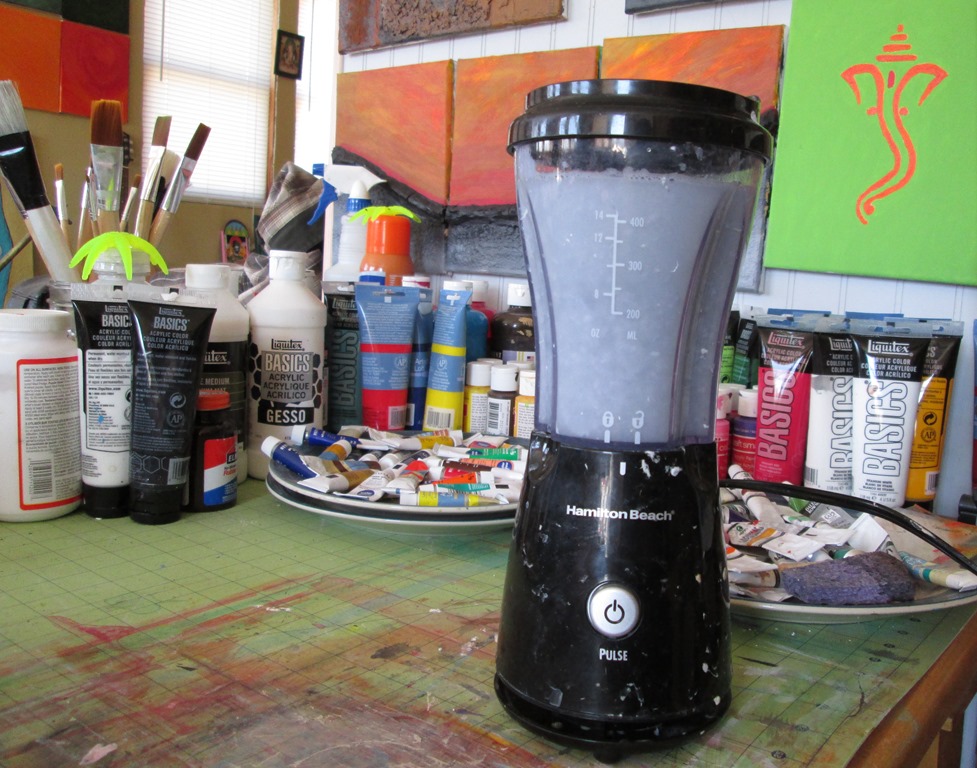 I used my trusty little blender to chop up the paper and turn it into pulp. Instead of pouring the pulp into a tray of water and using a deckle to ‘fish’ the fibers on to a mold or frame I poured the pulp directly into a strainer, removed most of the water and than ‘sculpted’ the pulp around a cylinder form. The last photo is of some of the finished 1/2 cylinders and some brown craft paper that I also made that day using a regular deckle.

28 Thursday Feb 2019
27 Wednesday Feb 2019
Posted in Mother Teresa, Uncategorized
≈ Comments Off on small things
27 Wednesday Feb 2019
Posted in Meditation, mindfulness, Self expression, Wellness
≈ Comments Off on Meditation can relieve pain
Meditation can relieve pain, and it does so by activating multiple brain areas, according to an April 2011 study in the Journal of Neuroscience. Fadel Zeidan of Wake Forest University and his colleagues scanned people’s brains as they received uncomfortably hot touches to the leg. When subjects practiced a mindful meditation technique that encourages detachment from experience while focusing on breathing, they reported less pain than when they simply paid attention to their breathing. Likewise, different patterns of brain activity emerged under the two conditions, with mindful meditating resulting in more activity not only in executive centers that evaluate experiences and regulate emotions but also in lower regions that control the signals coming from the body.
The volunteers learned the meditation technique in only four 20-minute sessions, which means this pill-free analgesia could be a feasible way to help real patients suffering from pain. “People can reap some of the benefits of meditation without extensive training,” Zeidan says.
When I work with patients using mindfulness I start by asking who has experience with any type of meditation, breathing techniques and/or relaxation exercises. We than have a brief explanation and question and answer period and I focus on removing any doubt, fear, or skepticism. I usually than do a 10 to 12 minute body scan moving right into a mindful meditation that focuses on the breath.
With the co-occurring patients I work with this process seems to work the best. The chat in the beginning warms people up, the body scan relaxes which helps the meditators enter into a more meditative state.




 RichardbBrunner