Posted by RichardB | Filed under Seguy Art Deco Designs
≈ Comments Off on Seguy Art Deco Designs 79

03 Saturday Sep 2022
Posted by RichardB | Filed under Seguy Art Deco Designs
≈ Comments Off on Seguy Art Deco Designs 79
02 Friday Sep 2022
Posted in Research
≈ Comments Off on US-European Satellite Will Make World’s First Global Freshwater Survey
https://nasa.gov/feature/jpl/us-european-satellite-will-make-world-s-first-global-freshwater-survey
“A collaboration between NASA and the French space agency Centre National d’Études Spatial (CNES), with contributions from the Canadian Space Agency and the United Kingdom Space Agency, SWOT is scheduled to launch in November from Vandenberg Space Force Base in California.“
“SWOT has several key tasks, including measuring the height of water bodies on Earth’s surface. Over the ocean, the satellite will be able to “see” features like eddies less than 60 miles (100 kilometers) across – smaller than those that previous sea level satellites could observe. SWOT will also measure more than 95% of Earth’s lakes larger than 15 acres (6 hectares) and rivers wider than 330 feet (100 meters) across.”
via #NASA_APP
31 Wednesday Aug 2022
Posted in Addiction, Coping Skills
≈ Comments Off on Addiction: One Perspective
Tags
Whether consciously acknowledged or not, we live in an almost constant state of anxiety. We are concerned with what we may lose, or what we may not gain. We also live in grief and regret over what we have left behind or at least feel we may have indeed lost. We thus attach ourselves to the very things that we cannot, ultimately, control, the past and the future. In truth, there is only today, this moment, and this breath with which we are, and can be, connected. The past is gone, and the future has not yet happened. We are here, now.
From a Buddhist perspective, addiction might be considered the archetype of attachment. Addiction is, in fact, a collection of attachments. It is attachment to fear, attachment to loss, and attachment to longing, emptiness, and a lack of a sense of purpose. Whether we choose alcohol, drugs, sex, food, pornography, exercise or even shopping, we are simply employing the means serving the compulsion to fill a space and dampen our pain. The means does not matter; that is simply a gesture. The compulsion is the crux of it, and that compulsion is not so much to drink, or do drugs, or to spend; that compulsion, ultimately, is to fill that space.
And just what is that space? We might look upon it as the “God-shaped hole.” The wisdom teachings suggest that in identifying with a self, a “me”, we divorce ourselves from the true nature of our existence. From a psychological perspective, this division presents itself as inauthenticity, and the internal conflict that condition engenders promotes internal strife. In our attempt to reconcile this sense of inauthenticity, we cling even more desperately to establishing a sense of “me-ness” and can, in some cases, become morbidly self-destructive in our attempts to soothe the pain of failure in that reconciliation.
Addiction generally begins as an interest. As soon as we express an interest in something, we are expressing a preference. In expressing a preference, we are dividing our attention and creating an attachment to something in the world around us. As that interest turns into a fascination, our attachment deepens. Our attention becomes more and more exclusive, and we become increasingly imbalanced; emotionally, intellectually, and spiritually.
Fascination may then flower into obsession, and we become a slave to our attachment. We are no longer ourselves, and rather than ‘losing our mind’, which would be the skillful means by which to escape our attachment, we are trapped inside the mind.
With obsession, our attachment becomes even more intensified, and our exclusion even more narrow. As we become slaves to our attachment, our mind, and our behavior, we lose the ability to exercise free will and, in that light, move from obsession to compulsion; from place of being driven, to a place of need.
At this point we fail the First Noble Truth; our attachment has become so involved that we have invited suffering. We are no longer willful, but, rather, subject to and at the sufferance of the will of our attachments. When we find ourselves in a place that we cannot live without exercising this attachment, whatever it may be, we have fallen into a state of addiction.
Within the context of addiction, people often feel that they do not have a choice. Nothing could be further from the truth. We always have a choice. When confronting someone who themselves is confronting an addiction, saying to them, “Stopping your behavior is your choice.” is, however, often met with profound resistance for their failure to see that choice.
The key to getting a grasp on this is recognizing that choice is a constant state; it is not a single moment in time. If the choice not to be addicted were a single choice point, then all we would ultimately do is move our attachment from something socially defined as negative (say, drinking or being promiscuous) to something that is socially defined as positive (not drinking or being chaste). In fact, we would become addicted, or at the very least attached, to not being addicted.
Buddha spoke of the Middle Way. Within the context of choice that suggests that if we are present in the moment, our choices are constant. We do not, then, go right or left, say yes or no, think good or bad, or see black or white; rather, we are aware that both opportunities are presenting themselves, we recognize this and acknowledge it, then choose neither.
When we lose the Middle Way and fall off our balancing point, we create our pain. We create our sense of emptiness, and our anxiety around loss. We deceive ourselves into believing that we are less than whom and what we are by virtue of attaching ourselves to things, objects, situations, emotions, and anxieties that take us away from ourselves. This is the engine of addiction.
Coming back to the present moment brings us back to our constancy of choice. We find ourselves in the Middle Way, on the balancing point and we are able to see both choices. Seeing both sides in balance and in perspective then gives us the opportunity to exercise compassion. Most importantly, it gives us the opportunity to exercise compassion toward ourselves. We are able to see the left and the right, and we are also able to see the left in the right and the right in the left.
Our frustration with the world and sense of victimhood thus becomes transformed into the recognition that we must set an intention in our lives. Our depression finds an antidote for itself in the gratitude that we can express simply for being alive. We begin to see outside ourselves with a clear vision and recognize that the things outside ourselves are, in fact, quite outside ourselves. In letting go of our attachments we also let go of the things that influence us and draw us into a state of mind where we feel less than we are, where we feel that something is missing, where we need to fill the space, or dampen the pain, or simply make it go away.
Coming back to the breath as a marker for the present moment and exercising the constancy of choice in that moment and every moment also gives us an opportunity to break free of the bonds of this supreme state of attachment and begin to climb out of the pit of suffering into which we have gotten ourselves.

29 Monday Aug 2022
Posted in Music, Uncategorized
≈ Comments Off on Top Songs I listened to in 2021: Natalia Lafourcade – Un Canto por México – El Musical
Tags
28 Sunday Aug 2022
27 Saturday Aug 2022
Tags

Posted by RichardB | Filed under Coloring Pages
≈ Comments Off on Coloring page: Kwakiutl Transformation Mask
26 Friday Aug 2022
Posted in Compassion, Pets, Wellness
≈ Comments Off on Palliative Care and Pets: Rethinking the way we say goodbye | Jackie Campbell | TEDxSouthBank
Tags
24 Wednesday Aug 2022
Posted in Coping Skills, Handout
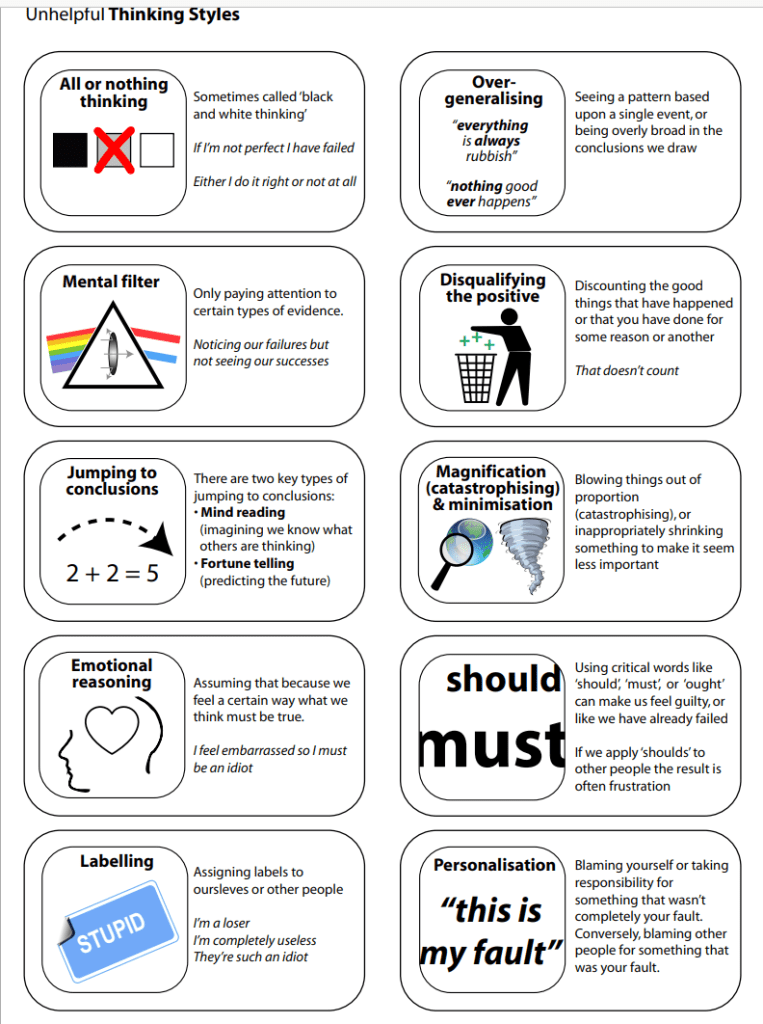
≈ Comments Off on Handout: Unhelpful Thinking Styles
Another handout to start the conversation in groups. If the group I am working with engages easily I will just use one copy. I have people, one at a time read a thinking style and we talk about it.
If the group does not engage easily I past out copies to everyone and they circle one or two and we discuss.
At the end of group (and most groups I do) I ask if this handout was useful or not, if there is anything that can be done to make it better.
22 Monday Aug 2022
Posted in Music, Uncategorized
≈ Comments Off on Keerthana Vaidyanathan ft. Akshay Yesodharan – Anbaale
21 Sunday Aug 2022
20 Saturday Aug 2022
Posted in art, Coloring Pages
≈ Comments Off on Amaterasu Coloring Page
Tags
Amaterasu, Amaterasu-ōmikami or Ōhirume-no-muchi-no-kami is a part of the Japanese myth cycle and also a major deity of the Shinto religion. She is seen as the goddess of the sun, but also of the universe. The name Amaterasu derived from Amateru meaning “shining in heaven.” The meaning of her whole name,Amaterasu-ōmikami, is “the great august kami (god) who shines in the heaven”.
https://en.wikipedia.org/wiki/Amaterasu

19 Friday Aug 2022
18 Thursday Aug 2022
Posted in brain
≈ Comments Off on Emotional Self-Control and the Brain
Tags
Different brain areas are activated when we choose to suppress an emotion, compared to when we are instructed to inhibit an emotion, according a new study from the UCL Institute of Cognitive Neuroscience and Ghent University.
In this study, published in Brain Structure and Function, the researchers scanned the brains of healthy participants and found that key brain systems were activated when choosing for oneself to suppress an emotion. They had previously linked this brain area to deciding to inhibit movement.

“This result shows that emotional self-control involves a quite different brain system from simply being told how to respond emotionally,” said lead author Dr Simone Kuhn (Ghent University).
In most previous studies, participants were instructed to feel or inhibit an emotional response. However, in everyday life we are rarely told to suppress our emotions, and usually have to decide ourselves whether to feel or control our emotions.
In this new study the researchers showed fifteen healthy women unpleasant or frightening pictures. The participants were given a choice to feel the emotion elicited by the image, or alternatively to inhibit the emotion, by distancing themselves through an act of self-control.
The researchers used functional magnetic resonance imaging (fMRI) to scan the brains of the participants. They compared this brain activity to another experiment where the participants were instructed to feel or inhibit their emotions, rather than choose for themselves.
Different parts of the brain were activated in the two situations. When participants decided for themselves to inhibit negative emotions, the scientists found activation in the dorso-medial prefrontal area of the brain. They had previously linked this brain area to deciding to inhibit movement.
In contrast, when participants were instructed by the experimenter to inhibit the emotion, a second, more lateral area was activated.
“We think controlling one’s emotions and controlling one’s behavior involve overlapping mechanisms,” said Dr Kuhn.
“We should distinguish between voluntary and instructed control of emotions, in the same way as we can distinguish between making up our own mind about what do, versus following instructions.”
Regulating emotions is part of our daily life and is important for our mental health. For example, many people have to conquer fear of speaking in public, while some professionals such as health-care workers and firemen have to maintain an emotional distance from unpleasant or distressing scenes that occur in their jobs.
Professor Patrick Haggard (UCL Institute of Cognitive Neuroscience) co-author of the paper said the brain mechanism identified in this study could be a potential target for therapies.
“The ability to manage one’s own emotions is affected in many mental health conditions, so identifying this mechanism opens interesting possibilities for future research.
“Most studies of emotion processing in the brain simply assume that people passively receive emotional stimuli, and automatically feel the corresponding emotion. In contrast, the area we have identified may contribute to some individuals’ ability to rise above particular emotional situations.
“This kind of self-control mechanism may have positive aspects, for example making people less vulnerable to excessive emotion. But altered function of this brain area could also potentially lead to difficulties in responding appropriately to emotional situations.”
15 Monday Aug 2022
Posted in Music
≈ Comments Off on Top Songs I listened to in 2021: Orchestral Qawwali | Rushil | Abi Sampa | Amrit – Man Kunto Maula
Tags
14 Sunday Aug 2022
13 Saturday Aug 2022
Posted in art, Coloring Pages
≈ Comments Off on Balsam Root Coloring Page
Tags

12 Friday Aug 2022
11 Thursday Aug 2022
Posted in Coping Skills, Handout
≈ Comments Off on Positive Statements Handout
Tags
About 75% of Psycho-educational groups I have facilitated over the decades have basicly been coping skills. This handout is for a self esteem group and usually generated engagement.
To begin I ask folks to fill out this handout and than we talk about it. Having a handout helps to facilitate interactions with clients, encouraging them to share …. which in ideal situations leads to a more open discussion, moving away from the handout but staying with the theme. If we have all shared and a new discussion does not evolve I ask the group what other questions should we ask …. and than we ask.
Positive Statements about you
1. I like myself because:
2. I’m an expert at:
3. I feel good about:
4. My friends would tell you I have a great:
5. My favorite place is:
6. I’m loved by:
7. People say I am a good:
8. I’ve been told I have:
08 Monday Aug 2022
Posted in Music, Uncategorized
≈ Comments Off on Top Songs I listened to in 2021: STEPAN AND VALENTINA NESTEROV – КАК НАД ЯРОМ | СОКОЛ
07 Sunday Aug 2022


 RichardbBrunner