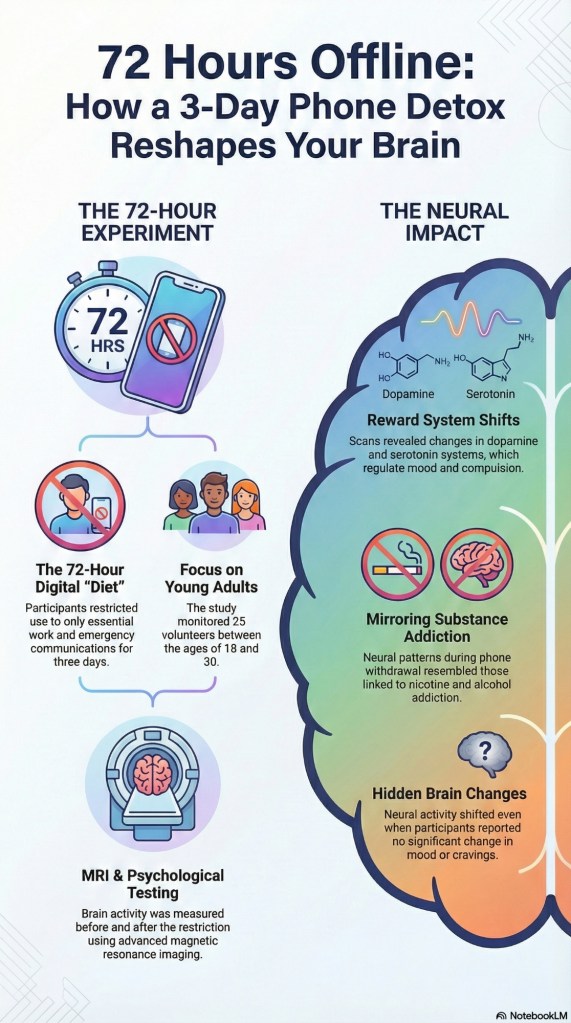
Researchers from German universities investigated 25 young adults who limited their phone use to essential tasks for 72 hours, using MRI scans and psychological tests before and after the restriction period. The core finding was that images of smartphones after the restriction triggered changes in brain regions associated with reward processing and cravings, similar to patterns observed in substance addictions. These neural changes were specifically linked to dopamine and serotonin systems, supporting the hypothesis that excessive smartphone use can be addictive. Although brain activity showed these changes, the psychological tests did not register significant changes in the participants’ mood or reported cravings during the brief period of restriction.
Over the years I have read articles and case files of clients that suggest there is an abundance of anxiety and anxiety related disorders with people who experience alcohol and drug addiction. One of the chief components that produce anxiety is stress and according to Volkow and Li (2005) stress increases vulnerability to drug use and relapse in those addicted. They both argue that there is evidence that, “corticotropin-releasing factor (CRF) might play a linking role through its effects on the mesocorticolimbic dopamine system and the hypothalamic-pituitary–adrenal axis15-16” (Volkow, Li, 2005, p 1429). In simpler terms, stress produces CRF which affects the limbic system and the adrenals which in turn increases the stress response cycle.
In thinking about stress I stumbled across another article in the same issue of Nature and Neuroscience that talked about stress like responses, abet in a somewhat indirect manner. The article, by Antoine Bechara (2005) talks about the amygdala being out of balance. Bechara argues that addicted people become unable to make drug-use choices on the basis of long-term outcome because of hyperactivity within the amygdala (Bechara, 2005, p.1458). The amygdala which signals pain or pleasure of immediate prospects, overpowers the reflective prefrontal cortex system for signaling pain or pleasure of future prospects thus altering the decision making process. Bachara goes on to say that substance use can trigger involuntary signals originating from the amygdala that modulate, bias or even hijack the goal-driven cognitive resources that are needed for the normal operation of the reflective system and for exercising the willpower to resist drugs (Bechara, 2005, p.1458).
Knowing the basics that there is a relationship between the amygdala, drug use and stress I am willing to hypothesize that there is a circular connection here. Stress (and drug use) changes the composition of the chemicals that move through the body, this changed composition changes us more by altering the functions in the amygdala, which leads to changes in the decision making process. This combination of factors (stress-chemical composition-amygdala- and temperament) could be an over whelming force.
In fact, as long as I am going out on a limb and possibly completely limbless, I hypothesize that this stress amygdala cycle maybe related to the high/low reactive response Kagan noticed behaviorally in infants some thirty plus years ago at Harvard.
From Kagan’s perspective, temperament is an emotional/behavioral bias, independent of cognitive abilities, that affects receptivity to certain moods and emotions (Mitchell, 2006). Temperament has an effect on the neural chemistry of the brain and thus the sensitivity of certain receptors. Kagan theorized this is based on inherited factors that control the amygdala and thus the production of chemicals in the brain (Mitchell, 2006). This sensitivity, Kagan believes, is the basis of the behavioral/temperamental aspect of an individual.
In Kagan’s theory the chemical production of the amygdala alters receptor connections forming what he describes as high and low reactive (Mitchell, 2006). A high reactive is a high level of arousal to stimuli (crying), versus a low reactive which has a more relaxed reaction to stimuli. Highs have a more active amygdala, and tend to need to be in more control (control their responses and avoid the high reactive reactions).
Thus Bechara theory that drugs stimulate the amygdala maybe the same responses/reactions that Kagan saw in high reactive individuals. If one is a high reactive addict and you are surrounded by stimuli your inherent reaction is to want to control your high response because it creates tension within. The addict wants to quiet the tension, and the brain remembers that using fills that immediate need for control by quieting the reactions. But the drug use only temporally gives control as it also creates a hyperactive response in the amygdala which also reinforces that experience/feeling/thought that it’s more important to use now and not worry about later.
This hypothetical situation might manifest itself somatically by the addict contracting in response to memories of the original or current stressor stimuli for example. This contraction may have become neurologically and psychologically habituated as, “the body movements we develop when we are young are the modus operandi of dissociating” (Caldwell, 1996, p. 28). This contraction would possibly be followed by the person moving to remedy the situation by desensitization through a known movement pattern of perhaps contraction and release. This contraction/release could be a strain/release pattern, followed by a stop/go hesitation pattern as the person struggles with the need to control/quiet the self and the amygdala sends signals/memories of use that overrule the reflective prefrontal cortex. The person uses and goes into a running/drifting rhythm followed by even flow as the effects of the usage wears off.
Despite some 40 plus years of working with folks using movement and therapy I am still learning about movement and its relationship to addictions and disorders (disharmony) in general. I feel like I am also in the beginning stages of learning about neuroscience and the body with its behaviors. I get a wee bit excited when I think about the journals and articles that I have had only a chance to skim or read once and the connections with addictions as well as Kagan, Bachara, Volkow, Li, and others theories of addiction and personality. I never would have thought I would spend so much time looking at addictions but I see in adults with addictions many issues; adolescence, child hood trauma, dysfunctional families, depression, anxiety, low self esteem, disassociation from the body and from feelings. One population with many pathologies, just like every other population (humans) I suppose.
Bechara, A. (2005). Decision making, impulse control and loss of willpower to resist drugs: a neurocognitive perspective. Nature Neuroscience. Vol 8, no. 11 Novemenber 2005.
Cadlwell, C. (1996). Getting our bodies back. Boston: Shambahala.
Capello, P,P. (2008). Dance/Movement Therapy with Children Throughout the World. American Journal Dance Therapy. (2008) Vol. 30. pg: 24–36
Fisher, B. MA, DTR. (1990). Dance/Movement Therapy:Its use in a 28 day substance abuse program. The Arts in Psychotherapy. Vol 17, pp.325-331
Fraser, J. S., & Solovey, A. D. (2007). Substance Abuse and Dependency. Second-order change in psychotherapy: The golden thread that unifies effective treatments., 223-244.
Lewis, P. (2003) Marian Chace Foundation Annual Lecture: Dancing with the Movement of the River. American Journal of Dance Therapy Vol. 25, No. 1, Spring/Summer 2003
Milliken, R. (1990). Dance/movement therapy with the substance abuser. The Arts in Psychotherapy, The creative arts therapies in the treatment of substance abuse, 17(4), 309-317.
Mitchell, N. (2006, August 26). All in the mind: Jerome Kagan, the father of temperament. Australia Broadcast Corporation, Radio National. Retrieved August 26, 2006, from http://abc.net.au/rn/aim/
TIPS, National Library of Medicine. (2008). Groups and substance abuse treatment: From Treatment Improvement Protocol Series. Retrieved February 25 2008 from Health Services Technology/Assessment Texts http://www.ncbi.nlm.nih.gov/books/bv.fcgi?rid=hstat5.section.78466
NIDA, National Institutes of Health (NIH), National Institute on Drug Abuse (NIDA). (2008). NIDA Info-Facts: Nationwide Trends. Retrieved February 22 2008 from U.S. Department of Health and Human Services. http://www.nida.nih.gov/Infofacts/nationtrends.html
Volkow,N. Li, Ting-Kai. (2005). The neuroscience of addiction. Nature Neuroscience. Vol 8, no. 11 Novemenber 2005 .
Rose,S. (1995). Movement as metaphor in treating chemical addiction. In F.J. Levy (Ed.), Dance and other expressive art therapies. New York: Routledge.
You’ve probably heard of the brain’s reward network. It’s activated by basic needs — including food, water and sex — and releases a surge of the feel-good neurotransmitter dopamine when those needs are met. But it can also be hijacked by drugs, which lead to a greater dopamine release than those basic needs.
But the reward network isn’t the only brain network altered by drug use. A new review concluded that drug addiction affects six main brain networks: the reward, habit, salience, executive, memory and self-directed networks.
In 2016, a total of 20.1 million people ages 12 and older in the U.S. had a substance-use disorder, according to the National Survey on Drug Use and Health, an annual survey on drug use. And drug addiction, regardless of the substance used, had surprisingly similar effects on the addicted brain, said the review, published in the journal Neuron.
The review looked at more than 100 studies and review papers on drug addiction, all of which studied a type of brain scan called functional magnetic resonance imaging (fMRI).
More than half of the studies out there look at the effects of drug use on the reward network, said Anna Zilverstand, lead author of the new review and an assistant professor of psychiatry at the Icahn School of Medicine at Mount Sinai in New York City.
“Because we showed that the effects are very distributed across the six different networks … [we can conclude that] an approach that only looks at one of these networks isn’t really justified,” Zilverstand told Live Science. “This [finding] will hopefully lead other researchers to look beyond the reward network.”
For example, the memory network is pretty much ignored in research on substance-use disorders, Zilverstand said. This network allows humans to learn non-habit-based things, such as a new physics concept or a history lesson. Some research has suggested that in people with substance-use disorders, stress shifts the person’s learning and memory away from the memory network to the habit network, which drives automatic behavior, such as seeking and taking drugs.
Another less-studied network is the self-directed network, which is involved in self-awareness and self-reflection, the review said. In people with addictions, this network has been associated with increasing craving.
Two other networks are involved in substance-use disorders: The executive network is normally responsible for goal-maintaining and execution, but drugs can alter this network as well, reducing a person’s ability to inhibit their actions. The salience network picks up important cues in a person’s environment and redirects the individual’s attention to them. (In people with drug addiction, attention is redirected toward drugs, increasing craving and drug-seeking.)
Which comes first, the brain activity or the drug use?
“For me, the most surprising [finding] was how consistent the effects were across addictions,” Zilverstand said. What’s more, “the fact that the effects are quite independent of the specific drug use points to them being something general that might actually precede drug use rather than be a consequence of drug use.”
Zilverstand said she hopes that more studies will look at whether some people have abnormal brain activity in these six networks naturally and if that activity just gets exacerbated if they begin drug use. It’s important to know if some of these traits precede drug use; if that’s the case, it might be possible to identify people who are prone to addiction and intervene before an addiction begins, she said.
Some research has pointed toward this possibility already. For example, studies have shown that some people have “difficulties … inhibiting impulsiveness before drug use,” Zilverstand said. “Some of these impairments precede drug use, and they may become worse with more drug use, but they exist before the problem escalates.”
The good news, however, is that activity in four of these networks — executive, reward, memory and salience — moves back toward “normal” once drug use ends. “We know that four of the networks (partially — not fully) recover but not yet what happens to the other two networks,” Zilverstand said in an email.
Zilverstand added that she’s particularly excited about an ongoing study called the Adolescent Brain Cognitive Development (ABCD) Study, which is tracking 10,000 children across the U.S. from around ages 9 or 10 to age 20 (the children are now around 13). Some of these individuals will inevitably become addicted to drugs, most likely marijuana or alcohol, Zilverstand said.
“We’ll be able to see if the effects that we found [in the review] exist in youth who have not yet abused drugs,” she said, and she predicted that researchers will be able to find a lot of the effects identified in the review in the six brain networks.
The authors noted that because some regions of the brain are very small — for example, the amygdala, which is found toward the center of the brain — the studies can’t identify strong signals from those areas on brain scans. So, it’s possible that drugs affect additional networks in the brain that are hidden because of the limitations of our technologies, Zilverstand said.
“We don’t want to conclude that [those effects] don’t exist,” she said.
The notion that “one size fits all” when applying drug treatments to addiction is challenged by a published in the journal Biological Psychiatry that investigates pharmacotherapies for cocaine addiction.
Currently, medication for drug addicts is prescribed in the same way for all patients, regardless of the extent of their addiction. The new study uses cocaine addiction – for which there are currently no Food and Drug Administration (FDA)-approved drug therapies – to study whether treatment is more or less responsive at different stages of addiction.
Increasingly, evidence suggests that addiction is caused by a convergence of different “neurobiological adaptations” that result in an eventual loss of control over drug-seeking behaviors. Cocaine, for instance, impairs the processes that govern impulse control but also promotes drug-seeking habits.
The adaptations within the brain triggered by addictive drugs include reduced metabolic activity and reduced production of dopamine – the hormone that controls the brain’s reward and pleasure centers.
At some point, over the course of addiction, a brain region called the nucleus accumbens takes over from the dorsolateral striatum (DLS) in managing control behaviors – systems that are both involved in the production of dopamine. As the nucleus accumbens is responsible for processing reward and the DLS is involved in habits, this shift results in a behavior change that favors high impulsivity and compulsive drug seeking.
To study how the DLS, impulsivity and phase of addiction of a subject influence their responsiveness to drug interventions, the researchers behind the new study – from the University of Cambridge in the UK – conducted an experiment in an animal model.
The rats that were in an early phase of addiction were not affected by the treatment. Instead, it was the animals who had a longer history of self-administering cocaine that exhibited the greatest change in behavior.
First, the “impulsivity” of 40 male rats was measured using a task in which rats were trained to self-administer food pellets by pushing open a panel during allocated periods signaled to the rats using a light.
Next, these rats were trained to press a lever to self-administer cocaine dissolved in water. The extent to which the rats exhibited cocaine-seeking behavior – for instance, repeatedly pressing the lever, even when cocaine was not delivered – was monitored by the researchers.
The team then administered a dopamine receptor-blocking drug called α-flupenthixol directly into the DLS of rats at various phases of addiction.
Also, the rats that were in an early phase of addiction were not affected by the treatment. Instead, it was the animals that had a longer history of self-administering cocaine that exhibited the greatest change in behavior.
Dr. John Krystal, editor of Biological Psychiatry, says the results show that dopamine receptor blockers play a role in treatment of addiction, but only at particular phases of the addiction process.
“The notion that particular brain mechanisms are engaged only at particular phases of the addiction process strikes me as an important insight that has yet to be harnessed in developing new medications for addiction treatment,” he says.
“The results of this study are important because they show that although both impulsive and non-impulsive rats developed cocaine-seeking habits, this was delayed in high impulsive rats,” adds first author Dr. Jennifer Murray. She continues:
“It is suggested that vulnerability to addiction conferred by impulsivity is less influenced by the propensity to develop drug-seeking habits and more by the inability of an individual to regain control over these habits that are rigidly and maladaptively established in the brain.”
We’re told studies have proven that drugs like heroin and cocaine instantly hook a user. But it isn’t that simple – little-known experiments over 30 years ago tells a very different tale.
Drugs are scary. The words “heroin” and “cocaine” make people flinch. It’s not just the associations with crime and harmful health effects, but also the notion that these substances can undermine the identities of those who take them. One try, we’re told, is enough to get us hooked. This, it would seem, is confirmed by animal experiments.
Many studies have shown rats and monkeys will neglect food and drink in favor of pressing levers to obtain morphine (the lab form of heroin). With the right experimental set up, some rats will self-administer drugs until they die. At first glance it looks like a simple case of the laboratory animals losing control of their actions to the drugs they need. It’s easy to see in this a frightening scientific fable about the power of these drugs to rob us of our free will.
But there is more to the real scientific story, even if it isn’t widely talked about. The results of a set of little-known experiments carried out more than 30 years ago paint a very different picture and illustrate how easy it is for neuroscience to be twisted to pander to popular anxieties. The vital missing evidence is a series of studies carried out in the late 1970s in what has become known as “Rat Park”. Canadian psychologist Bruce Alexander, at the Simon Fraser University in British Columbia, Canada, suspected that the preference of rats to morphine over water in previous experiments might be affected by their housing conditions.
To test his hypothesis, he built an enclosure measuring 95 square feet (8.8 square meters) for a colony of rats of both sexes. Not only was this around 200 times the area of standard rodent cages, but Rat Park had decorated walls, running wheels and nesting areas. Inhabitants had access to a plentiful supply of food, perhaps most importantly the rats lived in it together.
Rats are smart, social creatures. Living in a small cage on their own is a form of sensory deprivation. Rat Park was what neuroscientists would call an enriched environment, or – if you prefer to look at it this way – a non-deprived one. In Alexander’s tests, rats reared in cages drank as much as 20 times more morphine than those brought up in Rat Park.
Inhabitants of Rat Park could be induced to drink more of the morphine if it was mixed with sugar, but a control experiment suggested that this was because they liked the sugar, rather than because the sugar allowed them to ignore the bitter taste of the morphine long enough to get addicted. When naloxone, which blocks the effects of morphine, was added to the morphine-sugar mix, the rats’ consumption didn’t drop. In fact, their consumption increased, suggesting they were actively trying to avoid the effects of morphine, but would put up with it in order to get sugar.
‘Woefully incomplete’
The results are catastrophic for the simplistic idea that one use of a drug inevitably hooks the user by rewiring their brain. When Alexander’s rats were given something better to do than sit in a bare cage, they turned their noses up at morphine because they preferred playing with their friends and exploring their surroundings to getting high.
Further support for his emphasis on living conditions came from another set of tests his team carried out in which rats brought up in ordinary cages were forced to consume morphine for 57 days in a row. If anything should create the conditions for chemical rewiring of their brains, this should be it. But once these rats were moved to Rat Park they chose water over morphine when given the choice, although they did exhibit some minor withdrawal symptoms.
You can read more about Rat Park in the original scientific report. The results aren’t widely cited in the scientific literature, and the studies were discontinued after a few years because they couldn’t attract funding. There have been criticisms of the study’s design and the few attempts that have been made to replicate the results have been mixed.
Nonetheless the research does demonstrate that the standard “exposure model” of addiction is woefully incomplete. It takes far more than the simple experience of a drug – even drugs as powerful as cocaine and heroin – to make you an addict. The alternatives you have to drug use, which will be influenced by your social and physical environment, play important roles as well as the brute pleasure delivered via the chemical assault on your reward circuits
It suggests that even addictions can be thought of using the same theories we use to think about other choices, there isn’t a special exception for drug-related choices. Rat Park also suggests that when stories about the effects of drugs on the brain are promoted to the neglect of the discussion of the personal and social contexts of addiction, science is servicing our collective anxieties rather than informing us.
The human brain is the most complex organ in the body. This three-pound mass of gray and white matter sits at the center of all human activity—you need it to drive a car, to enjoy a meal, to breathe, to create an artistic masterpiece, and to enjoy everyday activities. In brief, the brain regulates your body’s basic functions; enables you to interpret and respond to everything you experience; and shapes your thoughts, emotions, and behavior.
The brain is made up of many parts that all work together as a team. Different parts of the brain are responsible for coordinating and performing specific functions. Drugs can alter important brain areas that are necessary for life-sustaining functions and can drive the compulsive drug abuse that marks addiction. Brain areas affected by drug abuse include:
The brain stem, which controls basic functions critical to life, such as heart rate, breathing, and sleeping.
The cerebral cortex, which is divided into areas that control specific functions. Different areas process information from our senses, enabling us to see, feel, hear, and taste. The front part of the cortex, the frontal cortex or forebrain, is the thinking center of the brain; it powers our ability to think, plan, solve problems, and make decisions.
The limbic system, which contains the brain’s reward circuit. It links together a number of brain structures that control and regulate our ability to feel pleasure. Feeling pleasure motivates us to repeat behaviors that are critical to our existence. The limbic system is activated by healthy, life-sustaining activities such as eating and socializing—but it is also activated by drugs of abuse. In addition, the limbic system is responsible for our perception of other emotions, both positive and negative, which explains the mood-altering properties of many drugs.
How do the parts of the brain communicate?
The brain is a communications center consisting of billions of neurons, or nerve cells. Networks of neurons pass messages back and forth among different structures within the brain, the spinal cord, and nerves in the rest of the body (the peripheral nervous system). These nerve networks coordinate and regulate everything we feel, think, and do.
Neuron to Neuron Each nerve cell in the brain sends and receives messages in the form of electrical and chemical signals. Once a cell receives and processes a message, it sends it on to other neurons.
Neurotransmitters – The Brain’s Chemical Messengers The messages are typically carried between neurons by chemicals called neurotransmitters.
Receptors – The Brain’s Chemical Receivers The neurotransmitter attaches to a specialized site on the receiving neuron called a receptor. A neurotransmitter and its receptor operate like a “key and lock,” an exquisitely specific mechanism that ensures that each receptor will forward the appropriate message only after interacting with the right kind of neurotransmitter.
Transporters – The Brain’s Chemical Recyclers Located on the neuron that releases the neurotransmitter, transporters recycle these neurotransmitters (that is, bring them back into the neuron that released them), thereby shutting off the signal between neurons.
To send a message, a brain cell (neuron) releases a chemical (neurotransmitter) into the space (synapse) between it and the next cell. The neurotransmitter crosses the synapse and attaches to proteins (receptors) on the receiving brain cell. This causes changes in the receiving cell—the message is delivered.
How do drugs work in the brain?
Drugs are chemicals that affect the brain by tapping into its communication system and interfering with the way neurons normally send, receive, and process information. Some drugs, such as marijuana and heroin, can activate neurons because their chemical structure mimics that of a natural neurotransmitter. This similarity in structure “fools” receptors and allows the drugs to attach onto and activate the neurons. Although these drugs mimic the brain’s own chemicals, they don’t activate neurons in the same way as a natural neurotransmitter, and they lead to abnormal messages being transmitted through the network.
Other drugs, such as amphetamine or cocaine, can cause the neurons to release abnormally large amounts of natural neurotransmitters or prevent the normal recycling of these brain chemicals. This disruption produces a greatly amplified message, ultimately disrupting communication channels.
How do drugs work in the brain to produce pleasure?
Most drugs of abuse directly or indirectly target the brain’s reward system by flooding the circuit with dopamine. Dopamine is a neurotransmitter present in regions of the brain that regulate movement, emotion, motivation, and feelings of pleasure. When activated at normal levels, this system rewards our natural behaviors. Overstimulating the system with drugs, however, produces euphoric effects, which strongly reinforce the behavior of drug use—teaching the user to repeat it.
Most drugs of abuse target the brain’s reward system by flooding it with dopamine.
How does stimulation of the brain’s pleasure circuit teach us to keep taking drugs?
Our brains are wired to ensure that we will repeat life-sustaining activities by associating those activities with pleasure or reward. Whenever this reward circuit is activated, the brain notes that something important is happening that needs to be remembered, and teaches us to do it again and again without thinking about it. Because drugs of abuse stimulate the same circuit, we learn to abuse drugs in the same way.
Why are drugs more addictive than natural rewards?
When some drugs of abuse are taken, they can release 2 to 10 times the amount of dopamine that natural rewards such as eating and sex do. In some cases, this occurs almost immediately (as when drugs are smoked or injected), and the effects can last much longer than those produced by natural rewards. The resulting effects on the brain’s pleasure circuit dwarf those produced by naturally rewarding behaviors. The effect of such a powerful reward strongly motivates people to take drugs again and again. This is why scientists sometimes say that drug abuse is something we learn to do very, very well.
Long-term drug abuse impairs brain functioning.
What happens to your brain if you keep taking drugs?
For the brain, the difference between normal rewards and drug rewards can be described as the difference between someone whispering into your ear and someone shouting into a microphone. Just as we turn down the volume on a radio that is too loud, the brain adjusts to the overwhelming surges in dopamine (and other neurotransmitters) by producing less dopamine or by reducing the number of receptors that can receive signals. As a result, dopamine’s impact on the reward circuit of the brain of someone who abuses drugs can become abnormally low, and that person’s ability to experience any pleasure is reduced.
This is why a person who abuses drugs eventually feels flat, lifeless, and depressed, and is unable to enjoy things that were previously pleasurable. Now, the person needs to keep taking drugs again and again just to try and bring his or her dopamine function back up to normal—which only makes the problem worse, like a vicious cycle. Also, the person will often need to take larger amounts of the drug to produce the familiar dopamine high—an effect known as tolerance.
Decreased Dopamine Transporters in a Methamphetamine Abuser
How does long-term drug taking affect brain circuits?
We know that the same sort of mechanisms involved in the development of tolerance can eventually lead to profound changes in neurons and brain circuits, with the potential to severely compromise the long-term health of the brain. For example, glutamate is another neurotransmitter that influences the reward circuit and the ability to learn. When the optimal concentration of glutamate is altered by drug abuse, the brain attempts to compensate for this change, which can cause impairment in cognitive function. Similarly, long-term drug abuse can trigger adaptations in habit or non-conscious memory systems. Conditioning is one example of this type of learning, in which cues in a person’s daily routine or environment become associated with the drug experience and can trigger uncontrollable cravings whenever the person is exposed to these cues, even if the drug itself is not available. This learned “reflex” is extremely durable and can affect a person who once used drugs even after many years of abstinence.
What other brain changes occur with abuse?
Chronic exposure to drugs of abuse disrupts the way critical brain structures interact to control and inhibit behaviors related to drug use. Just as continued abuse may lead to tolerance or the need for higher drug dosages to produce an effect, it may also lead to addiction, which can drive a user to seek out and take drugs compulsively. Drug addiction erodes a person’s self-control and ability to make sound decisions, while producing intense impulses to take drugs.
Somewhere south of a sunny childhood are emotional and physical abuse and neglect. There are four possible combinations: emotional abuse, emotional neglect, physical abuse, and physical neglect. If one or more of these describe your childhood, maybe you’ve worked hard to put all that stuff behind you — but a study in the journal Alcoholism: Clinical and Experimental Research shows it’s not that easy to keep your past in the past.
It may come as no surprise that people who were mistreated as children are more likely to struggle with addiction as adults. But exactly what kind of mistreatment you experienced can predict what kind of substance abuser you may become. Of course, having a bad childhood does not mean that you will abuse substances, and conversely there are plenty of folks who had wonderful childhoods and became substance abusers.
For better or for worse, you are shaped by your past. The kind of maltreatment you experienced as a child makes you more likely to lean in certain ways as an adult and how you may use alcohol in predictable patterns to attempt to bring yourself back into balance.
The study followed 314 young adults to discover exactly which unfortunate childhood experiences set people on the paths toward specific kinds of drinking. First the researchers asked about childhood maltreatment, personality and drinking, and then, five years later, they asked again, along with a measure of alcohol-related problems.
Which childhood experiences led to the development of alcohol-related problems as a young adult? Let’s look at each in turn:
1. Emotional Abuse
In this study, young adults who were emotionally abused as children were more likely to be depressed. These depressed people were, in turn, more likely to drink in order to feel better. Of all four types of maltreatment, emotional abuse was most likely to lead to people drinking during the week, and most likely to create alcohol-related problems like missing work or ending relationships.
2. Emotional Neglect
In this study, it was as if emotional neglect cut the head off young adults’ joy. These people weren’t any more likely to be depressed, but they were much less likely than others to be joyful, as if emotional neglect squeezed their positive adult emotions back toward the center. Perhaps because this group’s emotional experience wasn’t quite pushed into “negative” territory, they didn’t feel the need to compensate with alcohol and emotional neglect was the one form of maltreatment on this list that didn’t predict increased alcohol use.
3. Physical Abuse
The researchers call the result of physical abuse “positive emotionality and unconscientious disinhibition.” What this means is that people who were physically abused as children are more likely to be impulsive and seek rewards – they drink on weekends and have a hard time stopping. These people had alcohol-related problems related to massive over-consumption – not the consequences of day-in, day-out drinking, but the consequences of getting way too drunk in binges.
4. Physical Neglect
Like physical abuse, physical neglect made it difficult for people in this study to stop drinking; they had the same “unconscientious disinhibition,” or lack of personal control. But their reasons to start drinking were different. Physical neglect made people antisocial. One form of antisocial behavior was a cruel and sometimes self-destructive experience of drinking. Though physical neglect didn’t predict weekend drinking as strongly as did physical abuse, and it didn’t predict weekday drinking as strongly as did emotional abuse, physical neglect and its antisocial consequence predict both kinds of increased drinking – weekend and weekday…and maybe due to the combined effects, physical neglect leads to as many alcohol-related problems as the other versions of maltreatment.
As important as these specific results, is the idea that unresolved issues from your childhood influence why you drink, when you drink, and how much you drink as an adult. But each of these paths from a difficult childhood to adult alcohol problems pass through an important checkpoint, namely they pass through the person you become. It’s not that a traumatic childhood forces you to drink as an adult, it’s that left unexamined, a traumatic childhood can make you feel like you need to drink to get something you’re missing or get something you want as an adult.
One key function of treatment is working to uncover the unresolved experiences in your past that cause you to drink. Is there something in your past that makes you compensate with alcohol in the present? Only by working to resolve this past mistreatment can you truly move forward without feeling these needs, cravings, and compulsions to drink.
Think about an experience that makes you feel good. It could be successfully completing a project at work, eating a warm chocolate chip cookie or taking a swig of whiskey. It could be a puff of a cigarette or a shopping trip. A dose of Vicodin or a hit of heroin.
Those experiences don’t automatically lead to addiction. So, what makes a particular habit or substance an addiction? What propels some people to seek out these experiences, even if they are costly or detrimental to their health and relationships?
“Addiction is a biopsychosocial disorder. It’s a combination of your genetics, your neurobiology and how that interacts with psychological and social factors,” said Maureen Boyle, a public health advisor and director of the science policy branch at the National Institute on Drug Abuse. That means it’s a lot like any other chronic disorder, such as type 2 diabetes, cancer and heart disease. And just like other chronic diseases, addiction is both preventable and treatable, Boyle said, but added that if left untreated, it can last a lifetime.
Though everyone’s path to addiction is different — whether he or she tries a drug or a behavior because it’s what that person’s parents or peer do, or just out of curiosity — what’s common across all substance and behavioral addictions is their stunning ability to increase levels of an important chemical in the brain called dopamine,Dopamine is a molecule that ferries messages across the brain’s reward center. It’s what gives people the feeling of pleasure and reinforces behaviors critical for survival, such as eating food and having sex.
When someone uses a drug or engages in a pleasurable experience, the same natural reward circuitry is activated. “The problem with drugs is that they do the job better than natural rewards,” said Dr. Hitoshi Morikawa, an associate professor of neuroscience at the University of Texas at Austin.
Different drugs tap into the dopamine reward system in different ways. Marijuana and heroin have a chemical structure similar to another neurotransmitter and can trick some brain cells into activating neurons that use dopamine. Cocaine and amphetamines, on the other hand, prolong the effect of dopamine on its target neurons, disrupting normal communication in the brain.
How quickly each drug can get into the brain, and how powerfully it activates neural circuits, determines how addictive it will be, Morikawa told Live Science. Some modes of use, like injecting or snorting a drug, make the drug’s effects almost immediate. “That’s why heroin, for example, is the last drug you want to take,” he said. “It’s very addictive.”
As individuals continue with addictive habits or substances, the brain adapts. It tries to reestablish a balance between the dopamine surges and normal levels of the substance in the brain, Morikawa said. To do this, neurons begin to produce less dopamine or simply reduce the number of dopamine receptors. The result is that the individual needs to continue to use drugs, or practice a particular behavior, to bring dopamine levels back to “normal.” Individuals may also need to take greater amounts of drugs to achieve a high; this is called tolerance.
Without dopamine creating feelings of pleasure in the brain, individuals also become more sensitive to negative emotions such as stress, anxiety or depression, Morikawa said. Sometimes, people with addiction may even feel physically ill, which often compels them to use drugs again to relieve these symptoms of withdrawal.
Eventually, the desire for the drug becomes more important than the actual pleasure it provides. And because dopamine plays a key role in learning and memory, it hardwires the need for the addictive substance or experience into the brain, along with any environmental cues associated with it — people, places, things and situations associated with past use. These memories become so entwined that even walking into a bar years later, or talking to the same friends an individual had previously binged with, may then trigger an alcoholic’s cravings, Morikawa said.
Brain-imaging studies of people with addiction reveal other striking changes as well. For example, people with alcohol-, cocaine- or opioid-use disorders show a loss in neurons and impaired activity in their prefrontal cortex, according to a 2011 review of studies published in the journal Nature Reviews Neuroscience. This erodes their ability to make sound decisions and regulate their impulses.
Some people are more susceptible to these extreme neurobiological changes than others, and therefore more susceptible to addiction. Not everyone who tries a cigarette or gets morphine after a surgery becomes addicted to drugs. Similarly, not everyone who gambles becomes addicted to gambling. Many factors influence the development of addictions, Boyle said, from genetics, to poor social support networks, to the experience of trauma or other co-occurring mental illnesses.
One of the biggest risk factors is age. “The younger someone is, the more vulnerable they are to addiction,” Boyle said. In fact, a federal study from 2014 found that the majority (74 percent) of 18- to 30-year-olds admitted to treatment programs had started using drugs at age 17 or younger.
Additionally, like most behavioral and mental health disorders, there are many genes that add to a person’s level of risk or provide some protection against addiction, Boyle said. But unlike the way in which doctors can predict a person’s risk of breast cancer by looking for mutations in a certain gene, nobody knows enough to be able to single out any gene or predict the likelihood of inheriting traits that could lead to addiction, she said.
People who are exposed to secondhand marijuana smoke may feel a bit of the “high” that comes with using the drug, a study finds. They may also feel unable to think clearly, and they may even have detectable levels of the drug in their urine or blood. But all of this happens only if they are exposed to marijuana smoke under severely unventilated conditions, the study found.
“If you’re going to breathe in enough passive cannabis smoke to feel high and potentially be slightly impaired, you could fail a drug test,” said Evan S. Herrmann, the study’s lead author and postdoctoral fellow in psychiatry and behavioral sciences at Johns Hopkins School of Medicine. “But this only happens under a very extreme situation.”
Cannabis is the world’s most commonly used illicit drug. It is often smoked in small, enclosed spaces with poor ventilation, according to the study.
Studies in the 1980s showed that such “social exposure” to pot smoke could trigger positive drug tests for cannabis’ main psychoactive ingredient, tetrahydrocannabinol (THC). But such studies had several limitations. They used marijuana that had much lower potency than that available today and they failed to account for normal levels of ventilation in rooms. They also did not examine how people may feel or behave after such exposures.
“This study probes a question people have been wondering forever,” said Ziva Cooper, an assistant professor of clinical neurobiology at Columbia University, who was not involved in this research. “Do people actually get high from these ‘hot box’ effects? And if so, does it change your capabilities or cause you to fail a drug test?”
In the first study of its kind, Herrmann’s team recruited about 20 healthy people between the ages of 18 and 45, including some who smoked marijuana and some who didn’t use the drug. The researchers tested the participants’ blood, saliva, urine and hair samples for cannabis biomarkers, and then asked six smokers and six nonsmokers to relax in a Plexiglas and aluminum smoke chamber about the size of a dorm room. Participants underwent two separate sessions, each an hour long.
The researchers gave each of the six smokers 10 marijuana cigarettes, each containing 1 gram of high-potency weed, and instructed them to smoke at their leisure for the hour while the six non-smokers sat by their side in the chamber.
During one test session, the room’s ventilation system was switched on, allowing air to flow in and out at a standard office-building rate. In the other session, the researchers restricted the airflow in the chamber. After the 60 minutes, each participant completed a series of biological, cognitive and subjective surveys and tasks at regular intervals for up to 34 hours after exposure.
“Our results are pretty consistent with what we expected,” Herrmann said. The new findings confirm “it’s really hard to get a positive [drug test result] from passive smoke unless you’re in an extreme scenario,” he said.
Under the unventilated, “hot box” condition, the nonsmokers showed slight impairments on cognitive tests, reported feeling high, and had detectable levels of THC in their blood and urine for up to 22 hours post-exposure. Those in the ventilated condition had much lower levels of THC in their blood, did not feel impaired or high, and did not test positive for THC in their urine.
But the unventilated room is not representative of most real-life situations, the researchers said. “We modeled the worst-case scenario,” Herrmann said. “You are in an enclosed room for an hour with 15 grams of cannabis being smoked.”
Ideally, the study would have had a placebo group, in which nonsmokers were exposed to smoke without THC. This would have helped the researchers determine whether the feeling of being high was due to the marijuana or simply a placebo effect, from being exposed to smoke.
Still, “this study is really important because it adds to our limited knowledge of the direct effects of cannabis smoking and the potential dangers of second-hand smoke,” Cooper said.
This handout is a quick way to start the conversation in groups. I have folks circle the 10 traits that they (think/feel) have. Than I ask them to put them in a numbered order (1 to 10), best to worst. One day someone suggested that they had way more negative traits so…. I started asking folks (after they shared the positive traits) to write their negative traits on the back and share.
Most of the people that I worked with for the last 10 years were men between 20 and 35. Most had started using intoxicants as teens with cannabis and moved onto oxie and later stronger opioids and/or fentanyl. Most had felony possession charges and/or were on probation.
I kept a lose record of what people chose as their top 3 positive traits: 1. Hardworking, 2. Reliable, 3. Strong. One last thing, I usually asked folks at the end of group would their loved ones and/or family (however they chose to define that) agree with their list of positive traits. Most said (hell) no.
Substance addiction is a perplexing phenomenon for those who fortunately do not suffer from it. Although it is incredible to believe that people would willfully engage in behaviors that create problems with their lives on so many levels, substance addiction is a reality for millions of people. According to data published by NIDA (National Institutes of Drug Abuse) nearly 20 million Americans have undergone opioid de-addiction therapy in 2010. What makes some people so susceptible to substance abuse while others are able to protect themselves? A study of brain images of heroin addicts, conducted by Gold, Liu and colleagues, shows significant differences in brain activity even in resting state, without heroin use. Functional MRI (fMRI) images from opioid addicted patients were compared with similar images from health people.
Resting state fMRI images of men undergoing opioid substitution therapy showed that areas of the brain engaged in reward perception, motivation, memory and self-control show significantly different activity than comparable regions in healthy individuals. Areas like the orbitofrontal cortex, cingulate gyrus and hippocampus show consistently different resting state activities in heroin-dependent and healthy subjects. The prefrontal cortex of dependent patients was less active than that of healthy patients in the resting state, during de-addiction therapy. However, this area which controls motivation as well as degree of inhibition, was observed to be highly active during periods of opioid use. Other areas of the brain like the hippocampus which regulates memory, also showed activity patterns that were different from those in healthy subjects, in the resting state in addicted individuals. These images shed light on the mechanism of addiction in people and the areas of the brain that are engaged, perhaps constitutively, in sustaining addiction.
Given that study participants were enrolled from de-addiction clinics, episodes of heroin abuse had already taken place in their life. It is unclear whether the same areas of the brain would show similar activity in naive individuals. If this possibility is validated by comparative studies, these fMRI imaging techniques may have tremendous diagnostic potential in identifying people who are at high risk for addiction. One drawback of this investigation is that only male patients were included in this study. Therefore, we do not know whether there are gender-based differences in the resting state brain activity of female opioid addicts.
The study does throw up interesting possibilities. It is possible to enroll naive subjects, possibly teenagers or pre-teens, and obtain baseline brain images before these people have tried out any addictive substance like tobacco, heroin or alcohol. Follow-up studies with the same people can indicate whether experience of addictive substances can change the baseline pattern of activity. This kind of long-term and long-range study may help to identify brain markers for specific addiction disorders. The study also indicates why counseling fails to have an impact on some patients. It is likely that profound changes in resting state brain activity resulting from addiction may override the effects of received and processed advice.
Reference
Zhang Y, Tian J, Yuan K, Liu P, Zhuo L, Qin W, Zhao L, Liu J, von Deneen KM, Klahr NJ, Gold MS, & Liu Y (2011). Distinct resting-state brain activities in heroin-dependent individuals. Brain research, 1402, 46-53 PMID: 21669407
Recent research from Brown University could pave the way for new methods of treatment for those recovering from addiction. Researchers identified an exact brain region in rats where the neural steps leading to drug relapse take place, allowing them to block a crucial step in the process that leads to stress-induced relapse.
Prior research has established that acute stress can lead to drug abuse in vulnerable individuals and increase the risk of relapse in recovering addicts. But the exact way that stress triggers the neural processes leading to relapse is still not clearly understood. The Brown study provides new insights on how stress triggers drug abuse and could lead to more effective treatments for addiction.
According to the study, stress has significant effects on plasticity of the synapses on dopamine neurons in the ventral tegmental area (VTA), the brain region where the neural activities leading to a stress-induced drug relapse take place.
Stress activates kappa opioid receptors (KORs) in the VTA, and the researchers found that by blocking the KORs, they could prevent the rats from relapsing to cocaine use while under stress.
Published in the journal Neuron, the study shows blocking these receptors may be a critical step in preventing stress-related drug relapses in humans, as well. The chemical used to block the receptor, “nor-BMI,” may eventually be tested on humans, according to the study’s authors.
“If we understand how kappa opioid receptor antagonists are interfering with the reinstatement of drug seeking, we can target that process,” senior study author Julie Kauer said in a statement. “We’re at the point of coming to understand the processes and possible therapeutic targets. Remarkably, this has worked.”
Kauer noted that the study builds upon over a decade of research on how changes in brain synapses relate to behaviors like addiction. The advance is significant and could accelerate progress towards a medication for those struggling to recover from addiction.
“If we can figure out how not only stress, but the whole system works, then we’ll potentially have a way to tune it down in a person who needs that,” Kauer said.
Whether consciously acknowledged or not, we live in an almost constant state of anxiety. We are concerned with what we may lose, or what we may not gain. We also live in grief and regret over what we have left behind or at least feel we may have indeed lost. We thus attach ourselves to the very things that we cannot, ultimately, control, the past and the future. In truth, there is only today, this moment, and this breath with which we are, and can be, connected. The past is gone, and the future has not yet happened. We are here, now.
From a Buddhist perspective, addiction might be considered the archetype of attachment. Addiction is, in fact, a collection of attachments. It is attachment to fear, attachment to loss, and attachment to longing, emptiness, and a lack of a sense of purpose. Whether we choose alcohol, drugs, sex, food, pornography, exercise or even shopping, we are simply employing the means serving the compulsion to fill a space and dampen our pain. The means does not matter; that is simply a gesture. The compulsion is the crux of it, and that compulsion is not so much to drink, or do drugs, or to spend; that compulsion, ultimately, is to fill that space.
And just what is that space? We might look upon it as the “God-shaped hole.” The wisdom teachings suggest that in identifying with a self, a “me”, we divorce ourselves from the true nature of our existence. From a psychological perspective, this division presents itself as inauthenticity, and the internal conflict that condition engenders promotes internal strife. In our attempt to reconcile this sense of inauthenticity, we cling even more desperately to establishing a sense of “me-ness” and can, in some cases, become morbidly self-destructive in our attempts to soothe the pain of failure in that reconciliation.
Addiction generally begins as an interest. As soon as we express an interest in something, we are expressing a preference. In expressing a preference, we are dividing our attention and creating an attachment to something in the world around us. As that interest turns into a fascination, our attachment deepens. Our attention becomes more and more exclusive, and we become increasingly imbalanced; emotionally, intellectually, and spiritually.
Fascination may then flower into obsession, and we become a slave to our attachment. We are no longer ourselves, and rather than ‘losing our mind’, which would be the skillful means by which to escape our attachment, we are trapped inside the mind.
With obsession, our attachment becomes even more intensified, and our exclusion even more narrow. As we become slaves to our attachment, our mind, and our behavior, we lose the ability to exercise free will and, in that light, move from obsession to compulsion; from place of being driven, to a place of need.
At this point we fail the First Noble Truth; our attachment has become so involved that we have invited suffering. We are no longer willful, but, rather, subject to and at the sufferance of the will of our attachments. When we find ourselves in a place that we cannot live without exercising this attachment, whatever it may be, we have fallen into a state of addiction.
Within the context of addiction, people often feel that they do not have a choice. Nothing could be further from the truth. We always have a choice. When confronting someone who themselves is confronting an addiction, saying to them, “Stopping your behavior is your choice.” is, however, often met with profound resistance for their failure to see that choice.
The key to getting a grasp on this is recognizing that choice is a constant state; it is not a single moment in time. If the choice not to be addicted were a single choice point, then all we would ultimately do is move our attachment from something socially defined as negative (say, drinking or being promiscuous) to something that is socially defined as positive (not drinking or being chaste). In fact, we would become addicted, or at the very least attached, to not being addicted.
Buddha spoke of the Middle Way. Within the context of choice that suggests that if we are present in the moment, our choices are constant. We do not, then, go right or left, say yes or no, think good or bad, or see black or white; rather, we are aware that both opportunities are presenting themselves, we recognize this and acknowledge it, then choose neither.
When we lose the Middle Way and fall off our balancing point, we create our pain. We create our sense of emptiness, and our anxiety around loss. We deceive ourselves into believing that we are less than whom and what we are by virtue of attaching ourselves to things, objects, situations, emotions, and anxieties that take us away from ourselves. This is the engine of addiction.
Coming back to the present moment brings us back to our constancy of choice. We find ourselves in the Middle Way, on the balancing point and we are able to see both choices. Seeing both sides in balance and in perspective then gives us the opportunity to exercise compassion. Most importantly, it gives us the opportunity to exercise compassion toward ourselves. We are able to see the left and the right, and we are also able to see the left in the right and the right in the left.
Our frustration with the world and sense of victimhood thus becomes transformed into the recognition that we must set an intention in our lives. Our depression finds an antidote for itself in the gratitude that we can express simply for being alive. We begin to see outside ourselves with a clear vision and recognize that the things outside ourselves are, in fact, quite outside ourselves. In letting go of our attachments we also let go of the things that influence us and draw us into a state of mind where we feel less than we are, where we feel that something is missing, where we need to fill the space, or dampen the pain, or simply make it go away.
Coming back to the breath as a marker for the present moment and exercising the constancy of choice in that moment and every moment also gives us an opportunity to break free of the bonds of this supreme state of attachment and begin to climb out of the pit of suffering into which we have gotten ourselves.










 RichardbBrunner

