• Home
  • Music
  • About
  • Contact
  • CreativeTherapyTools.com

RichardbBrunner

~ creative arts therapist

RichardbBrunner

Category Archives: brain

Research Identifies How Stress Triggers Relapse

05 Wednesday Oct 2022

Posted by RichardB in Addiction, brain, Stress

≈ Comments Off on Research Identifies How Stress Triggers Relapse

Tags

research, wellness

Recent research from Brown University could pave the way for new methods of treatment for those recovering from addiction. Researchers identified an exact brain region in rats where the neural steps leading to drug relapse take place, allowing them to block a crucial step in the process that leads to stress-induced relapse.

Prior research has established that acute stress can lead to drug abuse in vulnerable individuals and increase the risk of relapse in recovering addicts. But the exact way that stress triggers the neural processes leading to relapse is still not clearly understood. The Brown study provides new insights on how stress triggers drug abuse and could lead to more effective treatments for addiction.

According to the study, stress has significant effects on plasticity of the synapses on dopamine neurons in the ventral tegmental area (VTA), the brain region where the neural activities leading to a stress-induced drug relapse take place.

Stress activates kappa opioid receptors (KORs) in the VTA, and the researchers found that by blocking the KORs, they could prevent the rats from relapsing to cocaine use while under stress.

Published in the journal Neuron, the study shows blocking these receptors may be a critical step in preventing stress-related drug relapses in humans, as well. The chemical used to block the receptor, “nor-BMI,” may eventually be tested on humans, according to the study’s authors.

“If we understand how kappa opioid receptor antagonists are interfering with the reinstatement of drug seeking, we can target that process,” senior study author Julie Kauer said in a statement. “We’re at the point of coming to understand the processes and possible therapeutic targets. Remarkably, this has worked.”

Kauer noted that the study builds upon over a decade of research on how changes in brain synapses relate to behaviors like addiction. The advance is significant and could accelerate progress towards a medication for those struggling to recover from addiction.

“If we can figure out how not only stress, but the whole system works, then we’ll potentially have a way to tune it down in a person who needs that,” Kauer said.

Emotional Self-Control and the Brain

18 Thursday Aug 2022

Posted by RichardB in brain

≈ Comments Off on Emotional Self-Control and the Brain

Tags

emotion, self control

Different brain areas are activated when we choose to suppress an emotion, compared to when we are instructed to inhibit an emotion, according a new study from the UCL Institute of Cognitive Neuroscience and Ghent University.

In this study, published in Brain Structure and Function, the researchers scanned the brains of healthy participants and found that key brain systems were activated when choosing for oneself to suppress an emotion. They had previously linked this brain area to deciding to inhibit movement.

“This result shows that emotional self-control involves a quite different brain system from simply being told how to respond emotionally,” said lead author Dr Simone Kuhn (Ghent University).

In most previous studies, participants were instructed to feel or inhibit an emotional response. However, in everyday life we are rarely told to suppress our emotions, and usually have to decide ourselves whether to feel or control our emotions.

In this new study the researchers showed fifteen healthy women unpleasant or frightening pictures. The participants were given a choice to feel the emotion elicited by the image, or alternatively to inhibit the emotion, by distancing themselves through an act of self-control.

The researchers used functional magnetic resonance imaging (fMRI) to scan the brains of the participants. They compared this brain activity to another experiment where the participants were instructed to feel or inhibit their emotions, rather than choose for themselves.

Different parts of the brain were activated in the two situations. When participants decided for themselves to inhibit negative emotions, the scientists found activation in the dorso-medial prefrontal area of the brain. They had previously linked this brain area to deciding to inhibit movement.

In contrast, when participants were instructed by the experimenter to inhibit the emotion, a second, more lateral area was activated.

“We think controlling one’s emotions and controlling one’s behavior involve overlapping mechanisms,” said Dr Kuhn.

“We should distinguish between voluntary and instructed control of emotions, in the same way as we can distinguish between making up our own mind about what do, versus following instructions.”

Regulating emotions is part of our daily life and is important for our mental health. For example, many people have to conquer fear of speaking in public, while some professionals such as health-care workers and firemen have to maintain an emotional distance from unpleasant or distressing scenes that occur in their jobs.

Professor Patrick Haggard (UCL Institute of Cognitive Neuroscience) co-author of the paper said the brain mechanism identified in this study could be a potential target for therapies.

“The ability to manage one’s own emotions is affected in many mental health conditions, so identifying this mechanism opens interesting possibilities for future research.

“Most studies of emotion processing in the brain simply assume that people passively receive emotional stimuli, and automatically feel the corresponding emotion. In contrast, the area we have identified may contribute to some individuals’ ability to rise above particular emotional situations.

“This kind of self-control mechanism may have positive aspects, for example making people less vulnerable to excessive emotion. But altered function of this brain area could also potentially lead to difficulties in responding appropriately to emotional situations.”

How to fix the exhausted brain | Brady Wilson | TEDxMississauga

10 Friday Jun 2022

Posted by RichardB in brain

≈ Comments Off on How to fix the exhausted brain | Brady Wilson | TEDxMississauga

Tags

brain, focus

The Brain,left,right and tested.

07 Tuesday Sep 2021

Posted by RichardB in brain, Health, Wellness

≈ Comments Off on The Brain,left,right and tested.

Do you know what the attributes of your right and left sides of your brain?  Listed below are the common elements of left and right brain hemisphere’s. Plus go here to take the left/right side brain test to see    which side may be dominant.
Left Hemisphere – Rational
Responds to verbal instructions
Problem solves by logically and sequentially looking at the parts of things
Looks at differences
Is planned and structured
Prefers established, certain information
Prefers talking and writing
Prefers multiple choice tests
Controls feelings
Prefers ranked authority structures
Right Hemisphere – Intuitive
Responds to demonstrated instructions
Problem solves with hunches, looking for patterns and configurations
Looks at similarities
Is fluid and spontaneous
Prefers elusive, uncertain information
Prefers drawing and manipulating objects
Prefers open ended questions
Free with feelings
Prefers collegial authority structures
It seems that lots of folks have emailed me about all sorts of other left/right side brain tests/quizzes online.  Here are the top 2 tests.
Hemispheric Dominance Inventory Test: This test has 18 questions and you choice between 2 answers. I like the questions they seem interesting and thought provoking.
Right Brain vs Left Brain Creativity Test: This test of 54 questions is multiple choice with 4 choices and all of the questions are on one page like the test above. Some repeating of questions, which is fairly standard in personality type tests.

Brain System For Emotional Self-Control

27 Thursday May 2021

Posted by RichardB in brain, Cognitive behavioral therapy, grounding, Health, mental health

≈ Comments Off on Brain System For Emotional Self-Control

Tags

brain, study

Different brain areas are activated when we choose to suppress an emotion, compared to when we are instructed to inhibit an emotion, according a new study from the UCL Institute of Cognitive Neuroscience and Ghent University.
In this study, published in Brain Structure and Function, the researchers scanned the brains of healthy participants and found that key brain systems were activated when choosing for oneself to suppress an emotion. They had previously linked this brain area to deciding to inhibit movement.
“This result shows that emotional self-control involves a quite different brain system from simply being told how to respond emotionally,” said lead author Dr Simone Kuhn (Ghent University).
In most previous studies, participants were instructed to feel or inhibit an emotional response. However, in everyday life we are rarely told to suppress our emotions, and usually have to decide ourselves whether to feel or control our emotions.
In this new study the researchers showed fifteen healthy women unpleasant or frightening pictures. The participants were given a choice to feel the emotion elicited by the image, or alternatively to inhibit the emotion, by distancing themselves through an act of self-control.
The researchers used functional magnetic resonance imaging (fMRI) to scan the brains of the participants. They compared this brain activity to another experiment where the participants were instructed to feel or inhibit their emotions, rather than choose for themselves.
Different parts of the brain were activated in the two situations. When participants decided for themselves to inhibit negative emotions, the scientists found activation in the dorso-medial prefrontal area of the brain. They had previously linked this brain area to deciding to inhibit movement.
In contrast, when participants were instructed by the experimenter to inhibit the emotion, a second, more lateral area was activated.
“We think controlling one’s emotions and controlling one’s behavior involve overlapping mechanisms,” said Dr Kuhn.
“We should distinguish between voluntary and instructed control of emotions, in the same way as we can distinguish between making up our own mind about what do, versus following instructions.”
Regulating emotions is part of our daily life, and is important for our mental health. For example, many people have to conquer fear of speaking in public, while some professionals such as health-care workers and firemen have to maintain an emotional distance from unpleasant or distressing scenes that occur in their jobs.
tivityProfessor Patrick Haggard (UCL Institute of Cognitive Neuroscience) co-author of the paper said the brain mechanism identified in this study could be a potential target for therapies.
“The ability to manage one’s own emotions is affected in many mental health conditions, so identifying this mechanism opens interesting possibilities for future research.
“Most studies of emotion processing in the brain simply assume that people passively receive emotional stimuli, and automatically feel the corresponding emotion. In contrast, the area we have identified may contribute to some individuals’ ability to rise above particular emotional situations.
“This kind of self-control mechanism may have positive aspects, for example making people less vulnerable to excessive emotion. But altered function of this brain area could also potentially lead to difficulties in responding appropriately to emotional situations.”

Yoga may boost your brain power

11 Friday Dec 2020

Posted by RichardB in brain, Health, Meditation, Relaxation, Wellness, Yoga

≈ Comments Off on Yoga may boost your brain power

Tags

balance, research, stress

Yogis may be enjoying a surprising benefit when they unroll their mats and strike a pose. A new study finds that just 20 minutes of hatha yoga stimulates brain function.

Researchers from the University of Illinois at Urbana-Champaign enlisted 30 subjects to take tests of working memory and inhibitory control, two measures of brain function associated with the ability to focus, retain, and use new information, the researchers said.

Subjects who took a single, 20-minute yoga session were significantly faster and more accurate on their tests than subjects who walked or jogged on a treadmill for 20 minutes.
Participants on the treadmill exercised with the goal of maintaining 60 to 70 percent of their maximum heart rate throughout the exercise session. “This range was chosen to replicate previous findings that have shown improved cognitive performance in response to this intensity,” the researchers said.yoga1

“Yoga is an ancient Indian science and way of life that includes not only physical movements and postures but also regulated breathing and meditation,” said study lead Neha Gothe. “The practice involves an active attentional or mindfulness component but its potential benefits have not been thoroughly explored.”

Subjects who practiced yoga performed a 20-minute sequence of seated, standing, and supine yoga postures, with the class ending in a meditative posture and deep breathing.

“It appears that following yoga practice, the participants were better able to focus their mental resources, process information quickly, more accurately and also learn, hold and update pieces of information more effectively than after performing an aerobic exercise bout,” Gothe said.

“The breathing and meditative exercises aim at calming the mind and body and keeping distracting thoughts away while you focus on your body, posture or breath,” she said. “Maybe these processes translate beyond yoga practice when you try to perform mental tasks or day-to-day activities.”

Findings, announced June 5, appear in the Journal of Physical Activity and Health.
A separate study published last month finds that twice-weekly yoga sessions can reduce high blood pressure. In the study, researchers led by Dr. Debbie Cohen of the University of Pennsylvania tracked 58 women and men, aged 38 to 62, for 24 weeks.

Another study published earlier this year in the journal Frontiers in Psychiatry found that the practice may soothe depression and help sleep problems.

Read more:A 20-minute yoga session may boost your brain power – The Denver Posthttp://www.denverpost.com/breakingnews/ci_23413802/20-minute-yoga-session-may-boost-your-brain#ixzz2VoCOdrUU

Drugs and the Brain

03 Thursday Dec 2020

Posted by RichardB in brain, drugs, research, Uncategorized

≈ Comments Off on Drugs and the Brain

Tags

brain, drugs

The human brain is the most complex organ in the body. This three-pound mass of gray and white matter sits at the center of all human activity—you need it to drive a car, to enjoy a meal, to breathe, to create an artistic masterpiece, and to enjoy everyday activities. In brief, the brain regulates your body’s basic functions; enables you to interpret and respond to everything you experience; and shapes your thoughts, emotions, and behavior.

The brain is made up of many parts that all work together as a team. Different parts of the brain are responsible for coordinating and performing specific functions. Drugs can alter important brain areas that are necessary for life-sustaining functions and can drive the compulsive drug abuse that marks addiction. Brain areas affected by drug abuse include: 

  • The brain stem, which controls basic functions critical to life, such as heart rate, breathing, and sleeping.
  • The cerebral cortex, which is divided into areas that control specific functions. Different areas process information from our senses, enabling us to see, feel, hear, and taste. The front part of the cortex, the frontal cortex or forebrain, is the thinking center of the brain; it powers our ability to think, plan, solve problems, and make decisions.
  • The limbic system, which contains the brain’s reward circuit. It links together a number of brain structures that control and regulate our ability to feel pleasure. Feeling pleasure motivates us to repeat behaviors that are critical to our existence. The limbic system is activated by healthy, life-sustaining activities such as eating and socializing—but it is also activated by drugs of abuse. In addition, the limbic system is responsible for our perception of other emotions, both positive and negative, which explains the mood-altering properties of many drugs.

How do the parts of the brain communicate?

The brain is a communications center consisting of billions of neurons, or nerve cells. Networks of neurons pass messages back and forth among different structures within the brain, the spinal cord, and nerves in the rest of the body (the peripheral nervous system). These nerve networks coordinate and regulate everything we feel, think, and do.

  • Neuron to Neuron
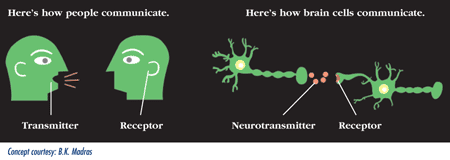
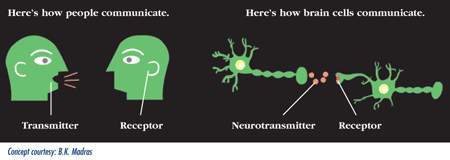
    Each nerve cell in the brain sends and receives messages in the form of electrical and chemical signals. Once a cell receives and processes a message, it sends it on to other neurons.
  • Neurotransmitters – The Brain’s Chemical Messengers
    The messages are typically carried between neurons by chemicals called neurotransmitters.
  • Receptors – The Brain’s Chemical Receivers
    The neurotransmitter attaches to a specialized site on the receiving neuron called a receptor. A neurotransmitter and its receptor operate like a “key and lock,” an exquisitely specific mechanism that ensures that each receptor will forward the appropriate message only after interacting with the right kind of neurotransmitter.
  • Transporters – The Brain’s Chemical Recyclers
    Located on the neuron that releases the neurotransmitter, transporters recycle these neurotransmitters (that is, bring them back into the neuron that released them), thereby shutting off the signal between neurons. soa_013.gif

To send a message, a brain cell (neuron) releases a chemical (neurotransmitter) into the space (synapse) between it and the next cell. The neurotransmitter crosses the synapse and attaches to proteins (receptors) on the receiving brain cell. This causes changes in the receiving cell—the message is delivered.

How do drugs work in the brain?

Drugs are chemicals that affect the brain by tapping into its communication system and interfering with the way neurons normally send, receive, and process information. Some drugs, such as marijuana and heroin, can activate neurons because their chemical structure mimics that of a natural neurotransmitter. This similarity in structure “fools” receptors and allows the drugs to attach onto and activate the neurons. Although these drugs mimic the brain’s own chemicals, they don’t activate neurons in the same way as a natural neurotransmitter, and they lead to abnormal messages being transmitted through the network.

Other drugs, such as amphetamine or cocaine, can cause the neurons to release abnormally large amounts of natural neurotransmitters or prevent the normal recycling of these brain chemicals. This disruption produces a greatly amplified message, ultimately disrupting communication channels.

How do drugs work in the brain to produce pleasure?

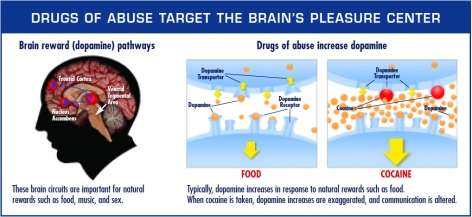
Most drugs of abuse directly or indirectly target the brain’s reward system by flooding the circuit with dopamine. Dopamine is a neurotransmitter present in regions of the brain that regulate movement, emotion, motivation, and feelings of pleasure. When activated at normal levels, this system rewards our natural behaviors. Overstimulating the system with drugs, however, produces euphoric effects, which strongly reinforce the behavior of drug use—teaching the user to repeat it.

Most drugs of abuse target the brain’s reward system by flooding it with dopamine.

soa_014_large

How does stimulation of the brain’s pleasure circuit teach us to keep taking drugs?

Our brains are wired to ensure that we will repeat life-sustaining activities by associating those activities with pleasure or reward. Whenever this reward circuit is activated, the brain notes that something important is happening that needs to be remembered, and teaches us to do it again and again without thinking about it. Because drugs of abuse stimulate the same circuit, we learn to abuse drugs in the same way.

Why are drugs more addictive than natural rewards?

When some drugs of abuse are taken, they can release 2 to 10 times the amount of dopamine that natural rewards such as eating and sex do.15 In some cases, this occurs almost immediately (as when drugs are smoked or injected), and the effects can last much longer than those produced by natural rewards. The resulting effects on the brain’s pleasure circuit dwarf those produced by naturally rewarding behaviors.16,17The effect of such a powerful reward strongly motivates people to take drugs again and again. This is why scientists sometimes say that drug abuse is something we learn to do very, very well.

Long-term drug abuse impairs brain functioning.

What happens to your brain if you keep taking drugs?

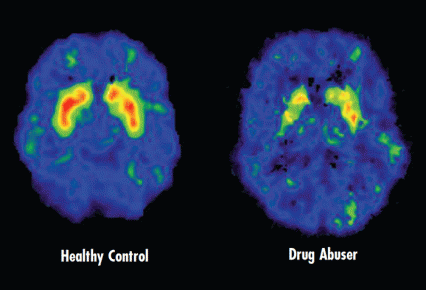
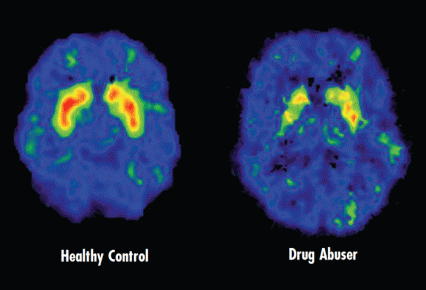
For the brain, the difference between normal rewards and drug rewards can be described as the difference between someone whispering into your ear and someone shouting into a microphone. Just as we turn down the volume on a radio that is too loud, the brain adjusts to the overwhelming surges in dopamine (and other neurotransmitters) by producing less dopamine or by reducing the number of receptors that can receive signals. As a result, dopamine’s impact on the reward circuit of the brain of someone who abuses drugs can become abnormally low, and that person’s ability to experience anypleasure is reduced.

This is why a person who abuses drugs eventually feels flat, lifeless, and depressed, and is unable to enjoy things that were previously pleasurable. Now, the person needs to keep taking drugs again and again just to try and bring his or her dopamine function back up to normal—which only makes the problem worse, like a vicious cycle. Also, the person will often need to take larger amounts of the drug to produce the familiar dopamine high—an effect known as tolerance.

Decreased Dopamine Transporters in a Methamphetamine Abuser18

soa_015.gif

How does long-term drug taking affect brain circuits?

We know that the same sort of mechanisms involved in the development of tolerance can eventually lead to profound changes in neurons and brain circuits, with the potential to severely compromise the long-term health of the brain. For example, glutamate is another neurotransmitter that influences the reward circuit and the ability to learn. When the optimal concentration of glutamate is altered by drug abuse, the brain attempts to compensate for this change, which can cause impairment in cognitive function. Similarly, long-term drug abuse can trigger adaptations in habit or non-conscious memory systems. Conditioning is one example of this type of learning, in which cues in a person’s daily routine or environment become associated with the drug experience and can trigger uncontrollable cravings whenever the person is exposed to these cues, even if the drug itself is not available. This learned “reflex” is extremely durable and can affect a person who once used drugs even after many years of abstinence.

What other brain changes occur with abuse?

Chronic exposure to drugs of abuse disrupts the way critical brain structures interact to control and inhibit behaviors related to drug use. Just as continued abuse may lead to tolerance or the need for higher drug dosages to produce an effect, it may also lead to addiction, which can drive a user to seek out and take drugs compulsively. Drug addiction erodes a person’s self-control and ability to make sound decisions, while producing intense impulses to take drugs.

Study brain can be trained in compassion

17 Thursday Sep 2020

Posted by RichardB in brain, Meditation, mindfulness, Wellness

≈ Comments Off on Study brain can be trained in compassion

Tags

behavior, compassion, mindfulness

Researchers at the Center for Investigating Healthy Minds at the Waisman Center of the University of Wisconsin-Madison examined whether training adults in compassion can result in greater altruistic behavior and related changes in neural systems underlying compassion.
In the study, the investigators trained young adults to engage in compassion meditation, an ancient Buddhist technique to increase caring feelings for people who are suffering.
In the meditation, participants envisioned a time when someone has suffered and then practiced wishing that his or her suffering was relieved.8d337-260291_10151674843907518_1073142538_n
Participants practiced with different categories of people, first starting with a loved one, someone whom they easily felt compassion for, like a friend or family member. Then, they practiced compassion for themselves and a stranger.
Finally, they practiced compassion for someone they actively had conflict with called the “difficult person”, such as a troublesome coworker or roommate.
“It’s kind of like weight training. Using this systematic approach, we found that people can actually build up their compassion ‘muscle’ and respond to others’ suffering with care and a desire to help,” said Helen Weng, lead author of the study and a graduate student in clinical psychology.
Compassion training was compared to a control group that learned cognitive reappraisal, a technique where people learn to reframe their thoughts to feel less negative.
“We wanted to investigate whether people could begin to change their emotional habits in a relatively short period of time,” said Weng.
The real test of whether compassion could be trained was to see if people would be willing to be more altruistic – even helping people they had never met.
“We found that people trained in compassion were more likely to spend their own money altruistically to help someone who was treated unfairly than those who were trained in cognitive reappraisal,” Weng said.
The study measured changes in brain responses using functional magnetic resonance imaging (fMRI) before and after training.
The researchers found that the people who were the most altruistic after compassion 260291_10151674843907518_1073142538_ntraining were the ones who showed the most brain changes when viewing human suffering.
They found that activity was increased in the inferior parietal cortex, a region involved in empathy and understanding others.
Compassion training also increased activity in the dorsolateral prefrontal cortex and the extent to which it communicated with the nucleus accumbens, brain regions involved in emotion regulation and positive emotions.

Drugs and the Brain

25 Tuesday Aug 2020

Posted by RichardB in brain, Creative Therapy Tools, drugs

≈ Comments Off on Drugs and the Brain

Tags

brain

The human brain is the most complex organ in the body. This three-pound mass of gray and white matter sits at the center of all human activity—you need it to drive a car, to enjoy a meal, to breathe, to create an artistic masterpiece, and to enjoy everyday activities. In brief, the brain regulates your body’s basic functions; enables you to interpret and respond to everything you experience; and shapes your thoughts, emotions, and behavior.

The brain is made up of many parts that all work together as a team. Different parts of the brain are responsible for coordinating and performing specific functions. Drugs can alter important brain areas that are necessary for life-sustaining functions and can drive the compulsive drug abuse that marks addiction. Brain areas affected by drug abuse include:

  • The brain stem, which controls basic functions critical to life, such as heart rate, breathing, and sleeping.
  • The cerebral cortex, which is divided into areas that control specific functions. Different areas process information from our senses, enabling us to see, feel, hear, and taste. The front part of the cortex, the frontal cortex or forebrain, is the thinking center of the brain; it powers our ability to think, plan, solve problems, and make decisions.
  • The limbic system, which contains the brain’s reward circuit. It links together a number of brain structures that control and regulate our ability to feel pleasure. Feeling pleasure motivates us to repeat behaviors that are critical to our existence. The limbic system is activated by healthy, life-sustaining activities such as eating and socializing—but it is also activated by drugs of abuse. In addition, the limbic system is responsible for our perception of other emotions, both positive and negative, which explains the mood-altering properties of many drugs.

How do the parts of the brain communicate?

The brain is a communications center consisting of billions of neurons, or nerve cells. Networks of neurons pass messages back and forth among different structures within the brain, the spinal cord, and nerves in the rest of the body (the peripheral nervous system). These nerve networks coordinate and regulate everything we feel, think, and do.

  • Neuron to Neuron
    Each nerve cell in the brain sends and receives messages in the form of electrical and chemical signals. Once a cell receives and processes a message, it sends it on to other neurons.
  • Neurotransmitters – The Brain’s Chemical Messengers
    The messages are typically carried between neurons by chemicals called neurotransmitters.
  • Receptors – The Brain’s Chemical Receivers
    The neurotransmitter attaches to a specialized site on the receiving neuron called a receptor. A neurotransmitter and its receptor operate like a “key and lock,” an exquisitely specific mechanism that ensures that each receptor will forward the appropriate message only after interacting with the right kind of neurotransmitter.
  • Transporters – The Brain’s Chemical Recyclers
    Located on the neuron that releases the neurotransmitter, transporters recycle these neurotransmitters (that is, bring them back into the neuron that released them), thereby shutting off the signal between neurons.

soa_013.gif

To send a message, a brain cell (neuron) releases a chemical (neurotransmitter) into the space (synapse) between it and the next cell. The neurotransmitter crosses the synapse and attaches to proteins (receptors) on the receiving brain cell. This causes changes in the receiving cell—the message is delivered.

How do drugs work in the brain?

Drugs are chemicals that affect the brain by tapping into its communication system and interfering with the way neurons normally send, receive, and process information. Some drugs, such as marijuana and heroin, can activate neurons because their chemical structure mimics that of a natural neurotransmitter. This similarity in structure “fools” receptors and allows the drugs to attach onto and activate the neurons. Although these drugs mimic the brain’s own chemicals, they don’t activate neurons in the same way as a natural neurotransmitter, and they lead to abnormal messages being transmitted through the network.

Other drugs, such as amphetamine or cocaine, can cause the neurons to release abnormally large amounts of natural neurotransmitters or prevent the normal recycling of these brain chemicals. This disruption produces a greatly amplified message, ultimately disrupting communication channels.

How do drugs work in the brain to produce pleasure?

Most drugs of abuse directly or indirectly target the brain’s reward system by flooding the circuit with dopamine. Dopamine is a neurotransmitter present in regions of the brain that regulate movement, emotion, motivation, and feelings of pleasure. When activated at normal levels, this system rewards our natural behaviors. Overstimulating the system with drugs, however, produces euphoric effects, which strongly reinforce the behavior of drug use—teaching the user to repeat it.

Most drugs of abuse target the brain’s reward system by flooding it with dopamine.

soa_014_large

How does stimulation of the brain’s pleasure circuit teach us to keep taking drugs?

Our brains are wired to ensure that we will repeat life-sustaining activities by associating those activities with pleasure or reward. Whenever this reward circuit is activated, the brain notes that something important is happening that needs to be remembered, and teaches us to do it again and again without thinking about it. Because drugs of abuse stimulate the same circuit, we learn to abuse drugs in the same way.

Why are drugs more addictive than natural rewards?

When some drugs of abuse are taken, they can release 2 to 10 times the amount of dopamine that natural rewards such as eating and sex do.15 In some cases, this occurs almost immediately (as when drugs are smoked or injected), and the effects can last much longer than those produced by natural rewards. The resulting effects on the brain’s pleasure circuit dwarf those produced by naturally rewarding behaviors.16,17The effect of such a powerful reward strongly motivates people to take drugs again and again. This is why scientists sometimes say that drug abuse is something we learn to do very, very well.

Long-term drug abuse impairs brain functioning.

What happens to your brain if you keep taking drugs?

For the brain, the difference between normal rewards and drug rewards can be described as the difference between someone whispering into your ear and someone shouting into a microphone. Just as we turn down the volume on a radio that is too loud, the brain adjusts to the overwhelming surges in dopamine (and other neurotransmitters) by producing less dopamine or by reducing the number of receptors that can receive signals. As a result, dopamine’s impact on the reward circuit of the brain of someone who abuses drugs can become abnormally low, and that person’s ability to experience anypleasure is reduced.

This is why a person who abuses drugs eventually feels flat, lifeless, and depressed, and is unable to enjoy things that were previously pleasurable. Now, the person needs to keep taking drugs again and again just to try and bring his or her dopamine function back up to normal—which only makes the problem worse, like a vicious cycle. Also, the person will often need to take larger amounts of the drug to produce the familiar dopamine high—an effect known as tolerance.

Decreased Dopamine Transporters in a Methamphetamine Abuser18

soa_015.gif

How does long-term drug taking affect brain circuits?

We know that the same sort of mechanisms involved in the development of tolerance can eventually lead to profound changes in neurons and brain circuits, with the potential to severely compromise the long-term health of the brain. For example, glutamate is another neurotransmitter that influences the reward circuit and the ability to learn. When the optimal concentration of glutamate is altered by drug abuse, the brain attempts to compensate for this change, which can cause impairment in cognitive function. Similarly, long-term drug abuse can trigger adaptations in habit or non-conscious memory systems. Conditioning is one example of this type of learning, in which cues in a person’s daily routine or environment become associated with the drug experience and can trigger uncontrollable cravings whenever the person is exposed to these cues, even if the drug itself is not available. This learned “reflex” is extremely durable and can affect a person who once used drugs even after many years of abstinence.

What other brain changes occur with abuse?

Chronic exposure to drugs of abuse disrupts the way critical brain structures interact to control and inhibit behaviors related to drug use. Just as continued abuse may lead to tolerance or the need for higher drug dosages to produce an effect, it may also lead to addiction, which can drive a user to seek out and take drugs compulsively. Drug addiction erodes a person’s self-control and ability to make sound decisions, while producing intense impulses to take drugs.

3 Dietary Interventions that Can Help Children with ADHD

30 Thursday Jul 2020

Posted by RichardB in brain, food, Research, Wellness

≈ Comments Off on 3 Dietary Interventions that Can Help Children with ADHD

Tags

ADHD, diet, food, kids, wellness

Are dietary inter­ven­tions effec­tive for treat­ing ADHD? For many par­ents and pro­fes­sion­als, try­ing to parse through the dif­fer­ent claims about the impact of diet on ADHD has been chal­leng­ing and confusing. At this point, sub­stan­tial research on how dietary inter­ven­tions impact ADHD has accu­mu­lated and sev­eral meta-analyses of this work have been pub­lished. Recently, a review of sev­eral meta-analyses of dietary inter­ven­tions for ADHD was pub­lished [Research review: The role of diet in the treat­ment of attention-deficit/hyper­ac­tiv­ity dis­or­der — an appraisal of the evi­dence on effi­cacy and rec­om­men­da­tions on the design of future stud­ies]. In this paper, the authors sum­ma­rize find­ings across 6 dif­fer­ent meta-analyses of the impact of diet on ADHD to pro­vide a high level sum­mary of the best avail­able evi­dence to date.

Types of dietary interventions j0430914

Three types of dietary inter­ven­tions were reviewed — Restricted Elim­i­na­tion Diets (RED), Arti­fi­cial food col­or­ing exclu­sion (AFCE), and sup­ple­men­ta­tion with free fatty acids (SFFA). Although other types of sup­ple­ments beyond free fatty acids have been inves­ti­gated, the authors felt there was not suf­fi­cient research on any sin­gle approach to include in their summary.

1. Restricted elim­i­na­tion diets (RED) — There are 2 dif­fer­ent approaches to imple­ment­ing this diet. In one approach, the child is placed on an extremely restricted diet, e.g., rice, turkey, a range of veg­eta­bles (let­tuce, car­rots, cau­li­flower, cab­bage, beets), pears and water; this is some­times referred to as the Few Food Diet. When a reduc­tion in ADHD behav­iors results — this would gen­er­ally occur within 2–3 weeks if the diet is going to have a pos­i­tive effect — new foods can be added back one at a time to see if they are well-tolerated or lead to an increase in prob­lem behav­iors. Alter­na­tively, par­tic­u­lar foods that are sus­pected to exac­er­bate a child’s symp­toms may be removed one at a time to see if the child’s behav­ior improves.

2. Arti­fi­cial food col­or­ing exclu­sion (AFCE)- As the title indi­cates, this involves efforts to remove all arti­fi­cial food col­or­ings from a child’s diet, e.g.,Yellow #6, Yel­low #5, Sodium Ben­zoate, Blue #2, etc., and observ­ing whether this is asso­ci­ated with a reduc­tion in ADHD behav­iors. Care­fully con­ducted tri­als have demon­strated that AFC’s – in amounts chil­dren could typ­i­cally con­sume – can increase ADHD symp­toms in many children.

3. Essen­tial fatty acid sup­ple­men­ta­tion — Cer­tain fatty acids, e.g., Omega 3 and Omega 6, pro­mote neural func­tion­ing. These fatty acids are called essen­tial because they are not syn­the­sized in the body and must be ingested. Chil­dren with ADHD may have lower lev­els of essen­tial fatty acids rel­a­tive to peers and sev­eral stud­ies have demon­strated a link between low lev­els of EFAs and the sever­ity of ADHD symp­toms. Stud­ies inves­ti­gat­ing the ben­e­fits of fatty acid sup­ple­men­ta­tion for youth with ADHD raise fatty acid lev­els by admin­is­ter­ing cap­sules con­tain­ing the fatty acids or some­times by intro­duc­ing diets rich in fish products. – See more at: http://www.creativitypost.com/science/3_dietary_interventions_that_can_help_children_with_adhd_especially_when_pr

Meditation Reduces Anxiety

16 Thursday Jul 2020

Posted by RichardB in brain, Meditation, mindfulness, Psychoeducation, Relaxation, Research, Stress, Wellness

≈ Comments Off on Meditation Reduces Anxiety

Tags

meditation, mindfulness, relaxation, research

Scientists at Wake Forest Baptist Medical Center have identified the brain functions involved in how meditation reduces anxiety.

The team wrote in the journal Social Cognitive and Affective Neuroscience about how they studied 15 healthy volunteers with normal levels of everyday anxiety. They said these individuals had no previous meditation experience or anxiety disorders.

Signature:baed3687aecc9fc02b05e033f52ab04b5ac34144c6f0702c4e0cfe36f9d34041

Signature:baed3687aecc9fc02b05e033f52ab04b5ac34144c6f0702c4e0cfe36f9d34041

The participants took four 20-minute classes to learn a technique known as mindfulness meditation. In this form of meditation, people are taught to focus on breath and body sensations and to non-judgmentally evaluate distracting thoughts and emotions.

“Although we´ve known that meditation can reduce anxiety, we hadn´t identified the specific brain mechanisms involved in relieving anxiety in healthy individuals,” said Dr. Fadel Zeidan, Ph.D., postdoctoral research fellow in neurobiology and anatomy at Wake Forest Baptist and lead author of the study. “In this study, we were able to see which areas of the brain were activated and which were deactivated during meditation-related anxiety relief.”

The researchers found that meditation reduced anxiety ratings by as much as 39 percent in the participants.

“This showed that just a few minutes of mindfulness meditation can help reduce normal everyday anxiety,” Zeidan said.

Fadel and colleagues were also able to reveal that meditation-related anxiety relief is associated with activation of the anterior cingulate cortex and ventromedial prefrontal cortex, which are areas of the brain involved with executive-level function.

“Mindfulness is premised on sustaining attention in the present moment and controlling the way we react to daily thoughts and feelings,” Zeidan said. “Interestingly, the present findings reveal that the brain regions associated with meditation-related anxiety relief are remarkably consistent with the principles of being mindful.”

He said the results of this neuroimaging experiment complement that body of knowledge by showing the brain mechanisms associated with meditation-related anxiety relief in healthy people.

Scientists wrote in the journal Frontiers in Human Neuroscience in November 2012 about how meditation has lasting emotional benefits. They found that participating in an eight-week meditation training program could have measurable effects on how the brain functions, even when someone is not actively meditating. The team used two forms of meditation training and saw some differences in the response of the amygdala, which is the part of the brain known to be important for emotion.

Brain System For Emotional Self-Control

09 Thursday Jul 2020

Posted by RichardB in brain, Cognitive behavioral therapy, grounding, Health, Mental Health

≈ Comments Off on Brain System For Emotional Self-Control

Tags

study

Different brain areas are activated when we choose to suppress an emotion, compared to when we are instructed to inhibit an emotion, according a new study from the UCL Institute of Cognitive Neuroscience and Ghent University.
In this study, published in Brain Structure and Function, the researchers scanned the brains of healthy participants and found that key brain systems were activated when choosing for oneself to suppress an emotion. They had previously linked this brain area to deciding to inhibit movement.
“This result shows that emotional self-control involves a quite different brain system from simply being told how to respond emotionally,” said lead author Dr Simone Kuhn (Ghent University).5a045-18
In most previous studies, participants were instructed to feel or inhibit an emotional response. However, in everyday life we are rarely told to suppress our emotions, and usually have to decide ourselves whether to feel or control our emotions.
In this new study the researchers showed fifteen healthy women unpleasant or frightening pictures. The participants were given a choice to feel the emotion elicited by the image, or alternatively to inhibit the emotion, by distancing themselves through an act of self-control.
The researchers used functional magnetic resonance imaging (fMRI) to scan the brains of the participants. They compared this brain activity to another experiment where the participants were instructed to feel or inhibit their emotions, rather than choose for themselves.
Different parts of the brain were activated in the two situations. When participants decided for themselves to inhibit negative emotions, the scientists found activation in the dorso-medial prefrontal area of the brain. They had previously linked this brain area to deciding to inhibit movement.
In contrast, when participants were instructed by the experimenter to inhibit the emotion, a second, more lateral area was activated.
“We think controlling one’s emotions and controlling one’s behavior involve overlapping mechanisms,” said Dr Kuhn.
“We should distinguish between voluntary and instructed control of emotions, in the same way as we can distinguish between making up our own mind about what do, versus following instructions.”
Regulating emotions is part of our daily life, and is important for our mental health. For example, many people have to conquer fear of speaking in public, while some professionals such as health-care workers and firemen have to maintain an emotional distance from unpleasant or distressing scenes that occur in their jobs.
tivityProfessor Patrick Haggard (UCL Institute of Cognitive Neuroscience) co-author of the paper said the brain mechanism identified in this study could be a potential target for therapies.
“The ability to manage one’s own emotions is affected in many mental health conditions, so identifying this mechanism opens interesting possibilities for future research.
“Most studies of emotion processing in the brain simply assume that people passively receive emotional stimuli, and automatically feel the corresponding emotion. In contrast, the area we have identified may contribute to some individuals’ ability to rise above particular emotional situations.
“This kind of self-control mechanism may have positive aspects, for example making people less vulnerable to excessive emotion. But altered function of this brain area could also potentially lead to difficulties in responding appropriately to emotional situations.”

the creative individual

09 Thursday Jul 2020

Posted by RichardB in brain, Creativity

≈ Comments Off on the creative individual

People are more creative than others and are literally bubbling with ideas, while others rarely or never show signs of creativity. What should we look for when searching for creative people?
Creativity can quite simply be defined as the capacity to come up with new ideas to serve a purpose. Creativity is thus one of the most important sources of renewal. Creativity contributes to innovation and improvements in working life, commerce and industry.

No wonder employers want creative employees in areas where it is essential to come up with proposals for new products and services, and new ways of doing things.
The creative personality
Professor Øyvind L. Martinsen at BI Norwegian Business School has conducted a study to develop a personality profile for creative people: Which personality traits characterize creative people?
The study was conducted with 481 people with different backgrounds. The segment consists of various groups of more or less creative people.

  • The first group of creative people consists of 69 artists working as actors or musicians in a well-known symphony orchestra or are members of an artist’s organization with admission requirements.
  • The second group of creative people consists of 48 students of marketing.
  • The remaining participants in the study are managers, lecturers and students in programs that are less associated with creativity than marketing.

The creativity researcher mapped the participants’ personality traits and tested their creative abilities and skills through various types of tasks.
Seven creativity characteristics
In his study Martinsen identifies seven paramount personality traits that characterize creative people:
• 1. Associative orientation: Imaginative, playful, have a wealth of ideas, ability to be committed, sliding transitions between fact and fiction.
• 2. Need for originality: Resists rules and conventions. Have a rebellious attitude due to a need to do things no one else does.
• 3. Motivation: Have a need to perform, goal-oriented, innovative attitude, stamina to tackle difficult issues.
• 4. Ambition: Have a need to be influential, attract attention and recognition.
• 5. Flexibility: Have the ability to see different aspects of issues and come up with optional solutions.
• 6. Low emotional stability: Have a tendency to experience negative emotions, greater fluctuations in moods and emotional state, failing self-confidence.
• 7. Low sociability: Have a tendency not to be very considerate, are obstinate and find faults and flaws in ideas and people.
Among the seven personality traits, associative orientation and flexibility are the factors that to the greatest extent lead to creative thinking.
“Associative orientation is linked to ingenuity. Flexibility is linked to insight,” says the professor. The other five characteristics describe emotional inclinations and motivational factors that influence creativity or spark an interest in creativity.
“The seven personality traits influence creative performance through inter-action,” Martinsen points out.
Øyvind L. Martinsen. The Creative Personality: A Synthesis and Development of the Creative Person Profile. Creativity Research Journal, 2011; 23 (3): 185 DOI: 10.1080/10400419.2011.595656


Brain Map

28 Thursday May 2020

Posted by RichardB in brain, mental health, research

≈ 1 Comment

Tags

brain, learn, map

See the interactive Brain Map here.

brainmapy.png


Artists have differently structured brains

21 Thursday May 2020

Posted by RichardB in artists, brain, Research

≈ Comments Off on Artists have differently structured brains

Coloured brain pathwaysBrain scans revealed artists have more grey matter in parts of their brains

Artists have structurally different brains compared with non-artists, a study has found.

Participants’ brain scans revealed that artists had increased neural matter in areas relating to fine motor movements and visual imagery.

The research, published in NeuroImage, suggests that an artist’s talent could be innate.

But training and environmental upbringing also play crucial roles in their ability, the authors report.

As in many areas of science, the exact interplay of nature and nurture remains unclear.

Lead author Rebecca Chamberlain from KU Leuven, Belgium, said she was interested in finding out how artists saw the world differently.

“The people who are better at drawing really seem to have more developed structures in regions of the brain that control for fine motor performance and what we call procedural memory,” she explained.

In their small study, researchers peered into the brains of 21 art students and compared them to 23 non-artists using a scanning method called voxel-based morphometry.

Detail of 'Giant Lobster' from NHM specimen collectionOne artist who has practiced for many years is Alice Shirley – here is a detail of her Giant Lobster

These detailed scans revealed that the artist group had significantly more grey matter in an area of the brain called the precuneus in the parietal lobe.

“This region is involved in a range of functions but potentially in things that could be linked to creativity, like visual imagery – being able to manipulate visual images in your brain, combine them and deconstruct them” .

‘I grew up in an arty family’

Alice Shirley – artist

“I had a very arty family. My mother was an art historian and my dad a photographer.

“I grew up surrounded by art and was encouraged to draw from a very young age, and I liked it so I did more of it. It was a combination of encouragement and enthusiasm that made me interested in pursuing art.

“It’s just in the blood.”


Participants also completed drawing tasks and the team looked at the relationship between their performance in this task and their grey and white matter.

A changing brain

Those better at drawing had increased grey and white matter in the cerebellum and also in the supplementary motor area – both areas that are involved with fine motor control and performance of routine actions.

Grey matter is largely composed of nerve cells, while white matter is responsible for communication between the grey matter regions.

But it is still not clear what this increase of neural matter might mean. From looking at related studies of other creative people, such as musicians, it suggests that these individuals have enhanced processing in these areas, Dr Chamberlain added.

“It falls into line with evidence that focus of expertise really does change the brain. The brain is incredibly flexible in response to training and there are huge individual differences that we are only beginning to tap into.”

A life-size drawing of the giant squid specimen in the NHM collection, painted in fresh squid ink

Another author of the paper, Chris McManus from University College London, said it was difficult to distinguish what aspect of artistic talent was innate or learnt.

“We would need to do further studies where we look at teenagers and see how they develop in their drawing as they grow older – but I think [this study] has given us a handle on how we could begin to look at this.”

Commenting on the small sample size, Prof McManus said: “Since the results were statistically significant then clearly there was the power to find something, which almost by definition means it was large enough.

“And also of interest is that other people have also had hints at effects in similar locations. Obviously in an ideal world we’d like 1000 subjects, but that isn’t realistic. It’s always a compromise between cost, practicality and interest.”

No ‘right’ side

Ellen Winner of Boston College, US, who was not involved with the study, commented that it was very interesting research.

She said it should help “put to rest the facile claims that artists use ‘the right side of their brain’ given that increased grey and white matter were found in the art group in both left and right structures of the brain”.

“Only a prospective study could get at the question of innate structural brain differences that predispose people to become visual artists, and this kind of study has not been done as it would be very difficult and very expensive to carry out.”

insight

05 Tuesday May 2020

Posted by RichardB in brain, create, creative

≈ Comments Off on insight

Among other characteristics that typically distinguish insight from “noninsight” solutions, people feel stuck before insight strikes; they can’t explain how they solved the problem and might say they were not even thinking about it; the solution appears suddenly and is immediately seen as correct. But are the neural processes involved in arriving at a solution through insight actually distinct from those related to more mundane problem-solving?


Recent findings suggest that people think about solutions, at an unconscious level, prior to solving insight problems, and that the right cerebral hemisphere (RH) appears to be preferentially involved. Jung-Beeman et al. predicted that a particular region of the RH, called the anterior superior temporal gyrus (aSTG), is likely involved in insight because it seems critical for tasks that require recognizing broad associative semantic relationships—exactly the type of process that could facilitate reinterpretation of problems and lead to insight.
verysmallBrain-0022

The Brain,left,right and tested.

09 Thursday Apr 2020

Posted by RichardB in brain, Health, test, Therapy, Wellness

≈ Comments Off on The Brain,left,right and tested.

Tags

brain, left, right, test

Do you know what the attributes of your right and left sides of your brain?  Listed below are the common elements of left and right brain hemisphere’s. Plus go here to take the left/right side brain test to see    which side may be dominant.

Left Hemisphere – Rational

Responds to verbal instructions
Problem solves by logically and sequentially looking at the parts of things
Looks at differences
Is planned and structured
Prefers established, certain information260291_10151674843907518_1073142538_n
Prefers talking and writing
Prefers multiple choice tests
Controls feelings
Prefers ranked authority structures

Right Hemisphere – Intuitive

Responds to demonstrated instructions
Problem solves with hunches, looking for patterns and configurations
Looks at similarities
Is fluid and spontaneous
Prefers elusive, uncertain information
Prefers drawing and manipulating objects
Prefers open ended questions
Free with feelings
Prefers collegial authority structures

It seems that lots of folks have emailed me about all sorts of other left/right side brain tests/quizzes online.  Here are the top 2 tests.

Hemispheric Dominance Inventory Test: This test has 18 questions and you choice between 2 answers. I like the questions they seem interesting and thought provoking.

Right Brain vs Left Brain Creativity Test: This test of 54 questions is multiple choice with 4 choices and all of the questions are on one page like the test above. Some repeating of questions, which is fairly standard in personality type tests.

Intelligence, creativity and brain function

31 Tuesday Mar 2020

Posted by RichardB in brain, creative, mental health, Neuroscience, research

≈ Comments Off on Intelligence, creativity and brain function

Tags

brain function, Creativity, Intelligence

Do you have to be intelligent to be creative? Can you learn to be more creative? In this episode, we speak with neuropsychologist Rex E. Jung, PhD, who studies intelligence, creativity and brain function. He discusses why – even if it sounds counterintuitive – intelligence and creativity may not have all that much in common.

Transcript of interview with Audrey and Rex Jung from the APA website.

Audrey Hamilton: Do you have to be intelligent to be creative? Can you really learn to be more creative? In this episode, we speak with one neuropsychologist who studies intelligence, creativity and brain function. He talks about why – even if it sounds counterintuitive – intelligence and creativity may not have all that much in common. I’m Audrey Hamilton and this is “Speaking of Psychology.”

Rex Jung is an assistant professor of neurosurgery at the University of New Mexico and a practicing clinical neuropsychologist in Albuquerque. He studies both brain disease and what the brain does well – a field of research known as positive neuroscience. His research is designed to relate behavioral measures, including intelligence, personality and creativity to brain function and structure. He has published research articles across a wide-range of topics including traumatic brain injury, lupus, schizophrenia, intelligence and creativity. Welcome, Dr. Jung.creative-art-brain-300x300
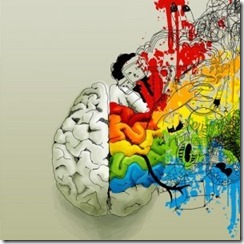
Rex Jung: Thank you, Audrey.

Audrey Hamilton: Could you first of all explain neuroimaging and tell our listeners how it helps researchers understand how people think and act?

Rex Jung: Sure. So, neuroimaging is the tool that we use to measure the brain and there’s lots of different neuroimaging techniques. I use three main neuroimaging techniques – the first that I learned in graduate school was magnetic resonance microscopy, which sounds kind of complicated. But, it is a technique that basically looks at the chemicals in your brain. It’s in a standard MRI machine like you would go to get your knee scanned. But, using some sophisticated techniques you can look at certain chemicals in the brain. Some of those chemicals are very involved in important neuronal processes. And we’ve correlated those with behavior.

A different technique is called diffusion tensor imaging, which allows us to look at water movement in the brain. And this is important because there’s lots of tubes going through your brain like the wires that connect up your computer to the Internet. And these tubes, called axons, are connecting up different processing modules of your brain and those have to be healthy. So, we can look at the health of those axons, those myelinated axons, the fatty sheath like the insulation that surrounds those tubes.

The third technique that we use is just structural magnetic resonance imaging and that allows us to look at the processing modules of the brain – the cortical thickness – the computers that are on the surface of the brain and how much or little of that you have on the surface of the brain. Those are the three main techniques that I use. There’s functional imaging, fMRI, that most people have heard of where you’re looking a blood flow, as well. Those are ways that we measure brain structure and function and this gives us the ability to do scientific measures that then we can correlate to behavioral measures in psychology.

Audrey Hamilton: Does being highly creative mean you’re also more intelligent?

Rex Jung: Not necessarily. There’s a controversy about this in the psychological literature and some people have found correlations between creativity and intelligence. They’re usually pretty low, this association. And some people make a lot of that, this low association. But usually, because this association between creativity and intelligence is low, it means that you don’t necessarily have to be intelligent to be creative. So, I spent over a decade studying intelligence. It’s one of the reasons I started studying creativity because it seemed like something distinctly different and interesting than intelligence, which I have studied. I work with very highly intelligent people in academia and scientists and not all of them are creative. Why is that? If they do go together I would be working with all of the creative people in my city in Albuquerque, but that wasn’t the case so creativity seemed to be something different.

Audrey Hamilton: Can a person learn to become more creative or simply gain intelligence?

Rex Jung: There are some tools and techniques that can help people to be more creative. We’re starting to learn more about creativity and it’s one of the things that I’m excited about in terms of creativity is that there might be ways to increase your creative capacity.

Intelligence unfortunately seems to be much more under tight genetic control. The genetic correlates of intelligence are high, like .75. So, if you have twins – they’re going to be identical twins – their correlation of their intelligence with one another is going to be very, very high. So that implies that the genetic involvement of that capacity is under much more tight control than the environment would be.

With creativity, we don’t have that information and I’m hopeful that you can modulate or modify creative cognition much more than intelligence. There are studies out there that have shown increases in intelligence scores of two, maybe three points on a particular measure, which are not particularly high. But those are also controversial. Some have been replicated. Some haven’t been replicated. And we really don’t see that in terms of intelligence. With creativity, there’s a pitched effort to try to increase creativity scores on some of these measures and we’re seeing some good initial results and I’m very hopeful about that.

Audrey Hamilton: How does the way a person’s brain works and is structured influence how creative or intelligent he or she is?

Rex Jung: The research that we’ve done shows that the brain organization of intelligence and creativity are quite different. So, when you think about those measures that I talked about, those neuroimaging measures, the brain of someone who is intelligent – think of bigger, better, stronger, faster – all the measures are pointing to higher integrity of the brain of someone who has high intelligence. So, the cortical mantle is thicker, the white matter, the wires are more myelinated, the water can travel faster and in a coherent direction, you have more of these certain chemicals that I was talking about.

crAudrey Hamilton: It’s beefed up.

Rex Jung: It’s beefed up, yes. So you can have a better organized brain.

With creativity, the story was different. In different regions of the brain, we were seeing weaker connections, thinner cortex and different levels of these same biochemicals. So, it was really clear from these studies that intelligence and creativity were different because we were seeing different pictures in the measures we were taking of the brain. But I tend to look at creativity and intelligence as two different kinds of reasoning. That creativity is kind of reasoning without all of the information present. So, call it abductive reasoning. But, you have hypothesis testing about how the world could work without all of the information present. So, you have to use abstraction and metaphor and stuff like that about this might look like this or this might be this way.

With intelligence, you’re using deductive reasoning, where it’s rule-based reasoning where a equals b and that’s the way it goes. You have a rule for how this relationship works. So, creativity and intelligence are probably different types of reasoning. Both are very adaptive, but they’re just different for different types of problems that you have to solve out in the world.

Audrey Hamilton: Is real creativity rare? How about genius?

Rex Jung: So, creativity is common and genius is a lot more rare than we would believe. The term genius gets thrown around a lot. But, I think genius is rare because that combination of brain organization where you have high fidelity, beefed up brain in certain regions and then kind of down regulated brain in other regions is really going to be kind of rare where that is present in the same brain. So, to have that back and forth between intelligence and creativity, the ability to do both of those reasoning processes well, where you can do first approximations, hypothesis testing, abstraction and then create a rule, a novel and useful rule out of nothing before is rare and that is true genius.

Audrey Hamilton: Well great. Thank you so much for joining us, Dr. Jung. It’s been very, very interesting.

Rex Jung: Great. Thank you, Audrey.

Problem solving

26 Thursday Mar 2020

Posted by RichardB in brain, creative

≈ Comments Off on Problem solving

Characteristics that typically distinguish insight from “noninsight” solutions, people feel stuck before insight strikes; they can’t explain how they solved the problem and might say they were not even thinking about it; the solution appears suddenly and is immediately seen as correct. But are the neural processes involved in arriving at a solution through insight actually distinct from those related to more mundane problem-solving?
Recent findings suggest that people think about solutions, at an unconscious level, prior to solving insight problems, and that the right cerebral hemisphere (RH) appears to be preferentially involved. Jung-Beeman et al. predicted that a particular region of the RH, called the anterior superior temporal gyrus (aSTG), is likely involved in insight because it seems critical for tasks that require recognizing broad associative semantic relationships—exactly the type of process that could facilitate reinterpretation of problems and lead to insight.
Problem-solving involves a complex cortical network to encode, retrieve, and evaluate information, but these results show that solving verbal problems with insight requires at least one additional component. Further, the fact that the effect occurred in RH aSTG suggests what that process may be: integration of distantly related information. Distinct neural processes, the authors conclude, underlie the sudden flash of insight that allows people to “see connections that previously eluded them.”

Yoga may boost your brain power

29 Wednesday Jan 2020

Posted by RichardB in brain, Health, Meditation, Relaxation, Wellness, Yoga

≈ Comments Off on Yoga may boost your brain power

Tags

balance, research, Stress

Yogis may be enjoying a surprising benefit when they unroll their mats and strike a pose. A new study finds that just 20 minutes of hatha yoga stimulates brain function.

Researchers from the University of Illinois at Urbana-Champaign enlisted 30 subjects to take tests of working memory and inhibitory control, two measures of brain function associated with the ability to focus, retain, and use new information, the researchers said.

Subjects who took a single, 20-minute yoga session were significantly faster and more accurate on their tests than subjects who walked or jogged on a treadmill for 20 minutes.
Participants on the treadmill exercised with the goal of maintaining 60 to 70 percent of their maximum heart rate throughout the exercise session. “This range was chosen to replicate previous findings that have shown improved cognitive performance in response to this intensity,” the researchers said.

young woman excercising power yoga

“Yoga is an ancient Indian science and way of life that includes not only physical movements and postures but also regulated breathing and meditation,” said study lead Neha Gothe. “The practice involves an active attentional or mindfulness component but its potential benefits have not been thoroughly explored.”

Subjects who practiced yoga performed a 20-minute sequence of seated, standing, and supine yoga postures, with the class ending in a meditative posture and deep breathing.

“It appears that following yoga practice, the participants were better able to focus their mental resources, process information quickly, more accurately and also learn, hold and update pieces of information more effectively than after performing an aerobic exercise bout,” Gothe said.

“The breathing and meditative exercises aim at calming the mind and body and keeping distracting thoughts away while you focus on your body, posture or breath,” she said. “Maybe these processes translate beyond yoga practice when you try to perform mental tasks or day-to-day activities.”

Findings, announced June 5, appear in the Journal of Physical Activity and Health.
A separate study published last month finds that twice-weekly yoga sessions can reduce high blood pressure. In the study, researchers led by Dr. Debbie Cohen of the University of Pennsylvania tracked 58 women and men, aged 38 to 62, for 24 weeks.

Another study published earlier this year in the journal Frontiers in Psychiatry found that the practice may soothe depression and help sleep problems.

Read more:A 20-minute yoga session may boost your brain power – The Denver Posthttp://www.denverpost.com/breakingnews/ci_23413802/20-minute-yoga-session-may-boost-your-brain#ixzz2VoCOdrUU

← Older posts
Newer posts →

instagram

Follow RichardbBrunner on WordPress.com
  • Tumblr
  • YouTube

Create a free website or blog at WordPress.com.

Privacy & Cookies: This site uses cookies. By continuing to use this website, you agree to their use.
To find out more, including how to control cookies, see here: Cookie Policy
  • Subscribe Subscribed
    • RichardbBrunner
    • Join 491 other subscribers
    • Already have a WordPress.com account? Log in now.
    • RichardbBrunner
    • Subscribe Subscribed
    • Sign up
    • Log in
    • Report this content
    • View site in Reader
    • Manage subscriptions
    • Collapse this bar
 

Loading Comments...