• Home
  • Music
  • About
  • Contact
  • CreativeTherapyTools.com

RichardbBrunner

~ creative arts therapist

RichardbBrunner

Category Archives: Social Science

Societal changes and the growth of devices

07 Friday Feb 2025

Posted by RichardB in Social Science

≈ Comments Off on Societal changes and the growth of devices

Tags

change, devices, society

The growth of devices has significantly changed society by impacting how we communicate, access information, work, interact with each other, and even our personal relationships, leading to increased global connectivity, but also raising concerns about privacy, digital divides, and potential social isolation.

Positive societal changes:

• Improved communication: With smartphones and the internet, people can easily connect with others across the globe through calls, texts, video chats, and social media, fostering closer relationships and facilitating collaboration.
• Access to information: The internet provides instant access to vast amounts of information on virtually any topic, enabling individuals to learn and stay updated on current events.
• Globalized economy: Digital technologies have enabled businesses to operate internationally, creating new markets and opportunities for economic growth.
• Medical advancements: Technological advancements in healthcare have led to improved diagnosis, treatment options, and access to medical information.
• Education accessibility: Online learning platforms provide access to educational materials and courses for people in remote areas or with different learning styles.

Negative societal changes:

• Privacy concerns: The constant collection of personal data through devices can raise privacy issues and concerns about surveillance.  
• Digital divide: Unequal access to technology can exacerbate existing social inequalities between those with and without access to devices and the internet.
• Social isolation: Excessive reliance on digital communication can lead to decreased face-to-face interactions and potential feelings of isolation.
• Cyberbullying and online harassment: The anonymity of the internet can facilitate cyberbullying and online harassment.
• Addiction and mental health issues: Excessive screen time and social media usage can contribute to addiction and negative impacts on mental health.
• Job displacement: Automation and technological advancements can lead to job losses in certain sectors, requiring workforce adaptation.

Key points to remember:

• The impact of technology on society is complex and multifaceted, with both positive and negative consequences.
• It’s crucial to address potential issues like digital literacy, privacy regulations, and ethical use of technology to maximize the benefits and mitigate the negative impacts.
• As technology continues to evolve, society must adapt to these changes and actively engage in discussions about its implications.


GA

Were French People Born to Speak French?

20 Friday Nov 2020

Posted by RichardB in people, Social Science

≈ Comments Off on Were French People Born to Speak French?

Tags

france, languages, people

No. The belief that people are suited to speak particular languages by biology is widespread—but wrong.

Psychological essentialism is the notion that particular groups of people are different because of some real, meaningful underlying essence that is present deep in their nature, and often biological in origin. So if you think that French speakers are fundamentally different from English speakers because of something about their essential nature or the biology they were born with—rather than the situational or cultural variable of having lived and been exposed to French rather than English—you are using essentialist reasoning. This common but misleading mental habit shapes our thinking in many domains.

Read the entire article here: Scientific American

parislarge

Modern Slavery

12 Thursday Nov 2020

Posted by RichardB in Justice, Research, Social Science

≈ Comments Off on Modern Slavery

Tags

map, modern, slavery

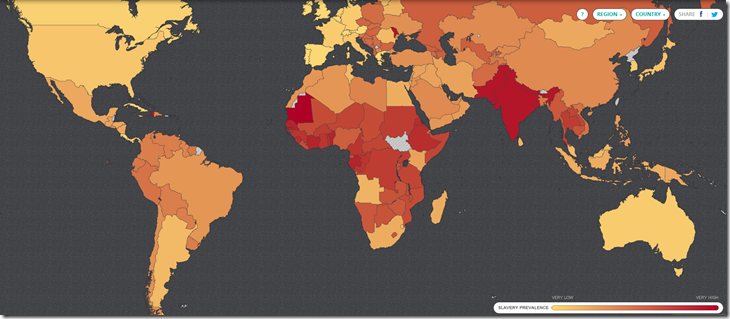
_61015024_61015019Nearly 30 million people around the world are living as slaves, according to a new index ranking 162 countries. The index was compiled by Australian-based rights organization Walk Free Foundation using a definition of modern slavery that includes debt bondage, forced marriage and human trafficking.

http://www.globalslaveryindex.org/
http://www.walkfree.org/
US trafficking report reveals ‘modern slavery’ toll
New global index exposes ‘modern slavery’ worldwide

slvy

American Views on China: A Pew Research Center Survey

25 Tuesday Aug 2020

Posted by RichardB in China, Research, Social Science

≈ Comments Off on American Views on China: A Pew Research Center Survey

Tags

China, news, research

The Pew Research Center has been polling American adults on their perceptions of China since 2005. The latest report, based on interviews conducted in March 2020, shows that growing numbers of Americans have become increasingly negative about China. For the first time, more than half of Americans between the ages of 18 and 29 held unfavorable views of China. Almost nine in ten Americans see China’s power and influence in the world as a threat, with 62% saying that it is a “major threat.”

Images from NYPL

30 Thursday Jul 2020

Posted by RichardB in art, discovery, library, photos, Social Science

≈ Comments Off on Images from NYPL

Tags

library, ny, public

Carol Burnett 0Want to do some research or just stumble across something interesting? Come and browse the digital stacks of one the worlds premier libraries. Here you will find a large image database which you can search and/or browse by subject or name.

The New York Public Library Digital Library Gallery-see it for yourself – online.

Moral determination

02 Thursday Jul 2020

Posted by RichardB in discovery, Research, Social Science, Wellness

≈ Comments Off on Moral determination

Tags

determination, moral, research

When people witness a hurtful action they make a moral determination based on whether it is intentional or accidental instantly, according to a new paper.

The paper says the brain is hard-wired to recognize when another person is being intentionally harmed. It also provides new insights into how such recognition is connected with emotion and morality, according to lead author Jean Decety, Professor of Psychology and Psychiatry at U of Chicago.

The researchers studied adults who watched videos of people who suffered accidental harm (such as being hit with a golf club) and intentional harm (such as being struck with a baseball bat). While watching the videos, brain activity 12balwas collected with equipment that accurately maps responses in different regions of the brain and importantly, the timing between these regions. The technique is known as high-density, event-related potentials technology.

The intentional harm sequence produced a response in the brain almost instantly. The study showed that within 60 milliseconds, the right posterior superior temporal sulcus (also known as TPJ area), located in the back of the brain, was first activated, with different activity depending on whether the harm was intentional or accidental. It was followed in quick succession by the amygdala, often linked with emotion, and the ventromedial prefrontal cortex (180 milliseconds), the portion of the brain that plays a critical role in moral decision-making.

There was no such response in the amygdala and ventromedial prefrontal cortex when the harm was accidental.

“Our data strongly support the notion that determining intentionality is the first step in moral computations,” said Decety, who conducted research on the topic with Stephanie Cacioppo, a research associate (assistant professor) in psychology at U of Chicago.

Other studies with functional MRI scans, including those in Decety’s lab, have shown that those areas of the brain become activated when people see others intentionally harmed, but those studies have been unable to separate or time the way the various parts of the brain may work together.

“High-density ERPs can identify spatio-temporal patterns of communication between regions that contrast analyses (such as fMRI) with low temporal resolution may not detect, and such methods are necessary to advance knowledge of neuroscience of morality,” said Cacioppo.

The ability to recognize and respond emotionally to the intentional infliction of harm is a critical source of morality that is universal across cultures, researchers believe. “It is part of humans’ evolutionary heritage,” Decety said. “The long history of mammalian evolution has shaped our brains to be sensitive to signs of suffering of others. And this constitutes a natural foundation for morality and sensitivity to justice.”

Philosophers have debated the origins of this moral response for ages. Some maintain that moral judgments begin with an immediate aversive reaction to perceived or imagined harm to victims, though the full moral judgment may form only after the fact. Other philosophers maintain that moral principals develop from reason alone and are not connected to emotion.

The new research suggests that emotion and the perception of intentionality, rather than deliberate reasoning, comprise the vital first component of moral responses—at least for responses that stem from care for others Decety said.

The research may help inform other areas of neurodevelopment research, including studies of the moral responses of psychopaths and of children who lack empathy for others, displaying what are called callous-unemotional traits.

Published in the Journal of Neurophysiology. See article here.

Creativity is akin to insanity

23 Thursday Jan 2020

Posted by RichardB in Research, Social Science

≈ Comments Off on Creativity is akin to insanity

Tags

Creativity

Creativity is akin to insanity, say scientists who have been studying how the mind works. Brain scans reveal striking similarities in the thought pathways of highly creative people and those with schizophrenia. Both groups lack important receptors used to filter and direct thought. It could be this uninhibited 394562_495612957133604_562232499_nprocessing that allows creative people to “think outside the box”, say experts from Sweden’s Karolinska Institute.  more here BBC News


Environment for the Americas

10 Friday Jan 2020

Posted by RichardB in Americas, discovery, Environment, Justice, poverty, Social Science

≈ Comments Off on Environment for the Americas

Tags

Americas, Bird, Environment, Migratory

Environment for the Americas was created as a result of International Migratory Bird Day’s success. Created in 1993, the celebration has grown to become much more than a one day event. Over 450 events are now hosted from South America to Canada, materials are available year-round, and other projects and programs have been developed to increase bird conservation education.. As a result of Bird Day’s growth, sponsors could no longer house the program. In 2006, formal steps were taken to create a 501(c)(3) organization to provide a permanent home for Bird Day and other exciting efforts. That organization is Environment for the Americas (EFTA)! Today, EFTA works with partners and programs throughout the Western Hemisphere.

EFTA GOALS
At EFTA we strive to make bird conservation education available throughout the Western Hemisphere.

Our Goals are to:
•Create the framework educators need to host bird-focused programs, events, and festivals;
•Develop education materials about birds and their conservation;
•Serve as a network for the exchange of information about successful bird conservation education programs;
•Motivate the public to become involved in bird conserva

The Science of Making Things Go #Viral

26 Friday Jul 2019

Posted by RichardB in Social Science

≈ Comments Off on The Science of Making Things Go #Viral

Tags

Science, Shrill, Viral

Courtesy of: Visual Capitalist

Warsaw Ghetto: The story of its secret archive

02 Saturday Feb 2019

Posted by RichardB in discovery, History, Holocaust, Social Science, Warsaw Ghetto

≈ Comments Off on Warsaw Ghetto: The story of its secret archive

Tags

history, Poland, Warsaw Ghetto

Throughout the bitter days of the Warsaw Ghetto, a clandestine group of researchers compiled a vast archive detailing every aspect of life in this prison city built and then obliterated by the Nazis. Led by a historian, Emanuel Ringelblum, the group then buried the archive for future generations. Continue the story here at the BBC.

Tablet Magazine is featuring stories from Warsaw, Poland; Click Here Tablet in Warsaw.

Is That a Real Service Dog?

23 Wednesday Jan 2019

Posted by RichardB in dogs, Humans, people, Social Science, Therapy

≈ Comments Off on Is That a Real Service Dog?

Tags

Service Dog

Is That a Real Service Dog?


The world at seven billion

19 Saturday Jan 2019

Posted by RichardB in discovery, Research, Social Science

≈ Comments Off on The world at seven billion

Tags

people, population, world

Thee BBC is big into these types of demographical thingies. : The world’s population is expected to hit seven billion in the next few weeks. After growing very slowly for most of human history, the number of people on Earth has more than doubled in the last 50 years. Where do you fit into this story of human life? Fill in your date of birth below to find out.   http://www.bbc.co.uk/news/world-15391515

people


What is Dance Movement Therapy?

01 Tuesday Jan 2019

Posted by RichardB in creative arts therapy, Dance, Dance Movement Therapy, Social Science, YouTube

≈ Comments Off on What is Dance Movement Therapy?

Tags

arts, creative, dance, therapy

According to the American Dance Therapy Association (ADTA): Based on the understanding that the body and mind are interrelated, dance/movement therapy (D/MT) is defined as the psychotherapeutic use of movement to further the emotional, cognitive, physical, and social integration of the individual. Dance/movement therapy is practiced in mental health, rehabilitation, medical, educational, and forensic settings, and in nursing homes, day care centers, disease prevention, and health promotion programs. The dance/movement therapist focuses on movement behavior as it emerges in the therapeutic relationship. Expressive, communicative, and adaptive behaviors are all considered for both group and individual treatment. Body movement as the core component of dance simultaneously provides the means of assessment and the mode of intervention for dance/movement therapy.

dance movement therapy is for everyone

I often define D/MT to clients as psychotherapy that is not limited to talking but encompasses the full range of human expression, including movement such as gestures and or postures, drawing, writing, drama, music and other expressions that can have a therapeutic benefit for the client(s).

See also:
Wikipedia Dance Therapy
ADTA Fact Sheet

New York 1911

08 Saturday Dec 2018

Posted by RichardB in Americas, discovery, History, people, Social Science

≈ Comments Off on New York 1911

Tags

1911, Early Film, New York, Tour

instagram

Follow RichardbBrunner on WordPress.com
  • Tumblr
  • YouTube

Blog at WordPress.com.

Privacy & Cookies: This site uses cookies. By continuing to use this website, you agree to their use.
To find out more, including how to control cookies, see here: Cookie Policy
  • Subscribe Subscribed
    • RichardbBrunner
    • Join 491 other subscribers
    • Already have a WordPress.com account? Log in now.
    • RichardbBrunner
    • Subscribe Subscribed
    • Sign up
    • Log in
    • Report this content
    • View site in Reader
    • Manage subscriptions
    • Collapse this bar
 

Loading Comments...