Self-Control Can Drain Your Memory

Tags

The human body has a finite amount of resources, and scientists are always discovering more about how these resources are shared, depleted, and replenished. Now a new study suggests that the areas in your brain responsible for self-control and forming memories are closely linked – in other words, if you’re concentrating hard on staying disciplined, you’re probably becoming less adept at remembering what’s happening.

Researchers Yu-Chin Chiu and Tobias Egner from Duke University in the US asked a group of volunteers to recognise a series of faces, both with and without the inclusion of a self-control test in the middle. They found that having to exercise self-control had a negative impact on the participants’ ability to recall which pictures they’d previously seen. The same experiment was then repeated with a new set of volunteers and brain-scanning fMRI (functional magnetic resonance imaging) equipment on hand. Brain-0008.jpg

The pair discovered that one area of the brain – the ventrolateral prefrontal cortex – was activated frequently during the self-control test and predicted the strength of the volunteers’ memory later on. The findings suggest that self-control and memory compete for the same resources inside the brain, and support the theory that inhibiting ourselves can also cause us to forget more easily.

“The control demands of response inhibition divert attention away from stimulus encoding, thereby weakening memory traces for inhibitory cues,” the researchers conclude in The Journal of Neurosience. “These findings shed new light on the relation between the control process of response inhibition and the cognitive domains of perception, attention, and memory.”

The self-control test used was a traditional Go/No-Go task: these tasks work by asking participants to view a series of items and push a button only when certain criteria are met – in the case of this experiment, when the face shown is male rather than female. The theory is that those who are able to hold back from a button push when necessary are those with the strongest self-control (or “response inhibition”, as neuroscientists like to call it). The participants were not told in advance that they would need to remember the faces they were shown.

“The scans revealed that responding to a cue and inhibiting a response produced overlapping activation patterns in brain regions within the right frontal and parietal lobes, a network that has previously been implicated in response inhibition,” Mo Costrandi reports for The Guardian. “Crucially, ‘no-go’ trials produced greater activation of this network than ‘Go’ trials, and activity in one specific brain region (the ventrolateral prefrontal cortex) predicted the strength of the participants’ memory, such that the greater the observed network activation, the more likely the participants were to forget that face later on.”

The researchers admit their theory is still “speculative” for now, but if further study confirms the link, they believe their discovery could be used to treat people who have problems with self-control: those suffering from ADHD (Attention Deficit Hyperactivity Disorder), for example, or some form of addiction.

One scenario put forward by the pair is having to suddenly cancel a lane change on the motorway because a car is already in the spot you want to move into. If they’re right, the act of having to control and inhibit your actions would make it less likely that you would remember the details of the incident – such as the make and model of the car that was blocking your path.

Drugs and the Brain

Tags

The human brain is the most complex organ in the body. This three-pound mass of gray and white matter sits at the center of all human activity—you need it to drive a car, to enjoy a meal, to breathe, to create an artistic masterpiece, and to enjoy everyday activities. In brief, the brain regulates your body’s basic functions; enables you to interpret and respond to everything you experience; and shapes your thoughts, emotions, and behavior.

The brain is made up of many parts that all work together as a team. Different parts of the brain are responsible for coordinating and performing specific functions. Drugs can alter important brain areas that are necessary for life-sustaining functions and can drive the compulsive drug abuse that marks addiction. Brain areas affected by drug abuse include:

  • The brain stemwhich controls basic functions critical to life, such as heart rate, breathing, and sleeping.
  • The cerebral cortex, which is divided into areas that control specific functions. Different areas process information from our senses, enabling us to see, feel, hear, and taste. The front part of the cortex, the frontal cortex or forebrain, is the thinking center of the brain; it powers our ability to think, plan, solve problems, and make decisions.
  • The limbic system, which contains the brain’s reward circuit. It links together a number of brain structures that control and regulate our ability to feel pleasure. Feeling pleasure motivates us to repeat behaviors that are critical to our existence. The limbic system is activated by healthy, life-sustaining activities such as eating and socializing—but it is also activated by drugs of abuse. In addition, the limbic system is responsible for our perception of other emotions, both positive and negative, which explains the mood-altering properties of many drugs.

How do the parts of the brain communicate?

The brain is a communications center consisting of billions of neurons, or nerve cells. Networks of neurons pass messages back and forth among different structures within the brain, the spinal cord, and nerves in the rest of the body (the peripheral nervous system). These nerve networks coordinate and regulate everything we feel, think, and do.

  • Neuron to Neuron
    Each nerve cell in the brain sends and receives messages in the form of electrical and chemical signals. Once a cell receives and processes a message, it sends it on to other neurons.
  • Neurotransmitters – The Brain’s Chemical Messengers
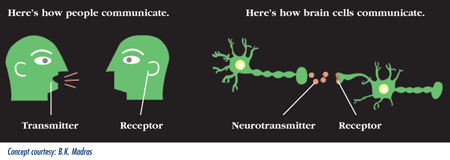
    The messages are typically carried between neurons by chemicals called neurotransmitters.
  • Receptors – The Brain’s Chemical Receivers
    The neurotransmitter attaches to a specialized site on the receiving neuron called a receptor. A neurotransmitter and its receptor operate like a “key and lock,” an exquisitely specific mechanism that ensures that each receptor will forward the appropriate message only after interacting with the right kind of neurotransmitter.
  • Transporters – The Brain’s Chemical Recyclers
    Located on the neuron that releases the neurotransmitter, transporters recycle these neurotransmitters (that is, bring them back into the neuron that released them), thereby shutting off the signal between neurons.
soa_013.gif

To send a message, a brain cell (neuron) releases a chemical (neurotransmitter) into the space (synapse) between it and the next cell. The neurotransmitter crosses the synapse and attaches to proteins (receptors) on the receiving brain cell. This causes changes in the receiving cell—the message is delivered.

How do drugs work in the brain?

Drugs are chemicals that affect the brain by tapping into its communication system and interfering with the way neurons normally send, receive, and process information. Some drugs, such as marijuana and heroin, can activate neurons because their chemical structure mimics that of a natural neurotransmitter. This similarity in structure “fools” receptors and allows the drugs to attach onto and activate the neurons. Although these drugs mimic the brain’s own chemicals, they don’t activate neurons in the same way as a natural neurotransmitter, and they lead to abnormal messages being transmitted through the network.

Other drugs, such as amphetamine or cocaine, can cause the neurons to release abnormally large amounts of natural neurotransmitters or prevent the normal recycling of these brain chemicals. This disruption produces a greatly amplified message, ultimately disrupting communication channels.

How do drugs work in the brain to produce pleasure?

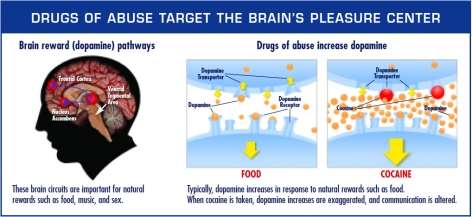
Most drugs of abuse directly or indirectly target the brain’s reward system by flooding the circuit with dopamine. Dopamine is a neurotransmitter present in regions of the brain that regulate movement, emotion, motivation, and feelings of pleasure. When activated at normal levels, this system rewards our natural behaviors. Overstimulating the system with drugs, however, produces euphoric effects, which strongly reinforce the behavior of drug use—teaching the user to repeat it.

Most drugs of abuse target the brain’s reward system by flooding it with dopamine.
soa_014_large

How does stimulation of the brain’s pleasure circuit teach us to keep taking drugs?

Our brains are wired to ensure that we will repeat life-sustaining activities by associating those activities with pleasure or reward. Whenever this reward circuit is activated, the brain notes that something important is happening that needs to be remembered, and teaches us to do it again and again without thinking about it. Because drugs of abuse stimulate the same circuit, we learn to abuse drugs in the same way.

Why are drugs more addictive than natural rewards?

When some drugs of abuse are taken, they can release 2 to 10 times the amount of dopamine that natural rewards such as eating and sex do.15 In some cases, this occurs almost immediately (as when drugs are smoked or injected), and the effects can last much longer than those produced by natural rewards. The resulting effects on the brain’s pleasure circuit dwarf those produced by naturally rewarding behaviors.16,17The effect of such a powerful reward strongly motivates people to take drugs again and again. This is why scientists sometimes say that drug abuse is something we learn to do very, very well.

Long-term drug abuse impairs brain functioning.

What happens to your brain if you keep taking drugs?

For the brain, the difference between normal rewards and drug rewards can be described as the difference between someone whispering into your ear and someone shouting into a microphone. Just as we turn down the volume on a radio that is too loud, the brain adjusts to the overwhelming surges in dopamine (and other neurotransmitters) by producing less dopamine or by reducing the number of receptors that can receive signals. As a result, dopamine’s impact on the reward circuit of the brain of someone who abuses drugs can become abnormally low, and that person’s ability to experience anypleasure is reduced.

This is why a person who abuses drugs eventually feels flat, lifeless, and depressed, and is unable to enjoy things that were previously pleasurable. Now, the person needs to keep taking drugs again and again just to try and bring his or her dopamine function back up to normal—which only makes the problem worse, like a vicious cycle. Also, the person will often need to take larger amounts of the drug to produce the familiar dopamine high—an effect known as tolerance.

Decreased Dopamine Transporters in a Methamphetamine Abuser18

soa_015.gif

How does long-term drug taking affect brain circuits?

We know that the same sort of mechanisms involved in the development of tolerance can eventually lead to profound changes in neurons and brain circuits, with the potential to severely compromise the long-term health of the brain. For example, glutamate is another neurotransmitter that influences the reward circuit and the ability to learn. When the optimal concentration of glutamate is altered by drug abuse, the brain attempts to compensate for this change, which can cause impairment in cognitive function. Similarly, long-term drug abuse can trigger adaptations in habit or non-conscious memory systems. Conditioning is one example of this type of learning, in which cues in a person’s daily routine or environment become associated with the drug experience and can trigger uncontrollable cravings whenever the person is exposed to these cues, even if the drug itself is not available. This learned “reflex” is extremely durable and can affect a person who once used drugs even after many years of abstinence.

What other brain changes occur with abuse?

Chronic exposure to drugs of abuse disrupts the way critical brain structures interact to control and inhibit behaviors related to drug use. Just as continued abuse may lead to tolerance or the need for higher drug dosages to produce an effect, it may also lead to addiction, which can drive a user to seek out and take drugs compulsively. Drug addiction erodes a person’s self-control and ability to make sound decisions, while producing intense impulses to take drugs.

American Views on China: A Pew Research Center Survey

Tags

, ,

The Pew Research Center has been polling American adults on their perceptions of China since 2005. The latest report, based on interviews conducted in March 2020, shows that growing numbers of Americans have become increasingly negative about China. For the first time, more than half of Americans between the ages of 18 and 29 held unfavorable views of China. Almost nine in ten Americans see China’s power and influence in the world as a threat, with 62% saying that it is a “major threat.”

Top songs I have listened too in 2019: Nicole Bus: NPR Music Tiny Desk Concert

Tags

, ,

Nicole Bus is a Dutch singer who is currently signed to Roc Nation. Her 2018 single, “You”, is tied for the fastest debut single to reach the top of the Billboard Adult R&B Songs chart. She released her American debut studio album, Kairos, in October 2019. Prior to signing to Roc Nation, Bus had released a variety of music in the Netherlands and won the Grote Prijs van Nederland (“Grand Prize of the Netherlands”) in the singer-songwriter category in 2010.

I have a 16,000 plus digital audio collection and I use Media Monkey to manage my files. One feature of Media Monkey is you can sort your collection based on the number of times played. This playlist is based on the top music and/or music video files I played/listened/streamed from my server in 2019. Complete 2019 Playlist HERE


Update: Afghanistan:the Saudi Arabia of lithium

Tags

,

In 2010 I linked to a NYT article about the mineral riches in Afghanistan and how China had signed a deal to extract one of the riches (copper). The article is here: U.S. Identifies Vast Mineral Riches in Afghanistan

Every once in awhile I check to see if anyone has written about the mineral deals taken place in America’s longest war battle ground. The latest is from 2017 from one of the more often checked media sources South China Morning Post: Talks Aim to Jump Start China Afghanistan Mining Deal.

Photo by Tom Fisk on Pexels.com

The Impact of China’s Belt and Road Initiative: Lessons from Sri Lanka

Tags

,

Speakers draw on the findings from a recent Chatham House paper to discuss the lessons that may improve future BRI projects in Sri Lanka and elsewhere in the region. China’s Belt and Road Initiative (BRI) is having profound impacts on recipient countries. Recently, Chinese outbound investment in Sri Lanka has come under scrutiny due to intensifying geopolitical rivalries in the Indian Ocean as well as Sri Lanka’s prime location and ports in the region. Much of the analysis on this topic so far has focused on how the economic relationship has informed Chinese geopolitical ambitions, via a so-called ‘debt-trap diplomacy’. Such a framing may be misleading, while also overlooking other dimensions of Chinese investment that warrant closer examination.

Ten Percent of American Adults Report Being in Recovery

Tags

Data Shows More Than 23 Million Adults Living in U.S. Once Had  Drug or Alcohol Problems, But No Longer Do

Survey data released by the Partnership for Drug-Free Kids and The New York State Office of Alcoholism and Substance Abuse Services (OASAS) show that 10 percent of all American adults, ages 18 and older, consider themselves to be in recovery from drug or alcohol abuse problems. These nationally representative findings indicate that there are 23.5 million American adults who are overcoming an involvement with drugs or alcohol that they once considered to be problematic. 10501634_10152483771078046_6376046067124349017_n.jpg

According to the new survey funded by OASAS, 10 percent of adults surveyed said yes to the question, “Did you once have a problem with drugs or alcohol, but no longer do?” – one simple way of describing recovery from drug and alcohol abuse or addiction.

“The OASAS study is an important contribution to the public’s understanding of recovery, as it represents the actual voices of millions of Americans whose lives have improved because they are living free of alcohol and other drug problems,” said Steve Pasierb, President and CEO of the Partnership for Drug-Free Kids. “This new learning provides a big reason – more than 23 million reasons – for all those who are struggling with their own, or a loved one’s substance use disorder, to have hope and know that they are not alone. These findings serve as a reminder that addiction is a treatable disease and recovery can be a reality. We are just scratching the surface here and more research is needed in this area, but we are proud to collaborate with New York OASAS in this meaningful process.”

“This research marks a vitally important step for those who are struggling with addiction by offering clear evidence to support what many know experientially – that millions of Americans have found a path to recovery,” said New York State Office of Alcoholism and Substance Abuse Services (OASAS) Commissioner Arlene González-Sánchez. “It is my hope that this new evidence will strengthen and inspire individuals and those that provide treatment and recovery services to help the broader community understand that treatment does work and recovery is possible.” 

Other self-reported findings from the new data conclude that: 

  • More males say they are in recovery than females (12 percent vs. 7 percent).
  • More adults ages 35-44 report being in recovery, compared to younger adults (18-34) and adults who are 55 years of age or older.
  • The Midwest has a higher prevalence of adults (14 percent) who say they are in recovery compared to adults in the South (7 percent). In other regions of the country, the percentage of adults[1] who say they are in recovery is 11 percent for the West and 9 percent for the Northeast.

The study also found no significant difference between parents and adults without children who say they are in recovery. This demonstrates that parents are as likely as non-parents to be in recovery. 

“This new research also supports findings from a groundbreaking survey done for Faces and Voices of Recovery by Peter Hart Associates that provided the initial evidence that there was a large population in recovery in the United States,” said Tom Hedrick, Senior Program Officer and one of the founding members of the Partnership for Drug-Free Kids. “Those 2004 findings concluded that ‘38 percent of adults have a family member or close friend (or both) who is in recovery from addiction to alcohol or other drugs.”

Top songs I have listened too in 2019: Natalia Lafourcade – Una Vida

Tags

,

María Natalia Lafourcade Silva is a Mexican pop-rock folk singer and songwriter who since her debut in 2003 has been one of the most successful singers in Latin America. Lafourcade’s voice has been categorized as a lyric soprano.

I have a 16,000 plus digital audio collection and I use Media Monkey to manage my files. One feature of Media Monkey is you can sort your collection based on the number of times played. This playlist is based on the top music and/or music video files I played/listened/streamed from my server in 2019. Complete 2019 Playlist HERE