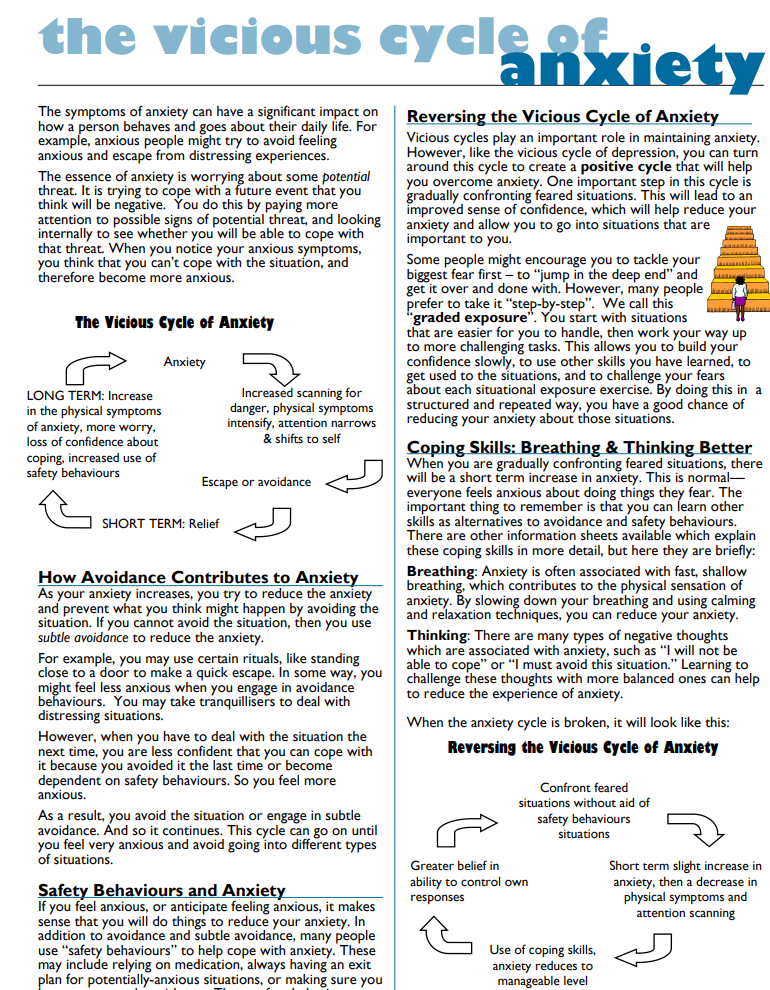
I usually used this handout with a guided relaxation after.

14 Wednesday Sep 2022
Posted in Handout, Uncategorized
≈ Comments Off on Cycle of Anxiety Handout
07 Wednesday Sep 2022
Posted in Coping Skills, Handout
≈ Comments Off on Irrational Statements
When we think (and strongly believe!), really irrational stuff, we are most likely thinking one or more of the following:

Sure, there are other possible irrational statements, but these are among the most frequent, I believe; these are the big five. They represent “must”, “awfulizing”, “low frustration tolerance (LFT)”, and “condemning” beliefs.
A fellow maniac of the freeways cuts you off at the pass. You flip into overdrive rage: “Hey, jerk!” “You learn to drive in your living room (translation: He shouldn’t drive like that)?” “That’s the way to get people killed (translation: That’s awful)!” “I can’t stand drivers like that (translation: I can’t stand driver’s like you)!” You only needed three of the five crazy beliefs here.
I find these five statements are frequently part of the irrational thinking that gets people in trouble. If you work diligently to notice these irrational beliefs, that is the first step in having control.
If you have a little difficulty seeing that you believe these crazy ideas, just pay attention to what goes through your mind when you feel upset. That’s the way it sometimes is with “new thinking;” we need a little time and pushing to catch it. Be patient with yourself, and you’ll catch on, too.
24 Wednesday Aug 2022
Posted in Coping Skills, Handout
≈ Comments Off on Handout: Unhelpful Thinking Styles
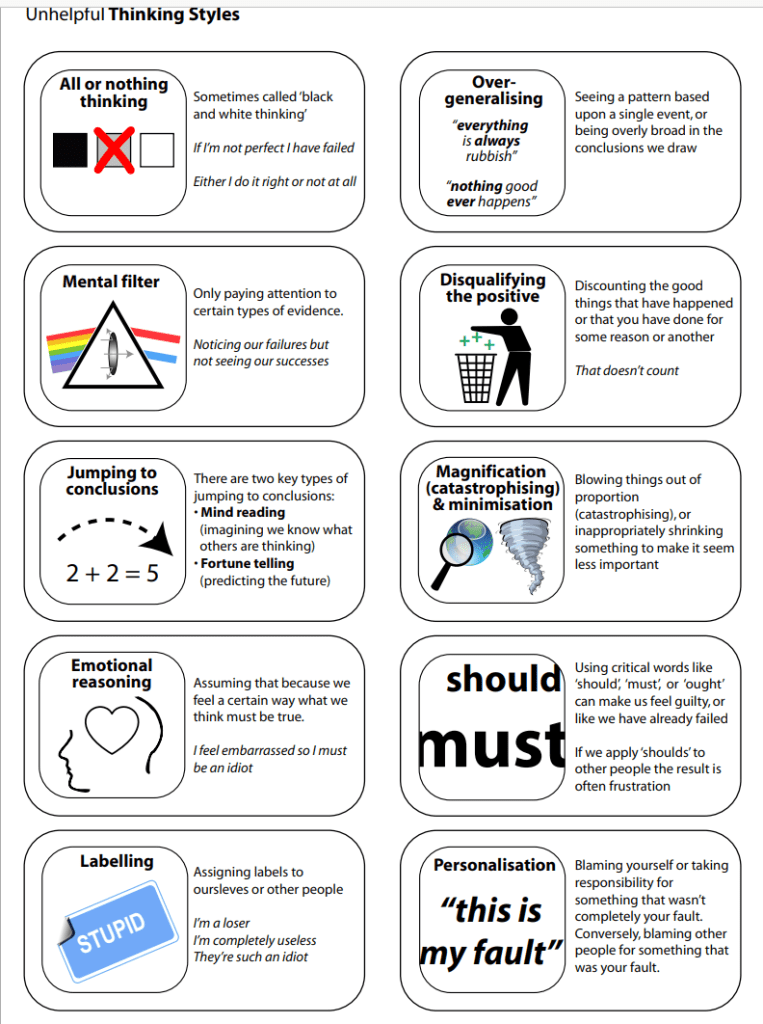
Another handout to start the conversation in groups. If the group I am working with engages easily I will just use one copy. I have people, one at a time read a thinking style and we talk about it.
If the group does not engage easily I past out copies to everyone and they circle one or two and we discuss.
At the end of group (and most groups I do) I ask if this handout was useful or not, if there is anything that can be done to make it better.
11 Thursday Aug 2022
Posted in Coping Skills, Handout
≈ Comments Off on Positive Statements Handout
Tags
About 75% of Psycho-educational groups I have facilitated over the decades have basicly been coping skills. This handout is for a self esteem group and usually generated engagement.
To begin I ask folks to fill out this handout and than we talk about it. Having a handout helps to facilitate interactions with clients, encouraging them to share …. which in ideal situations leads to a more open discussion, moving away from the handout but staying with the theme. If we have all shared and a new discussion does not evolve I ask the group what other questions should we ask …. and than we ask.
Positive Statements about you
1. I like myself because:
2. I’m an expert at:
3. I feel good about:
4. My friends would tell you I have a great:
5. My favorite place is:
6. I’m loved by:
7. People say I am a good:
8. I’ve been told I have:
30 Thursday Jun 2022
Posted in Coping Skills, Handout
≈ Comments Off on Anger Diary Handout
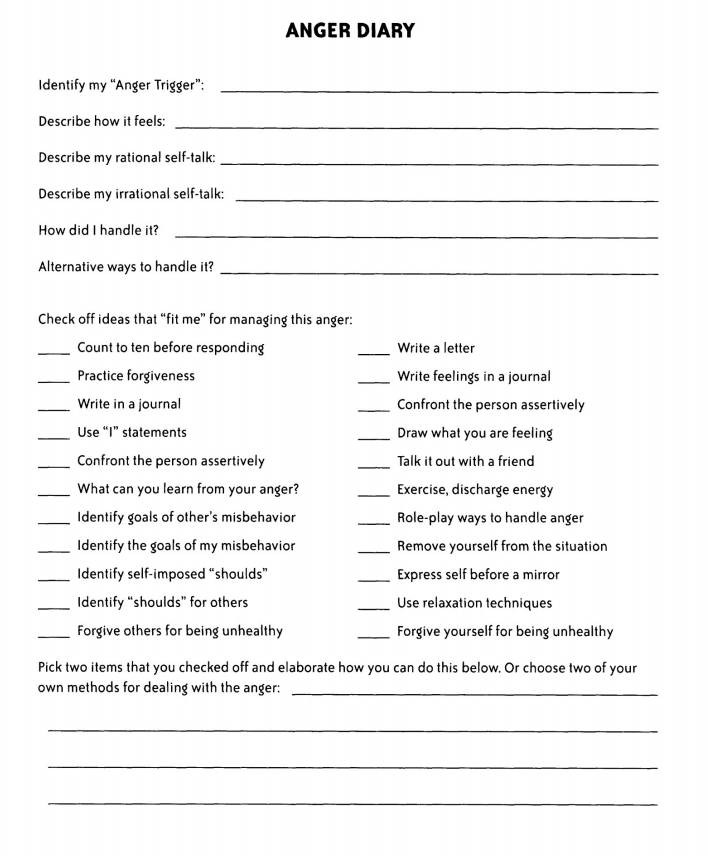
I spent years leading an anger management group and this handout was one I used when groups had difficulty engaging.
As in all groups at the end I asked people if this handout was useful or not and what could be done to make it better. Most said that it was somewhat useful. This handout was not my first choice in working with groups.
23 Thursday Jun 2022
Posted in Coping Skills, Handout, Stress
≈ Comments Off on Manage stress handout
If your methods of coping with stress aren’t contributing to your greater emotional and physical health, it’s time to find healthier ones. There are many healthy ways to manage and cope with stress, but they all require change. You can either change the situation or change your reaction. When deciding which option to choose, it’s helpful to think of the four As: avoid, alter, adapt, or accept.

Since everyone has a unique response to stress, there is no “one size fits all” solution to managing it. No single method works for everyone or in every situation, so experiment with different techniques and strategies. Focus on what makes you feel calm and in control.
Dealing with Stressful Situations: The Four A’s
| Change the situation: Avoid the stressor. Alter the stressor. | Change your reaction: Adapt to the stressor. Accept the stressor. |
1. Avoid unnecessary stress
Not all stress can be avoided, and it’s not healthy to avoid a situation that needs to be addressed.
Learn how to say “no” – Know your limits and stick to them.
Avoid people who stress you out –Limit the amount of time you spend with people that cause you stress.
Take control of your environment – If the evening news makes you anxious, turn the TV off.
Avoid hot-button topics –If you repeatedly argue about the same subject with the same people, stop bringing it up or excuse yourself when it’s the topic of discussion.
Pare down your to-do list –If you’ve got too much on your plate, distinguish between the “shoulds” and the “musts.”
2. Alter the situation
If you can’t avoid a stressful situation, try to alter it. Figure out what you can do to change things so the problem doesn’t present itself in the future.
Express your feelings instead of bottling them up. If something or someone is bothering you, communicate your concerns in an open and respectful way.
Be willing to compromise. When you ask someone to change their behavior, be willing to do the same.
Be more assertive. Deal with problems head on, doing your best to anticipate and prevent them.
Manage your time better. Plan ahead and make sure you don’t overextend yourself.
3. Adapt to the stressor
If you can’t change the stressor, change yourself. You can adapt to stressful situations and regain your sense of control by changing your expectations and attitude.
Reframe problems. Try to view stressful situations from a more positive perspective.
Look at the big picture. Will it matter in a month, or a year?
Adjust your standards. Set reasonable standards for yourself and others, and learn to be okay with “good enough.”
Focus on the positive. When stress is getting you down, take a moment to reflect on all the things you appreciate in your life, including your own positive qualities and gifts.
4. Accept what you can’t change
Some sources of stress are unavoidable, in such cases; the best way to cope with stress is to accept things as they are. Acceptance may be difficult, but in the long run, it’s easier than railing against a situation you can’t change.
Don’t try to control the uncontrollable. Focus on the things you can control such as the way you choose to react to problems.
Look for the upside. As the saying goes, “What doesn’t kill us makes us stronger.” When facing major challenges, try to look at them as opportunities for personal growth.
Share your feelings. Talk to a trusted friend or make an appointment with a therapist.
Learn to forgive. Accept the fact that we live in an imperfect world and that people make mistakes.
5. Make time for fun & relaxation
You can reduce stress in your life by nurturing yourself. If you regularly make time for healthy fun and relaxation, you’ll be in a better place to handle life’s stressors.
Healthy ways to relax and recharge
| Go for a walk. Spend time in nature. Call a good friend. Exercise. Write in your journal. Take a long bath. Light scented candles | Play with a pet. Work in your garden. Get a massage. Curl up with a good book. Listen to music. Watch a comedy |
Nurturing yourself is a necessity, not a luxury.
Set aside relaxation time. Include rest and relaxation in your daily schedule..
Connect with others. Spend time with positive people who enhance your life.
Do something you enjoy every day. Make time for leisure activities that bring you joy, whether it be stargazing, playing the piano, or working on your bike.
Keep your sense of humor. This includes the ability to laugh at yourself.
6. Adopt a healthy lifestyle
You can increase your resistance to stress by strengthening your physical health.
Exercise regularly. Physical activity plays a key role in reducing and preventing the effects of stress.
Eat a healthy diet. Well-nourished bodies are better prepared to cope with stress, so be mindful of what you eat.
Reduce caffeine and sugar. The temporary “highs” caffeine and sugar provide often end in with a crash in mood and energy. By reducing the amount of coffee, soft drinks, chocolate, and sugar snacks in your diet, you’ll feel more relaxed and you’ll sleep better.
Avoid alcohol, cigarettes, and drugs. Self-medicating with alcohol or drugs may provide an easy escape from stress, but the relief is only temporary.
Get enough sleep. Adequate sleep fuels your mind, as well as your body. Feeling tired will increase your stress because it may cause you to think irrationally.
12 Thursday May 2022
Posted in Creative Therapy Tools, Handout
≈ Comments Off on Habit myths
DESPITE our best intentions for the new year, the reality is that gym memberships will lapse, chocolate will replace carrots and Candy Crush will edge out Moby Dick.
It’s not (only) that we’re undisciplined slugs. It’s that much of what we know — or think we know — about habits is wrong. Here’s a primer that might help keep you off the couch and on the treadmill.
MYTH 1 We fail to change our habits — or start good new ones — because we lack willpower.

Not really, said Wendy Wood, a professor of psychology and business at the University of Southern California. Willpower, she said, is more about looking at those yummy chocolate chip cookies and refusing them. A good habit ensures you’re rarely around those chocolate chip cookies in the first place.
To create or change a habit, you might consider thinking much more about altering your environment and patterns of living than work on steeling your mind, Professor Wood said, because “behavior is very much a product of environment.”
Habits — at least good ones — exist so we don’t have to resist temptation all the time. Imagine if every morning you had a debate with yourself about eating cake or cereal for breakfast. Instead, most of us form the habit of eating something relatively healthy for breakfast, which bypasses the lure of the cake altogether.
That’s why it’s sometimes easiest to start or break a habit during a major transition. This may sound counterintuitive, but a new house, job or relationship breaks old patterns, said Gretchen Rubin, author of the forthcoming book, “Better Than Before: Mastering the Habits of Our Everyday Lives.”
“People say wait a few days to get settled, but don’t,” she said. “Start right away.”
MYTH 2 We fall back on bad habits when stressed. In fact, good habits persist even in times of high anxiety, Professor Wood said. A study of which Professor Wood was one of the co-authors found that students who already had unhealthy diets would eat junk food when stressed, but those who already had the habit of eating well — or of reading a newspaper or of going to the gym — were just as likely to do that.
MYTH 3 It takes about 21 days to break or make a habit.
That number seems to have cropped up in the 1960s and somehow became “fact” with no real proof. But in 2009, researchers in Britain decided to take a deeper look by studying how long it took participants to learn new habits, such as eating fruit daily or going jogging. The average was 66 days.
But individuals’ times varied greatly, from 18 days to 245 days, depending on temperament and, of course, the task involved. It will most likely take far less time to get into the habit of eating an apple every afternoon than of practicing the piano for an hour a day.
MYTH 4 You need positive thinking to break or make a habit.
“We find positive fantasy is not helpful and may even be hurtful when trying to reach a desired future or fulfill a wish,” said Gabriele Oettingen, a professor of psychology at New York University and the University of Hamburg.
Over years of research, she discovered that people need to pair optimistic daydreams about the future with identifying and imagining the obstacles that prevent them from reaching that goal — something she calls mental contrasting.
Say you want to stop being a procrastinator. The first step is easy. Imagine how it will feel if your work is completed with plenty of time to spare, if you can sleep instead of pulling an all-nighter, said Professor Oettingen, author of “Rethinking Positive Thinking.”
But don’t just resolve to stop procrastinating. The second step is to identify what holds you back from changing yourself. Is it fear that you won’t succeed? Is it the adrenaline rush of frantically working at the last minute? Is it because of negative feelings toward a boss or teacher?
The mental contrasting needs to be in the right order. It’s important to “experience our dreams, then switch gears and mentally face reality,” Professor Oettingen said.
Doing it the opposite way — imagining the obstacles and then fantasizing about changing habits — doesn’t seem to work as well, research shows.
MYTH 5 Doing things by rote, or habit, isn’t good in most cases. It’s better to be mindful of everything we do.
Research shows that most people repeat about 40 percent of their activities almost every day.
“We only have so much room in our brain,” said Ian Newby-Clark, an associate professor of psychology at the University of Guelph in Canada. “It would be incredibly taxing if we had to mindfully plan every step of our day.” Habits free us up so we can think about other things.
And while some habits are objectively bad — smoking, say, or being consistently late — most are subjective. “Habits are only good or bad to the extent they’re consistent or inconsistent with your goals,” Professor Wood of U.S.C. said. It’s a bad habit when “it starts interfering with other goals you have.”
For example, many people said their resolution this year was to cut down the time they spend online.
But why? Because it’s an inherently bad thing to do? Or is it an obstacle to spending more time reading books or riding a bike or learning to knit?
After thinking about it, you may choose to spend less time on your computer or phone. Or you might decide it’s not so terrible in limited doses and shed the habit of feeling guilty about it.
MYTH 6 Everything in moderation.
“There’s a real difference among people about how easily they adapt to habits,” Ms. Rubin said. Some see habits as liberating; some see them as a trap. Some prefer to make a huge change all at once; others proceed step by step.
“I’m in the small minority that loves habits,” Ms. Rubin said, adding that she tends to find it easier to abstain from certain things altogether. For example, she eats no carbohydrates.
“People said I was doomed to failure, but it’s not true,” she said. But, she noted, “it’s a mistake to think the abstainer is more disciplined. For me it’s easier to be an abstainer than have to deliberate each time whether I can eat something or not. Others would go nuts if they abstain.”
That’s why you shouldn’t listen to people who tell you you’re doing it wrong if it works for you, she said.
Also, people shouldn’t fear that their habit will dissolve if they don’t practice it daily.
“If you lapse once or twice, you’re not ruined,” Professor Wood said. “That’s a misconception.”
And that leads to …
MYTH 7 Shame and guilt keep you on track.
No. People need to be kinder to themselves, showing self-compassion if they lapse, Ms. Rubin said. But it’s a fine balance between treating yourself kindly and making endless rationalizations and excuses.
“I might mindfully make an exception,” she said, such as choosing to eat a traditional Christmas cake every year. “But I’m not making excuses in the moment: I’ll hurt the hostesses’ feelings. You only live once. It’s the holidays.”
One last piece of advice: If you want to be in better shape, get a dog. Professor Wood said studies show dog owners have lower body mass indexes. But here’s the catch: That’s only true if you walk ’em.
13 Wednesday Apr 2022
Tags

Posted by RichardB | Filed under Creative Therapy Tools, Handout
≈ Comments Off on Handout: Self-esteem Barometer
10 Thursday Feb 2022
Posted in Creative Therapy Tools, Handout
≈ Comments Off on Handout: How I see myself
I have spent many years working with groups in a therapeutic setting and the last 17 years have been mostly psycho-educational. The manner that I facilitate groups in this process starts with a lot of direction, as the clients/patients open to sharing so do the boundaries (meaning less direction). Below is an image of a handout I have used.
One day a client mentioned that how others see him is totally different than how he sees himself. So, I added another part (asking folks to write on the back of the page): “how do you think others see you positively/negatively.
At the end of groups, I often ask what was it like doing this activity (useful, annoying, stupid, ect). Folks nearly always reported for this handout that it was useful. The addition of how others see us opened a whole new conversation level about the perceptions of others.

05 Friday Feb 2021
Posted in boundaries, Handout, Uncategorized
≈ Comments Off on Setting boundaries
Setting boundaries is an essential skill in life, especially for people in recovery. Addicts often grow up in dysfunctional homes, where boundaries were either too rigid (leading to suppressed emotions or distant relationships) or too enmeshed (depriving them of a sense of personal identity). Later in life, their interpersonal relationships may continue to be defined by old roles and patterns, increasing the risk of depression, anxiety and addictive or compulsive behaviors. 
As part of recovery, addicts learn how to set boundaries and to respect other people’s boundaries in return. In the addiction field, treatment providers often refer to this process as embracing the authentic self. While it may sound like psychobabble, it is really a process of discovering who you want to be, how you want to interact with other people, and taking responsibility for the consequences of your choices.
Why are boundaries important? They keep you safe from being manipulated, abused or taken advantage of, while also protecting other people from harm you may consciously or unconsciously inflict. They prevent both parties in a relationship from blurring the lines between self and others, which can lead to enmeshment and codependency. With healthy boundaries in place, you can begin to tune in to your inner voice and trust your own thoughts and feelings, and then communicate those to other people.
Distinguishing Healthy and Unhealthy Boundaries
Without a healthy role model, it can be difficult to know what healthy boundaries look like. First, let’s cover what healthy boundaries are not. They are not threats or attempts to control or manipulate others into doing what you want. They are not rigid rules or “walls” designed to keep people out or shield you from expressing your emotions.
Healthy boundaries are simply a delineation of what type of treatment is acceptable to you, and what consequences will result from violating a boundary. People with healthy boundaries share their thoughts and feelings, take care of their own needs, and are able to say no when necessary.
 By contrast, people with weak boundaries often:
• Sacrifice their personal values, plans or goals to please others
• Allow others to define who they are and make decisions for them
• Expect others to fulfill all their needs
• Feel guilty when they say no
• Hesitate to share their opinions or assert themselves if they are being treated unfairly
• Frequently feel used, threatened, victimized or mistreated by others
• Frequently offer unsolicited advice, or feel pressured to follow someone else’s advice
• Take responsibility for other people’s feelings
• Tell others how to think, feel or act
A Boundary-Setting Roadmap
Every individual is called upon to set their own boundaries. What works for some may seem either too intrusive or too distant to others. When laying out your boundaries, work through the following steps:
Create a Personal Bill of Rights. Before you can start setting boundaries, you have to recognize your right to have your own feelings, values and beliefs and to express to others how you want to be treated. For some, this requires a colossal leap in self-worth.
Identify Your Emotions. Our parents always admonish us to “think before you act.” When you have a strong response, take a time-out to identify the underlying emotion and figure out what you want to convey. Doing so allows you to interact with other people in an honest, direct way rather than blaming or lashing out.
Set Limits. Once you have a few guidelines in place for how you expect to be treated, practice setting limits with people in a clear, direct way. Examples of healthy boundaries are: “I choose to be around sober people” or “I’ll be happy to talk with you when your voice is calm.”
Assert Your Needs. If you feel that your boundaries are being violated, speak up. This doesn’t mean lashing out or blaming others, but rather assertively communicating your needs. Ask for what you want and say no, politely yet firmly, if something isn’t right for you.
Listen to Your Instincts. If a situation feels uncomfortable or inappropriate, chances are a boundary is being pushed. By tuning into your instincts, you’re more likely to respond in ways that are true to your authentic self.
Defend Your Boundaries. Once you set boundaries, expect that they will be tested. Before this happens, set consequences that you are willing and able to enforce (e.g., “If you continue this behavior, I will…”). Know that by setting limits, you may disappoint the other person, especially if they have weak boundaries themselves. While you should always act with dignity and respect, you can’t control other people’s feelings and behaviors.
If someone continually violates your boundaries, you may need to minimize contact with them, or if they are toxic to your recovery, cut ties altogether. By choosing not to let people violate your boundaries, you stop being the victim, stop blaming others and start reclaiming responsibility for your own life.
Respect Other People’s Boundaries. Just as important as honoring your own boundaries is respecting other people’s, even if they are different from yours. If they don’t have defined boundaries, show them the respect you know they deserve anyway.
17 Thursday Dec 2020
Posted in Anger, Handout, Uncategorized
≈ Comments Off on Thinking influences
Thinking influences our feelings through the things that we say to ourselves. Unhelpful thoughts can add fuel to the fire and play a large role in keeping anger going after the event has passed. However, using helpful self-statements (or ‘cooling thoughts’) can be a good way to manage our anger and guide our behavior.  Examples of these include:
To use this strategy we need to break anger into several stages:

Preparing for a provoking situations
During the event
Coping with stress
08 Tuesday Dec 2020
Posted in Handout, Minfulness, Wellness
≈ Comments Off on Mindfulness Minds
Tags
I have been practicing meditation since the mid-70’s and started a mindfulness meditation practice in the mid-90’s. Mindfulness has to do with the quality of awareness that we bring to what we are doing and experiencing, to being in the here and now. It has to do with learning to focus on being in the present, to focusing our attention on what we are doing and what is happening in the present.
Many of us are distracted by images, thoughts and feelings of the past, perhaps dissociating, worrying about the future, negative moods and anxieties about the present. It’s hard to put these thing away and concentrate on the task at hand.
I started teaching mindfulness to patients/clients a few years ago and often used the following as a hand out:
Mindfulness has to do with states of mind. Reason Mind, Emotion Mind, and Wise Mind. Reason Mind is your rational, thinking, logical mind. It plans and evaluates things logically. It is your “cool” part. Reasonable Mind can be very beneficial. It is easier to be in Reasonable Mind when you feel good. It is much harder to be in Reasonable Mind when you don’t feel good.
You Would Use Your Reasonable Mind To:
Build a bridge
Figure out how to double a recipe
Balance your checkbook
Figure out the fastest way from point “A” to point “B”

Emotion Mind describes times when emotions are what influence or control your thinking and behavior. Emotional Mind can also be very beneficial. Emotions are what motivate us to action. Emotions are what keep us attached to others and building relationships.
Emotion Mind can be aggravated by:
Illness, Lack Of Sleep, Tiredness, Drugs, Alcohol, Hungry, Overeating, Poor nutrition and/or lack of exercise, Environmental stress and threats, not taking your meds.
Both Emotion and Reasonable Mind Are Equally Important And Valuable
Reasonable mind gives you a way to solve your problems.
Emotion mind gives you a reason (motivation) to want to solve them.
Wise Mind is the integration of emotional and reasonable mind. Wise mind is that part of each person that can know and experience truth. It is where the person knows something to be true or valid. It is where the person knows something in a centered (balanced) way. It is almost always quiet and calm in this part of the mind.
Everyone Has A Wise Mind!
Some people have simply never experienced it.
No one is in Wise Mind all of the time.

Wise Mind – An Analogy for Wise Mind is like a deep well in the ground. The water is at the bottom of the well. The entire underground is an ocean called Wise Mind. But on the way down, there are often trap doors that stop progress. Sometimes the trap doors are so cleverly built that you actually believe that there is no water at the bottom of the well. The trap door may look like the bottom of the well. Perhaps it is locked and you need a key. Perhaps it is nailed shut and you need a hammer. Perhaps it is glued shut and you need a chisel.
16 Wednesday Sep 2020
Posted in grounding, Handout, Meditation, mindfulness, Wellness
≈ Comments Off on Opportunities 4 mindfulness
Tags
For most of us, a typical day begins when we get out of bed, wash, and then start our activities. At some point, we get a bite to eat, walk somewhere, and talk to someone. Often, by the end of the day we find ourselves stressed out and physically exhausted. It doesn’t have to be that way!
Everyday activities can be an opportunity for a meditation moments; bringing mindfulness, clarity, and peace into your day while energizing yourself and reducing stress.
A study published in the journal Consciousness and Cognition found: “Brief meditation training reduced fatigue, anxiety, and increased mindfulness. Moreover, brief mindfulness training significantly improved visuo-spatial processing, working memory, and executive functioning.”
These brief mindfulness meditations can be done anywhere or anytime …well using common sense. Just like you should not text and drive I would not meditate and drive either.
Here are two examples of how to add meditation without taking time out of your schedule.
11 Friday Sep 2020
Posted in Handout, mental health, Self Esteem
≈ Comments Off on Positive Statements about you
I am a group therapist who generally works with adults. I facilitate groups using creative arts, processing oriented, or psycho-education. Sometimes I actually sort of combine these in to a psycho-educational process oriented creative group. I provide info (psycho-educational, we talk about it from a personal perspective, and than create something out of the discussion.

One thing I have notice over the decades is that when people are stressed or overwhelmed about events in their life they tend towards a negative self perception. Below is a handout that I often use. One way of using this is to start out discussing what is positive self esteem, how you get it, maintain it, and why bother with it. I than pass out the hand out and folks write and than we share it in the group or in groups of 2 or 3 folks.
Positive Statements about you
02 Wednesday Sep 2020
Posted in grounding, Handout, mindfulness, Relaxation, Stress, Wellness
Tags
I’ve been teaching a stress less/relaxation class for years and below is one the handouts that participants report is most helpful.:
Change the situation: Avoid – Alter. Change your reaction: Adapt – Accept
1. Avoid unnecessary stress
Not all stress can be avoided, and it’s not healthy to avoid a situation that needs to be addressed.
Learn how to say “no” – Know your limits and stick to them.
Avoid people who stress you out –Limit the amount of time you spend with people that cause you stress.
Take control of your environment – If the evening news makes you anxious, turn the TV off.
Avoid hot-button topics –If you repeatedly argue about the same subject with the same people, stop bringing it up or excuse yourself when it’s the topic of discussion.
Pare down your to-do list –If you’ve got too much on your plate, distinguish between the “shoulds” and the “musts.”
2. Alter the situation
If you can’t avoid a stressful situation, try to alter it. Figure out what you can do to change things so the problem doesn’t present itself in the future.
Express your feelings instead of bottling them up. If something or someone is bothering you, communicate your concerns in an open and respectful way.
Be willing to compromise. When you ask someone to change their behavior, be willing to do the same.
Be more assertive. Deal with problems head on, doing your best to anticipate and prevent them.
Manage your time better. Plan ahead and make sure you don’t overextend yourself.
3. Adapt to the stressor
If you can’t change the stressor, change yourself. You can adapt to stressful situations and regain your sense of control by changing your expectations and attitude.
Reframe problems. Try to view stressful situations from a more positive perspective.
Look at the big picture. Will it matter in a month, or a year?
Adjust your standards. Set reasonable standards for yourself and others, and learn to be okay with “good enough.”
Focus on the positive. When stress is getting you down, take a moment to reflect on all the things you appreciate in your life, including your own positive qualities and gifts.
4. Accept what you can’t change
Some sources of stress are unavoidable, in such cases; the best way to cope with stress is to accept things as they are. Acceptance may be difficult, but in the long run, it’s easier than railing against a situation you can’t change.
Don’t try to control the uncontrollable. Focus on the things you can control such as the way you choose to react to problems.
Look for the upside. As the saying goes, “What doesn’t kill us makes us stronger.” When facing major challenges, try to look at them as opportunities for personal growth.
Share your feelings. Talk to a trusted friend or make an appointment with a therapist.
Learn to forgive. Accept the fact that we live in an imperfect world and that people make mistakes.
26 Tuesday May 2020
Posted in Handout, Meditation, mindfulness, Relaxation, Wellness
≈ Comments Off on Relaxation

Currently, there is some scientific evidence that relaxation techniques may be an effective part of an overall treatment plan for some disorders, including:
Relaxation involves practice and willingness to fully engage in the process of relaxing. Stay tuned for some great relaxing tools.
30 Thursday Apr 2020
Once a week I facilitate a anger management group. I use a variety of handouts and activities to have a process oriented group interaction. One of the hand outs I use is below. I use it in 1 of 2 ways. I have folks fill it out first and then we discuss or we go  through it together and discuss. We explore as a group, learning from each other.
ANGER WORDS
anger disgust grumpiness rage aggravation dislike hate resentment agitation envy hostility revulsion annoyance exasperation irritation scorn bitterness ferocity jealousy spite contempt frustration loathing torment cruelty fury mean-spiritedness vengefulness destructiveness grouchiness outrage wrath
Other:_________________________
Prompting Events for Feeling Anger
Losing power.
Losing status.
Losing respect.
Being insulted.
Not having things turn out the way you expected.
Experiencing physical pain.
Experiencing emotional pain.
Being threatened with physical or emotional pain by someone or something.
Having an important or pleasurable activity interrupted, postponed, or stopped.
Not obtaining something you want (which another person has).
Other:_______________________________
Interpretations That Prompt Feelings of Anger
Expecting pain.
Feeling that you have been treated unfairly.
Believing that things should be different.
Rigidly thinking “I’m right.”
Judging that the situation is illegitimate, wrong, or unfair.
Ruminating about the event that set off the anger in the first place, or in the past.
Other:____________________________
Experiencing the Emotion of Anger
Feeling incoherent.
Feeling out of control.
Feeling extremely emotional.
Feeling tightness or rigidity in your body.
Feeling your face flush or get hot.
Feeling nervous tension, anxiety or discomfort.
Feeling like you are going to explode.
Muscles tightening. .
Teeth clamping together, mouth tightening.
Crying; being unable to stop tears.
Wanting to hit, bang the wall, throw something, blow up.
Other:__________________________
Expressing and Acting on Anger
Frowning or not smiling; mean or unpleasant facial expression.
Gritting or showing your teeth in an unfriendly manner.
Grinning.
A red or flushed face.
Verbally attacking the cause of your anger; criticizing.
Physically attacking the cause of your anger.
Using obscenities or cursing.
U sing a loud voice, yelling, screaming, or shouting.
Complaining or bitching; talking about how lousy things are.
Clenching your hands or fists.
Making aggressive or threatening gestures.
Pounding on something, throwing things, breaking things.
Walking heavily or stomping; slamming doors, walking out.
Brooding or withdrawing from contract with others.
Other:_____________________
Aftereffects of Anger
Narrowing of attention.
Attending only to the situation making you angry.
Ruminating about the situation making you angry and not being able to think of anything else.
Remembering and ruminating about other situations that have made you angry in the past.
Imagining future situations that will make you angry.
Depersonalization, dissociative experience, numbness.
Intense shame, fear, or other negative emotions.
Other:______________________
16 Thursday Apr 2020
Posted in Handout, Health, Psychoeducation
≈ Comments Off on The Ten Rules For Being Human
1. You will receive a body.
2. You will be presented with lessons.
3. There are no mistakes, only lessons.
4. Lessons are repeated until learned.
5. Learning does not end.
6. “There” is no better than “here.”
7. Others are only mirrors of you.
8. What you make of your life is up to you.
9. All the answers lie inside of you.
10. You will forget all of this at birth.
26 Wednesday Feb 2020
Posted in Handout, recovery, relapse stages
≈ Comments Off on Relapse Stages
One of the hand outs I use with groups. This is a shorten version of Relapse Stages and just a starting off point for further discussion.
First stage – I am un aware. I don’t see it, and have no idea I am in trouble. (people around us may notice subtle changes in attitude and behavior).
Second Stage – We become restless, incurable and discontent. Our focus shifts from internal to external, we stop focusing on ourselves and start focusing on other people around us. We start blaming; acting the victim, fear and anger start to become evident.
Third stage – Unresolved feelings occur and they are not dealt with in a healthy manner. We go into the emotional and physical withdrawal, than start to isolate. Negative attitudes start to predominate such as compulsive behavior, we start discounting recovery, we may engage in magical thinking.
Fourth stage – A crisis in our life provides the excuse for us to start using it again, or we create a crisis that rationalizes are returned to use. In other words, we have made the decision to use, and are ready to light the fuse.

As we move through the stages of relapse, a few different things are occurring. Firstly, the need to regain our ‘right’ to re-engage in our addiction seems to make sense. We talk ourselves into the false belief that this time we can control it.
There’s a gradual and progressive destabilization of our lifestyle. Lastly, Stress and Stressors will accelerate this process.
21 Friday Feb 2020
Posted in Handout, Relaxation, Stress, Wellness
≈ Comments Off on Relaxation & stressless
Tags
Stress is one reason people report relapsing and using substances/intoxicants. I’ve been teaching a stress less/relaxation class for years and below is one the handouts that participants report is most helpful.:
Change the situation: Avoid – Alter. Change your reaction: Adapt – Accept
1. Avoid unnecessary stress
Not all stress can be avoided, and it’s not healthy to avoid a situation that needs to be addressed.
Learn how to say “no” – Know your limits and stick to them.
Avoid people who stress you out –Limit the amount of time you spend with people that cause you stress.
Take control of your environment – If the evening news makes you anxious, turn the TV off.
Avoid hot-button topics –If you repeatedly argue about the same subject with the same people, stop bringing it up or excuse yourself when it’s the topic of discussion.
Pare down your to-do list –If you’ve got too much on your plate, distinguish between the “shoulds” and the “musts.”
2. Alter the situation
If you can’t avoid a stressful situation, try to alter it. Figure out what you can do to change things so the problem doesn’t present itself in the future.
Express your feelings instead of bottling them up. If something or someone is bothering you, communicate your concerns in an open and respectful way.
Be willing to compromise. When you ask someone to change their behavior, be willing to do the same.
Be more assertive. Deal with problems head on, doing your best to anticipate and prevent them.
Manage your time better. Plan ahead and make sure you don’t overextend yourself.
3. Adapt to the stressor
If you can’t change the stressor, change yourself. You can adapt to stressful situations and regain your sense of control by changing your expectations and attitude.
Reframe problems. Try to view stressful situations from a more positive perspective.
Look at the big picture. Will it matter in a month, or a year?
Adjust your standards. Set reasonable standards for yourself and others, and learn to be okay with “good enough.”
Focus on the positive. When stress is getting you down, take a moment to reflect on all the things you appreciate in your life, including your own positive qualities and gifts.
4. Accept what you can’t change
Some sources of stress are unavoidable, in such cases; the best way to cope with stress is to accept things as they are. Acceptance may be difficult, but in the long run, it’s easier than railing against a situation you can’t change.
Don’t try to control the uncontrollable. Focus on the things you can control such as the way you choose to react to problems.
Look for the upside. As the saying goes, “What doesn’t kill us makes us stronger.” When facing major challenges, try to look at them as opportunities for personal growth.
Share your feelings. Talk to a trusted friend or make an appointment with a therapist.
Learn to forgive. Accept the fact that we live in an imperfect world and that people make mistakes.
 RichardbBrunner