Global weather patterns map

Tags

, ,

A supercomputer-powered Web site project sporting the humble name “earth” is a fascinating look at global weather patterns. It comes from software developer Cameron Beccario and it will suck you into a world full of weather-induced curves and swirls viewable at different levels in the atmosphere.

The globe, with its animated lines of colorful wind patterns, can be rotated and zoomed to get in close on a particular location. The closer you click, the more surreal it gets, until the wind looks like some hairy alien growing across your state.

Try out the different heights and overlay options (like temperature) and watch weather patterns around the world meld into each other and connect across continents. The visualization of global weather conditions is generated by supercomputers, with the forecast being updated every three hours.windmaie

Medication And Addiction

Drug treatment providers in California and elsewhere have relied for decades on abstinence and therapy to treat addicts. In recent years, they’ve turned to medication.

Faced with a worsening opiate epidemic and rising numbers of overdose deaths, policymakers are ramping up medication-assisted treatment.

1pillst

President Barack Obama at the end of April 2016 said he’d allocate more money for states to expand access to the medications. He also proposed that physicians be able to prescribe one of the most effective anti-addiction drugs, buprenorphine, to more patients.

California already plans to expand access to medications as it launches an overhaul of the state’s substance abuse treatment system for low-income residents. The state recently embarked on a five-year demonstration project on the premise that addiction is a chronic disease and should be treated as such.

While medication is not for everyone, it can be critical for some people with severe addiction, said Marlies Perez, chief of the substance use disorder compliance division for the state Department of Health Care Services. The medications, she said, “have been proven as the gold standard for really helping people recover.”

The best-known medication, methadone, blocks the effect of certain drugs and lessens withdrawal symptoms. It is highly regulated and can only be prescribed by clinics that have government approval. Buprenorphine, which can be prescribed in doctors’ offices, produces mild opioid effects while also easing withdrawal symptoms. Another medication available by prescription, naltrexone, blocks the effect of opioids.

The medications are available across the country but must be prescribed by physicians with special training. There are only about 30,000 authorized doctors nationwide, and they can only prescribe to a limited number of patients.

Obama’s proposal would allow qualified doctors to prescribe buprenorphine to 200 patients, up from 100.

That could make a big difference in California, Perez said. The state is also trying to better link treatment centers with trained prescribing doctors so that physicians can consult with one another on treatment options for their patients. “Not all physicians, even in the substance use field, have that clinical knowledge,” she said.

The use of medication in treatment conflicts with the 12-step and Narcotics Anonymous philosophy of addiction recovery, which is based on abstinence, experts said. For many, experts said, simple abstinence doesn’t work.

“You would hope that just by talking to somebody, they could get rid of their problem with drugs,” said James Sorensen, a University of California, San Francisco professor and interim director of the substance abuse and addiction medicine program at Zuckerberg San Francisco General Hospital. “The reality is, that is simply not efficient, so we look for other tools.”

Medication is one of the most successful, evidence-based treatments available, and more access should have a big impact on those with substance abuse disorders, said John Connolly, deputy director for substance abuse prevention and control for the Los Angeles County Department of Public Health. But, he cautioned medication should be used alongside more traditional treatment methods.

“The medication has tremendous effect, but it is most impactful when it is prescribed with the necessary counseling and social supports,” he said.

Stephen Kaplan, director of behavioral health and recovery services for San Mateo County, said the county has increased its use of medication. About two years ago, the county began a pilot project to prescribe naltrexone to people with severe alcoholism who hadn’t been successful in traditional treatment.

The medication reduced people’s cravings and drinking, Kaplan said. The county recently began expanding the project to include people with opiate addictions.

Kaplan said he respects providers who believe that replacing one drug with another is not true recovery. But from a policy standpoint, Kaplan said, the medications are effective and should be more integrated into overall recovery for people with substance abuse disorders.

“We need to make available to them every possible option,” he said.

Perez of the state Department of Health Care Services said she believes that Obama’s focus on the opiate epidemic — and his recognition that it is a disease and not a moral failing — helps reduce the stigma.

“That makes a huge difference in folks coming forward and looking for treatment,” she said

Behavior Influences Attitudes

Tags

It’s true that our behavior influences our attitudes. Tibetan monks say their prayers by whirling their prayer wheels on which their prayers are inscribed. The whirling wheels spin the prayers into divine space. Sometimes, a monk will keep a dozen or so prayer wheels rotating like some juggling act in which whirling plates are balanced on top of long thin sticks. Many novice monks are not that all emotionally or spiritually involved at first. It may be that the novice is thinking about his family, his doubts about a religious vocation or something else while he is going through the motions of spinning his prayer wheel. When the novice adopts the pose of a monk and makes it obvious to themselves and others by playing a role, their brain will soon follow the role they are playing. It is not enough for the novice to have the intention of becoming a monk: the novice must act like a monk and rotate the prayer wheels. If one has the intention of becoming a monk and goes through the motions of acting like a monk, one will become a monk.

The great surrealist artist Salvador Dali was described by his fellow students at the Madrid art academy as “morbidly” shy according to his biographer Ian Gibson. He had a great fear of blushing and his shame about being ashamed drove him into solitude. It was his uncle who gave him the sage advice to become an actor in his relations with the people around him. He instructed him to pretend he was an extrovert and to act like an extrovert with everyone including your closest companions. Dali did just that to disguise his mortification. Every day he went through the motions of being an extrovert and, eventually, he became celebrated as the most extroverted, fearless, uninhibited and gregarious personalities of his time. He became what he pretended to be.

The Greek philosopher Diogenes was once noticed begging from a statue. His friends were puzzled and alarmed at this behavior. Asked the reason for this pointless behavior, Diogenes replied, “I am practicing the art of being rejected.” By pretending to be rejected continually by the statue, Diogenes was beginning to understand the mind of a beggar. Every time we pretend to have an attitude and go through the motions, we trigger the emotions we create and strengthen the attitude we wish to cultivate.

If you want to become an artist and go through the motions of being an artist by painting a picture every day, you will become an artist. You may not become another Vincent Van Gogh, but you will create the attitude of an artist and you will become more of an artist than someone who has never tried.

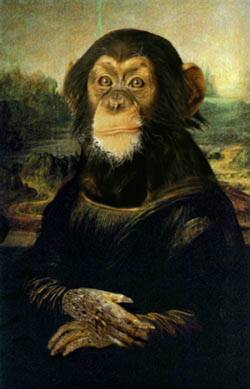
Mona Lisa’s Smile

Think, for a moment, about social occasions-visits, dates, dinners out with friends, gatherings, birthday parties, weddings, etc. Even when you’re unhappy or depressed, these occasions force us to act as if we were happy. Observing other’s faces, postures, and voices, we unconsciously mimic their reactions. We synchronize our movements, posture, and tone of voice with theirs. Then my mimicking happy people, we become happy. You begin to behave like the people who surround you, and that behavior influences your attitude.

Leonardo da Vinci also observed that it’s no mystery why it is fun to be around happy people and depressing to be around depressed people. He also observed the melancholy that painters usually give to portraits. He attributed that to the solitariness of the artist and their joyless environment. According to Giorgio Vasari (1568) that while painting the Mona Lisa Leonardo employed singers, musicians and jesters to chase away his melancholy as he painted. The musicians and jesters forced him laugh and be joyful. This behavior created the attitude of joy and pleasure as he painted. As a result, he painted a smile so pleasing that it seems divine and as alive as the original.

Even Facial Expressions Can Change Your Emotions

CIA researchers have long been interested in developing techniques to help them study facial expressions of suspects. Two of the researchers began simulating facial expressions of anger and distress all day, each day for weeks. One of them admitted feeling terrible after a session of making those faces. Then the other realized that he felt poorly, too, so they began to keep track. They began monitoring their body during facial movements. Their findings were remarkable. They discovered that a facial expression alone is sufficient to create marked changes in the nervous system.

In one exercise they raised their inner eyebrows, raised their cheeks, and lowered the corner of their lips and held this facial expression for a few minutes. They were stunned to discover that this simple facial expression generated feelings of sadness and anguish within them. The researchers then decided to monitor the heart rate and body temperatures of two groups of people. One group was asked to remember and relive the most sorrowful experience in their life. The other group in another room was simply asked to produce a series of facial expressions expressing sadness. Remarkably, the second group, the people who were pretending, showed the same physiological responses as the first.

The CIA researchers in a further experiment had one group of subjects listen to recordings of top comedians and look at a series of cartoons while holding a pen pressed between their lips an action that makes it impossible to smile. Another group held a pen between their teeth which had the opposite effect and made them smile. The people with the pen between their teeth rated the comedians and cartoons much funnier than the other group. What’s more, neither group of subjects knew they were making expressions of emotion. Amazingly, an expression you do not even know you have can create an emotion you did not choose to feel. Emotion doesn’t just go from the inside out. It goes from the outside in.

Try the following thought experiment.

•Lower your eyebrows.

•Raise your upper eyelid.

•Narrow the eyelids.Press your lips together.

Hold this expression and you will generate anger. Your heartbeat will go up ten or twelve beats. Your hands will get hot, and you will feel very unpleasant.

The next time you’re feeling depressed and want to feel happy and positive, try this.

•Put a pen between your teeth in far enough so that it’s stretching the edges of your mouth back without feeling uncomfortable. This will force a smile. Hold it there for five minutes or so. You’ll find yourself inexplicably in a happy mood. Then try walking with long strides and looking straight ahead. You will amaze yourself at how fast your facial expressions can change your emotions.

All in the Mind: The Animal Mind Audio

Tags

, , ,

From All in the Mind and Australian Broadcasting : Most of us have an intuitive feeling that our pet dogs or cats have thoughts and even feel emotions—but did you know that ants can teach, rats have a sense of humor, chimpanzees can deceive and elephants grieve? Scientists are discovering that animals’ cognitive and emotional processes are far more sophisticated than we once thought.  Listen/Download the audio here.

1902757_719741958047001_1385244069_n

Fighting the Drug Epidemic

Tags

Most communities across New Hampshire have been touched by the opioid crisis that’s taken the lives of more than 400 Granite Staters last year, a majority from heroin and fentanyl.21789-113979.jpg

But one place in the Lakes Region stands out not for its significantly high overdose numbers but rather how its community is responding

If you’re doing something illegal, the last person you’d willingly call is probably the police. Well that’s not always the case in Laconia – at least when it comes to using drugs.

“What do I do? My dealer is blowing up my phone, it’s driving me crazy. What do I do?,” said Police Officer Eric Adams, who was talking about one of the many calls he gets at all hours from those battling a drug addiction in the community. Read the entire article HERE.