• Home
  • Music
  • About
  • Contact
  • CreativeTherapyTools.com

RichardbBrunner

~ creative arts therapist

RichardbBrunner

Tag Archives: handout

Handout: Anger Words

03 Wednesday Jul 2024

Posted by RichardB in Creative Therapy Tools, Handout

≈ Comments Off on Handout: Anger Words

Tags

angry, groups, handout

Anger groups are usually straight forward …. OK, no group is like that. They each have their own dynamics which are dependent on many factors.

I used to work as a float at a hospital and would walk onto a unit to facilitate a group of (usually) adults with a mix of diagnoses none of whom I had ever met before. In those situations I usually keep it very basic and thus very safe.

The list of words below was generated over a few years of asking folks in groups,’what are your angry words’. I have not included the usual assortment of curse words but there were quite a few favorites in the uncensored list.

If a group is not very talkative, this list is a good way to start the conversation. I might ask folks to circle 6 words that most express their typical (or specific) anger. We then share, or if in a larger group have folks share with a partner.


ANGER WORDS
anger disgust grumpiness rage
aggravation dislike hate resentment


agitation envy hostility revulsion
annoyance exasperation irritation scorn
bitterness ferocity jealousy spite
contempt frustration loathing torment


cruelty fury mean-spiritedness vengefulness
destructiveness grouchiness outrage wrath
add your own …..

angry

Irrational Beliefs Guide

25 Wednesday Oct 2023

Posted by RichardB in Coping Skills

≈ Comments Off on Irrational Beliefs Guide

Tags

handout, Irrational Beliefs

Consider the following questions carefully. Reflectively answer each one briefly but completely regarding those people or things about which you are most emotionally disturbed. This assignment may be emotionally painful, but it may help you achieve needed insight so that you can end your pain.

  • Who or what disturbs or upsets you?
  • Who or what do you strongly believe should, ought, must, or have to be different?
  • Who or what do you strongly think is or awful, terrible, horrible, or catastrophic?
  • Who or what do you down, damn, condemn or believe is worthless?
  • Who or what do you believe is absolutely needed, necessary, or required?
  • What are the things you strongly believe are absolutes, extremes, or critically important?
  • Who or what do you most often or most strongly complain about?
  • What is your greatest wish that you believe you most likely won’t get?
  • What goal have you made (even unconsciously) into a demand because you not only want to but have convinced yourself you must achieve it?
  • What happened in your past from which you cannot recover?
  • What things do you find are, too hard, too much, too painful, too upsetting, or that you just can’t stand?
  • Who or what are you most likely to lose your temper over?
  • What are the biggest stresses in your life?
  • Who or what do you feel most helpless about?
  • Who or what do you feel most hopeless about?
  • What are your most strongly felt demands, wishes, or hopes?
  • What insight or awareness have you come to because of this exercise?

Ways to increase happiness

20 Wednesday Sep 2023

Posted by RichardB in Coping Skills

≈ Comments Off on Ways to increase happiness

Tags

guilt, handout, Happiness, sad, shame

The most important question to ask when you feel down

Sometimes it doesn’t feel like your brain wants you to be happy. You may feel guilty or shameful. Why?

Believe it or not, guilt and shame activate the brain’s reward center.

Despite their differences, pride, shame, and guilt all activate similar neural circuits, including the dorsomedial prefrontal cortex, amygdala, insula, and the nucleus accumbens. Interestingly, pride is the most powerful of these emotions at triggering activity in these regions — except in the nucleus accumbens, where guilt and shame win out. This explains why it can be so appealing to heap guilt and shame on ourselves — they’re activating the brain’s reward center.

And you worry a lot, too. Why? In the short term, worrying makes your brain feel a little better — at least you’re doing something about your problems.

In fact, worrying can help calm the limbic system by increasing activity in the medial prefrontal cortex and decreasing activity in the amygdala. That might seem counterintuitive, but it just goes to show that if you’re feeling anxiety, doing something about it — even worrying — is better than doing nothing.

But guilt, shame, and worry are horrible, long-term solutions. So what do neuroscientists say you should do? Ask yourself this question:

What am I grateful for?

Yeah, gratitude is awesome … but does it really affect your brain at the biological level? Yup.

You know what the antidepressant Wellbutrin does? Boosts the neurotransmitter dopamine. So does gratitude.

The benefits of gratitude start with the dopamine system, because feeling grateful activates the brain stem region that produces dopamine. Additionally, gratitude toward others increases activity in social dopamine circuits, which makes social interactions more enjoyable …

Know what Prozac does? Boosts the neurotransmitter serotonin. So does gratitude.

One powerful effect of gratitude is that it can boost serotonin. Trying to think of things you are grateful for forces you to focus on the positive aspects of your life. This simple act increases serotonin production in the anterior cingulate cortex.

I know, sometimes life lands a really mean punch in the gut and it feels like there’s nothing to be grateful for. Guess what?

Doesn’t matter. You don’t have to find anything. It’s the searching that counts.

It’s not finding gratitude that matters most; it’s remembering to look in the first place. Remembering to be grateful is a form of emotional intelligence. One study found that it actually affected neuron density in both the ventromedial and lateral prefrontal cortex. These density changes suggest that as emotional intelligence increases, the neurons in these areas become more efficient. With higher emotional intelligence, it simply takes less effort to be grateful.

And gratitude doesn’t just make your brain happy — it can also create a positive feedback loop in your relationships. So express that gratitude to the people you care about.

For more on how gratitude can make you happier and more successful.

But what happens when bad feelings completely overtake you? When you’re really in the dumps and don’t even know how to deal with it? There’s an easy answer …

Label negative feelings

You feel awful. OK, give that awfulness a name. Sad? Anxious? Angry?

Boom. It’s that simple. Sound stupid? Your noggin disagrees.

In one fMRI study, appropriately titled “Putting Feelings into Words” participants viewed pictures of people with emotional facial expressions. Predictably, each participant’s amygdala activated to the emotions in the picture. But when they were asked to name the emotion, the ventrolateral prefrontal cortex activated and reduced the emotional amygdala reactivity. In other words, consciously recognizing the emotions reduced their impact.

Suppressing emotions doesn’t work and can backfire on you.

Gross found that people who tried to suppress a negative emotional experience failed to do so. While they thought they looked fine outwardly, inwardly their limbic system was just as aroused as without suppression, and in some cases, even more aroused. Kevin Ochsner, at Columbia, repeated these findings using an fMRI. Trying not to feel something doesn’t work, and in some cases even backfires.

But labeling, on the other hand, makes a big difference.

To reduce arousal, you need to use just a few words to describe an emotion, and ideally use symbolic language, which means using indirect metaphors, metrics, and simplifications of your experience. This requires you to activate your prefrontal cortex, which reduces the arousal in the limbic system. Here’s the bottom line: describe an emotion in just a word or two, and it helps reduce the emotion.

Ancient methods were way ahead of us on this one. Meditation has employed this for centuries. Labeling is a fundamental tool of mindfulness.

Make that decision

Ever make a decision and then your brain finally feels at rest? That’s no random occurrence.

Brain science shows that making decisions reduces worry and anxiety — as well as helping you solve problems.

Making decisions includes creating intentions and setting goals — all three are part of the same neural circuitry and engage the prefrontal cortex in a positive way, reducing worry and anxiety. Making decisions also helps overcome striatum activity, which usually pulls you toward negative impulses and routines. Finally, making decisions changes your perception of the world — finding solutions to your problems and calming the limbic system.

But deciding can be hard. I agree. So what kind of decisions should you make? Neuroscience has an answer.

Make a “good enough” decision. Don’t sweat making the absolute 100% best decision. We all know being a perfectionist can be stressful. And brain studies back this up.

Trying to be perfect overwhelms your brain with emotions and makes you feel out of control.

Trying for the best, instead of good enough, brings too much emotional ventromedial prefrontal activity into the decision-making process. In contrast, recognizing that good enough is good enough activates more dorsolateral prefrontal areas, which helps you feel more in control …

So when you make a decision, your brain feels you have control. And, as I’ve talked about before, a feeling of control reduces stress. But here’s what’s really fascinating: Deciding also boosts pleasure.

Actively choosing caused changes in attention circuits and in how the participants felt about the action, and it increased rewarding dopamine activity.

We don’t just choose the things we like; we also like the things we choose.

Touch people

No, not indiscriminately; that can get you in a lot of trouble.

But we need to feel love and acceptance from others. When we don’t it’s painful. And I don’t mean “awkward” or “disappointing.” I mean actually painful.

Neuroscientists did a study where people played a ball-tossing video game. The other players tossed the ball to you and you tossed it back to them. Actually, there were no other players; that was all done by the computer program.

But the subjects were told the characters were controlled by real people. So what happened when the “other players” stopped playing nice and didn’t share the ball?

Subjects’ brains responded the same way as if they experienced physical pain. Rejection doesn’t just hurt like a broken heart; your brain feels it like a broken leg.

In fact, as demonstrated in an fMRI experiment, social exclusion activates the same circuitry as physical pain … at one point they stopped sharing, only throwing back and forth to each other, ignoring the participant. This small change was enough to elicit feelings of social exclusion, and it activated the anterior cingulate and insula, just like physical pain would.

Relationships are important to your brain’s feeling of happiness. Want to take that to the next level? Touch people.

One of the primary ways to release oxytocin is through touching. Obviously, it’s not always appropriate to touch most people, but small touches like handshakes and pats on the back are usually okay. For people you’re close with, make more of an effort to touch more often.

Touching is incredibly powerful. We just don’t give it enough credit. It makes you more persuasive, increases team performance, improves your flirting … heck, it even boosts math skills.

Touching someone you love actually reduces pain. In fact, when studies were done on married couples, the stronger the marriage, the more powerful the effect.

In addition, holding hands with someone can help comfort you and your brain through painful situations. One fMRI study scanned married women as they were warned that they were about to get a small electric shock. While anticipating the painful shocks, the brain showed a predictable pattern of response in pain and worrying circuits, with activation in the insula, anterior cingulate, and dorsolateral prefrontal cortex. During a separate scan, the women either held their husbands’ hands or the hand of the experimenter. When a subject held her husband’s hand, the threat of shock had a smaller effect. The brain showed reduced activation in both the anterior cingulate cortex and dorsolateral prefrontal cortex — that is, less activity in the pain and worrying circuits. In addition, the stronger the marriage, the lower the discomfort-related insula activity.

Sum up

Here’s what brain research says will make you happy:

  • Ask “What am I grateful for?” No answers? Doesn’t matter. Just searching helps.
  • Label those negative emotions. Give it a name and your brain isn’t so bothered by it.
  • Decide. Go for “good enough” instead of ‘best decision ever made on Earth.”
  • Hugs, hugs, hugs. Don’t text — touch.

Honesty Handout: Lies

23 Wednesday Aug 2023

Posted by RichardB in Creative Therapy Tools

≈ Comments Off on Honesty Handout: Lies

Tags

handout, Honesty

1. Figure out why you lie and who you lie to. We’ve all lied at one time or another, to different people, to ourselves, and for different reasons. But coming up with a systematic plan for becoming more honest will be difficult unless you try to define those reasons and those people for yourself.

Lies to make ourselves look better might include exaggerations, embellishments, and flat-out tall-tales we tell to others, and ourselves, to make ourselves feel better about our inadequacies. When you’re unhappy about something, it’s much easier to fill it in with lies than tell the truth.
o We lie to peers we think are better than us, because we want them to respect us as we respect them. Unfortunately, being dishonest is disrespectful in the long run. Give people more credit for their ability to empathize and understand you on a deeper level.
Lies that avoid embarrassment might include lies told to cover up bad behaviors, transgressions, or any activity we’re not proud of. If your mom found a pack of cigarettes in your jacket, you might lie and say that they’re your friend’s to avoid punishment.
We lie to authoritative figures to avoid embarrassment and punishment, including ourselves. When we’ve done something we feel guilty about, lies are told to eliminate the guilt, avoid the punishments, and get back to the objectionable behavior we’re forced to lie about. It’s a vicious cycle.

2. Anticipate behaviors that will make you feel guilty. To break the chain of embarrassment and lying, it’s important to learn to anticipate things that you’ll likely feel guilty about in the future, and avoid those behaviors. When you lie, you’re covering up some uncomfortable truth that’s more easily couched in a lie. You can either get comfortable with the truth, or abandon the behavior that makes you embarrassed.
If you smoke cigarettes, you won’t have to lie if everyone knows it’s true. Own up to it. If a behavior is un-own-upable, it’s probably best to avoid it. It would be humiliating for your wife to find out that you had an inappropriate relationship with a coworker, but you won’t have to lie if you don’t do it.

3. Avoid situations in which you’ll have to lie for others. Be wary when someone tells you something in confidence that you know that you should share with someone else (e.g., knowledge of a crime, a lie, or a harmful act against another). Hearing such information puts you in a difficult position, especially when the truth eventually emerges and reveals to the affected person that you knew all along.
If someone begins a sentence with “Don’t tell so-and-so about this, okay?” be prepared to offer your own disclaimer: “If it’s something that I’d want to know about were I them, then please don’t tell me. I don’t want to be responsible for anyone’s secrets but my own.”

Handout: Characteristics of people in your life

16 Wednesday Aug 2023

Posted by RichardB in Creative Therapy Tools

≈ Comments Off on Handout: Characteristics of people in your life

Tags

characteristics, handout, Mens group, process

Here is a simple and potentially deep handout. It developed out of a process conversation in Mens group when I asked who was the first person to turn you onto drugs or alcohol. From that question and conversation came the next which was what character traits did that person have. After many Mens groups it eventually developed into the handout below. Sometimes I combine who first turned you on with other people who had an influence. Sometimes I add: what characteristics does a person in recovery have, or what are your characteristics?

Ideally this is a conversation, but if your group is not open to sharing than I hand out a sheet with the questions and folks write out their answers and than we share.

The Handout: List four people in your life that have had an influence, affect, change. Two positive and two negative. What aspects stood out in their characteristics; (respectful, kind, stingy, generous, loner, peple person, ect).

Being Disturbed About Being Disturbed

07 Wednesday Jun 2023

Posted by RichardB in Coping Skills

≈ Comments Off on Being Disturbed About Being Disturbed

Tags

CBT, handout

Isn’t it bad enough to be disturbed about events? Now you find out you can even be disturbed about being disturbed about the event.

A person is so afraid to ride in an elevator, that they develop a phobia about it. Soon, not only anxious about elevators, they worry about anxiety about elevators. “Something is drastically wrong with me,” they think; “Maybe I’m going crazy.” “I should not be so anxious about elevators that I can’t use them; that’s an awful problem; I can’t stand to have this fear; I must certainly be inadequate.” “I know I’m losing control; soon I’ll bet I won’t be able to take care of myself at all; I’ll wind up in a mental hospital.”

Can you see how they are not only fearful of elevators, but down on themselves for being afraid of them? In this case there are two A-B-C sets:

  • Activating event A1: Elevator ride
  • Irrational belief B1: “I couldn’t stand to be trapped forever.”
  • Emotional consequence C1: Anxiety (about being trapped).
  • Activating event A2: Anxiety at C1 (about being trapped).
  • Irrational belief B2: “I should not be anxious about elevators.”
  • Emotional consequence C2: “I’m crazy.” Anxiety (about the anxiety).

We might find it more efficient to work on the secondary set of A-B-C’s first. Once the person can think differently (more rationally) about having an emotional reaction, they may be more able to concentrate on working through the first set of A-B-C’s.

Do you also have a few sets of secondary A-B-C’s that prevent you from making progress?

What works and will work for you handout

25 Wednesday Jan 2023

Posted by RichardB in Coping Skills, Handout

≈ Comments Off on What works and will work for you handout

Tags

handout

With this handout I usually had folks write in the category areas what worked for them, what didn’t work, and what will work in the future.

Cognitive Distortions

18 Wednesday Jan 2023

Posted by RichardB in Handout, Uncategorized

≈ Comments Off on Cognitive Distortions

Tags

Distortions, Group Therapy, handout

A basic handout I have used with groups. Ideally I use handouts only to get a conversation going. The handout becomes a frame work for people to open up and start sharing.

Cognitive Distortions and Strategies to dispute them

  • Personalizing: When you blame yourself entirely as the cause of something or blame someone else as the sole reason why something happens . “It’s my fault ” “It’s his/her fault.”
    Strategy: Don’t look for blame. Find other causes. List other possibilities.
  • All or nothing/black and white thinking: When you use extreme terms, “all”, “never”, “none”, “everybody”, “no one”. Also watch for “can’t”.
    Strategy: Look for gray areas. Modify your language by substituting less extreme terms such as “some”, “often”, “most”.
  • Catastrophizing: When you predict or expect the worst will happen.
    Strategy: Expect more positive outcomes and possibilities.
  • Should-ing: When you refer to (or rely on) your list of inflexible rules of acceptable behavior and believe you’re guilty or unworthy if you violate the rules. Or, when you get angry with others if they break the (your) rules. This results in “always having to be right “, or being “super human” or “perfect”.
    Strategy: Change your language: “I should/must” to “I’d prefer” or “I’d rather”.
  • Over-generalizing: When you make an overall assessment based on one example or incident.
    Strategy: Remember that no one situation can exactly predict future outcomes. Look for individuality in each case. Remember that possibilities may exist that have not existed before by recognizing that you have the ability to change, and that things are always changing.
  • Fallacy of fairness: When you expect things to work out based on some unseen system of “karma”, balance, morality, payback, justice, or what “should be fair”.
    Strategy: Change your expectations. There is no inherent system of fairness. Things can happen for no apparent reason.
  • Labeling/Name calling: When you attach powerful words or labels to yourself or others as if those words describe you, or them, or the situation completely. “This day is terrible”, or I’m stupid”.
    Strategy: Define the term, see if it is really accurate. Use only accurate terms. Avoid intense labeling and name-calling. Use less weighted, destructive or inflammatory words. Are you using a double standard? Are you judging yourself more harshly than others would judge you or than you would judge others?
  • Emotional reasoning: When you use your emotions or feelings as proof of how things are. “I feel so sad; things must be hopeless”.
    Strategy: Evaluate the evidence objectively. Feelings are not proof of how things are or will be. Recognize that emotions change.
  • Mind-reading: When you know what others are thinking and why they act the way they do. Particularly, you “know” how people think and feel about you.
    Strategy: Seek other explanations for why people behave the way they do. Don’t assume. Check it out. Ask for their thoughts, opinions and feedback. Remind yourself that you don’t know what they are thinking.
  • Disqualifying the positive: When you devalue anything “good” in a particular situation in light of the “bad”.
    Strategy: Make an accurate assessment. See that “negatives” or “shortcomings” don’t erase strengths and assets, but that these can co-exist.
  • Comparing: When you measure yourself against others, focusing on their accomplishments and attributes, or when you compare yourself to your own ideal.
    Strategy: One can’t compare apples and oranges. We’re all different with different qualities. We can usually find somebody who may be “better” in some way. So what? That doesn’t help. Focus on your own inherent worth and aspirations instead.

Anger Group

11 Wednesday Jan 2023

Posted by RichardB in Anger, Anxiety, emotions, Handout, Mental Health

≈ Comments Off on Anger Group

Tags

anger, handout, therapy

feelings-07Once a week I facilitate a anger management group. I use a variety of handouts and activities to have a process oriented group interaction. One of the hand outs I use is below. I use it in 1 of 2 ways. I have folks fill it out first and then we discuss or we go through it together and discuss. We explore as a group, learning from each other.

ANGER WORDS

anger disgust grumpiness rage  aggravation dislike hate resentment  agitation envy hostility revulsion  annoyance exasperation irritation scorn  bitterness ferocity jealousy spite  contempt frustration loathing torment  cruelty fury mean-spiritedness vengefulness  destructiveness grouchiness outrage wrath

Other:_________________________

Prompting Events for Feeling Anger

Losing power.

Losing status.

Losing respect.

Being insulted.

Not having things turn out the way you expected.

Experiencing physical pain.

Experiencing emotional pain.

Being threatened with physical or emotional pain by someone or something.

Having an important or pleasurable activity interrupted, postponed, or stopped.

Not obtaining something you want (which another person has).

Other:_______________________________

Interpretations That Prompt Feelings of Anger

Expecting pain.

Feeling that you have been treated unfairly.

Believing that things should be different.

Rigidly thinking “I’m right.”

Judging that the situation is illegitimate, wrong, or unfair.

Ruminating about the event that set off the anger in the first place, or in the past.

Other:____________________________

Experiencing the Emotion of Anger

Feeling incoherent.

Feeling out of control.

Feeling extremely emotional.

Feeling tightness or rigidity in your body.

Feeling your face flush or get hot.

Feeling nervous tension, anxiety or discomfort.

Feeling like you are going to explode.

Muscles tightening. .

Teeth clamping together, mouth tightening.

Crying; being unable to stop tears.

Wanting to hit, bang the wall, throw something, blow up.

Other:__________________________

Expressing and Acting on Anger

Frowning or not smiling; mean or unpleasant facial expression.

Gritting or showing your teeth in an unfriendly manner.

Grinning.

A red or flushed face.

Verbally attacking the cause of your anger; criticizing.

Physically attacking the cause of your anger.

Using obscenities or cursing.

U sing a loud voice, yelling, screaming, or shouting.

Complaining or bitching; talking about how lousy things are.

Clenching your hands or fists.

Making aggressive or threatening gestures.

Pounding on something, throwing things, breaking things.

Walking heavily or stomping; slamming doors, walking out.

Brooding or withdrawing from contract with others.

Other:_____________________

Aftereffects of Anger

Narrowing of attention.

Attending only to the situation making you angry.

Ruminating about the situation making you angry and not being able to think of anything else.

Remembering and ruminating about other situations that have made you angry in the past.

Imagining future situations that will make you angry.

Depersonalization, dissociative experience, numbness.

Intense shame, fear, or other negative emotions.

Other:______________________

Men and Depression

21 Wednesday Dec 2022

Posted by RichardB in Depression, Handout, men

≈ Comments Off on Men and Depression

Tags

depression, handout, men

In my years of facilitating groups I have on occasion facilitated men only groups. One issue that comes up is depression. We all have bouts of sadness now and then and when those bouts of sadness interfere with our daily lives than we need to take a step in the direction of change. Below is part of a handout I often use, particularly with dual diagnosed men.  

Symptoms of Depression

Not everyone who is depressed or manic experiences every symptom. Some people experience only a few; some people suffer many. The severity of symptoms varies among individuals and also over time.

· Persistent sad, anxious, or “empty” mood.

· Feelings of hopelessness or pessimism.

· Feelings of guilt, worthlessness, or helplessness.

· Loss of interest or pleasure in hobbies and activities that were once enjoyable

· Decreased energy, fatigue; feeling “slowed down.”

· Difficulty concentrating, remembering, or making decisions.

· Trouble sleeping, early-morning awakening, or oversleeping.

· Changes in appetite and/or weight.

· Thoughts of death or suicide, or suicide attempts.

· Restlessness or irritability.

· Persistent physical symptoms, such as headaches, digestive disorders, and chronic pain that do not respond to routine treatment.

Co-Occurrence of Depression with Other Illnesses

Depression can coexist with other illnesses. In such cases, it is important that the depression and each co-occurring illness be appropriately diagnosed and treated. Research has shown that anxiety disorders which include post-traumatic stress disorder (PTSD), obsessive-compulsive disorder, panic disorder, social phobia, and generalized anxiety disorder commonly accompany depression.

Substance use disorders (abuse or dependence) also frequently co-occur with depressive disorders. Research has revealed that people with drug and/or alcohol addiction are almost twice as likely to experience depression.

Depression has been found to occur at a higher rate among people who have other serious illnesses such as heart disease, stroke, cancer, HIV, diabetes, and Parkinson’s.

Causes of Depression

Very often, a combination of cognitive, genetic, and environmental factors is involved in the onset of depression. Modern brain-imaging technologies reveal that, in depression, neural circuits responsible for the regulation of moods, thinking, sleep, appetite, and behavior fail to function properly.

In some families, depressive disorders seem to occur generation after generation; however, they can also occur in people with no family history of these illnesses. Genetics research indicates that risk for depression results from the influence of specific multiple genes acting together with non-genetic factors.

Environmental factors such as trauma, loss of a loved one, a difficult relationship, financial problem, or any stressful change in life patterns, whether the change is unwelcome or desired, can trigger a depressive episode in vulnerable individuals. Once someone experiences a bout of depression later episodes of depression may occur without an obvious cause.

Men and Depression

Men are more likely than women to report alcohol and drug abuse or dependence in their lifetime; however, there is debate among researchers as to whether substance use is a “symptom” of underlying depression in men or a co-occurring condition that more commonly develops in men. Nevertheless, substance use can mask depression, making it harder to recognize depression as a separate illness that needs treatment.

Instead of acknowledging their feelings, asking for help, or seeking appropriate treatment, men may turn to alcohol or drugs when they are depressed, or become frustrated, discouraged, angry, irritable, and, sometimes, violently abusive. Some men deal with depression by throwing themselves compulsively into their work, attempting to hide their depression from themselves, family, and friends. Other men may respond to depression by engaging in reckless behavior, taking risks, and putting themselves in harm’s way.

Positive Traits Handout

23 Wednesday Nov 2022

Posted by RichardB in Addiction, Creative Therapy Tools, groups, Handout, positive

≈ Comments Off on Positive Traits Handout

Tags

handout, positive traits, Self Esteem

This handout is a quick way to start the conversation in groups. I have folks circle the 10 traits that they (think/feel) have. Than I ask them to put them in a numbered order (1 to 10), best to worst. One day someone suggested that they had way more negative traits so…. I started asking folks (after they shared the positive traits) to write their negative traits on the back and share.

Most of the people that I worked with for the last 10 years were men between 20 and 35. Most had started using intoxicants as teens with cannabis and moved onto oxie and later stronger opioids and/or fentanyl. Most had felony possession charges and/or were on probation.

I kept a lose record of what people chose as their top 3 positive traits: 1. Hardworking, 2. Reliable, 3. Strong. One last thing, I usually asked folks at the end of group would their loved ones and/or family (however they chose to define that) agree with their list of positive traits. Most said (hell) no.

Anxiety Handout

26 Wednesday Oct 2022

Posted by RichardB in Coping Skills, Handout

≈ Comments Off on Anxiety Handout

Tags

Anxiety, handout

We all know the uncomfortable feeling of anxiety. Our hearts race, our fingers sweat, and our breathing gets shallow and labored. We experience racing thoughts about a perceived threat we fear will be too much to handle. That’s because our “fight or flight” response has kicked in, resulting in sympathetic arousal and a narrowing of attention and focus on avoiding the threat. We seem to be locked in that state, unable to focus on our daily chores or longer-term goals. Below are six strategies that you can use to help relieve your everyday anxiety:

  • Reevaluate the probability of the threatening event actually happening.

Anxiety makes us feel that a threat is imminent, yet most of the time what we worry most about never happens. By recording our worries—and how few actually came true—we can notice how much we overestimate the prospect of negative events.

  • De-catastrophize.

Even if a bad event happened, we may still be able to handle it by using  coping skills and problem-solving abilities or by enlisting others to help. Although not pleasant, we could still survive encountering a spider, having a panic attack, or losing money. It’s important to realize that very few things are the end of the world.

  • Use deep breathing and relaxation.

By deliberately relaxing our muscles we begin to calm down so we can think clearly. If you practice this at first without a threat present, it can start to become automatic and will be easier to use in the moment when you face a threat. Deep breathing engages the parasympathetic nervous system to put the brakes on sympathetic arousal.

  • Become mindful of your own physical and mental reactions.

The skill of mindfulness involves calmly observing our own reactions, including fear, without panic or feeling compelled to act. It can be taught in therapy and improves with practice.

  • Accept fear and commit to living a life based on core values.

Acceptance and Commitment Therapy (ACT) is an approach that encourages people to accept the inevitability of negative thoughts and feelings and not try to repress or control them. By directing attention away from the fear and back onto life tasks and valued goals, we can live a full life despite the fear.

  • Exposure.

Exposure is the most powerful technique for anxiety and it involves facing what we fear and staying in the situation long enough for the fear to habituate or go down, as it naturally does. Fear makes us avoid or run away, so our minds and bodies never learn that much of what we fear is not truly dangerous.

Anger Handout

12 Wednesday Oct 2022

Posted by RichardB in Coping Skills, Handout

≈ Comments Off on Anger Handout

Tags

anger, handout

I often work with groups I have never met before. When I walk into group I start to evaluate and access right away. For psych-educational groups I mostly focus on do I need to pull out a handout or not. That decision depends on the openness of the folks. Do they greet me verbally, with postures and/or gestures, eye contact, expressions of thoughts/feelings, where and how they are sitting.

In most places I have worked I would facilitate an anger management group. I used a variety of handouts and activities to have a process oriented group interaction. One of the handouts I use is below. I use it in 1 of 2 ways. I have folks fill it out first and then we discuss or we discuss while filling it out. Both ways we explore as a group, learning from each other.

ANGER WORDS

anger disgust grumpiness rage  aggravation dislike hate resentment  agitation envy hostility revulsion  annoyance exasperation irritation scorn  bitterness ferocity jealousy spite  contempt frustration loathing torment  cruelty fury mean-spiritedness vengefulness  destructiveness grouchiness outrage wrath

Other:_________________________

Prompting Events for Feeling Anger

Losing power.

Losing status.

Losing respect.

Being insulted.

Not having things turn out the way you expected.

Experiencing physical pain.

Experiencing emotional pain.

Being threatened with physical or emotional pain by someone or something.

Having an important or pleasurable activity interrupted, postponed, or stopped.

Not obtaining something you want (which another person has).

Other:_______________________________

Interpretations That Prompt Feelings of Anger

Expecting pain.

Feeling that you have been treated unfairly.

Believing that things should be different.

Rigidly thinking “I’m right.”

Judging that the situation is illegitimate, wrong, or unfair.

Ruminating about the event that set off the anger in the first place, or in the past.

Other:____________________________

Experiencing the Emotion of Anger

Feeling incoherent.

Feeling out of control.

Feeling extremely emotional.

Feeling tightness or rigidity in your body.

Feeling your face flush or get hot.

Feeling nervous tension, anxiety or discomfort.

Feeling like you are going to explode.

Muscles tightening. .

Teeth clamping together, mouth tightening.

Crying; being unable to stop tears.

Wanting to hit, bang the wall, throw something, blow up.

Other:__________________________

Expressing and Acting on Anger

Frowning or not smiling; mean or unpleasant facial expression.

Gritting or showing your teeth in an unfriendly manner.

Grinning.

A red or flushed face.

Verbally attacking the cause of your anger; criticizing.

Physically attacking the cause of your anger.

Using obscenities or cursing.

U sing a loud voice, yelling, screaming, or shouting.

Complaining or bitching; talking about how lousy things are.

Clenching your hands or fists.

Making aggressive or threatening gestures.

Pounding on something, throwing things, breaking things.

Walking heavily or stomping; slamming doors, walking out.

Brooding or withdrawing from contract with others.

Other:_____________________

After effects of Anger

Narrowing of attention.

Attending only to the situation making you angry.

Ruminating about the situation making you angry and not being able to think of anything else.

Remembering and ruminating about other situations that have made you angry in the past.

Imagining future situations that will make you angry.

Depersonalization, dissociative experience, numbness.

Intense shame, fear, or other negative emotions.

Other:______________________

Emotional Intelligence

28 Wednesday Sep 2022

Posted by RichardB in Coping Skills

≈ Comments Off on Emotional Intelligence

Tags

handout

I often work with groups using lists. In creative arts therapy as well as educational and process oriented groups lists are a great framework to explore thoughts, and/or feelings. Here is a list that often comes up in groups: ten suggestions about feelings.

1. Become emotionally literate.

Label your feelings, rather than labeling people or situations.

Use three word sentences beginning with “I feel”.

“I feel impatient.” vs “This is ridiculous.” I feel hurt and bitter”. vs. “You are an insensitive jerk.”

“I feel afraid.” vs. “You are driving like an idiot.”

2. Distinguish between thoughts and feelings.

Thoughts: I feel like…& I feel as if…. & I feel that

Feelings: I feel: (feeling word)

3. Take more responsibility for your feelings.

“I feel jealous.” vs. “You are making me jealous.”

Analyze your own feelings rather than the action or motives of other people. 

Let your feelings help you identify your unmet emotional needs.

4. Use your feelings to help make decisions

“How will I feel if I do this?” “How will I feel if I don’t?”

“How do I feel?” “What would help me feel better?”

Ask others “How do you feel?” and “What would help you feel better?”

5. Use feelings to set and achieve goals

6. Feel energized, not angry.

Use what others call “anger” to help feel energized to take productive action.

7. Validate other people’s feelings.

Show empathy, understanding, and acceptance of other people’s feelings.

8. Use feelings to help show respect for others.

How will you feel if I do this? How will you feel if I don’t? Then listen and take their feelings into consideration.

9. Don’t advise, command, control, criticize, judge or lecture to others.

Instead, try to just listen with empathy and non-judgment.

10. Avoid people who invalidate you. While this is not always possible, at least try to spend less time with them, or try not to let them have psychological power over you.

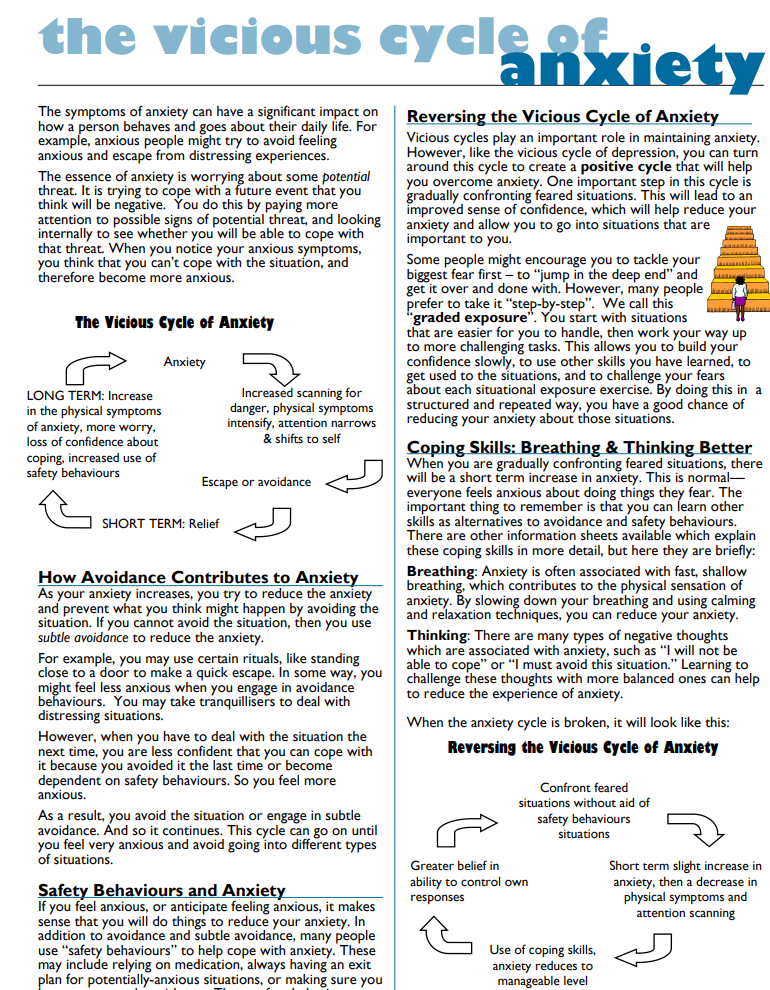
Cycle of Anxiety Handout

14 Wednesday Sep 2022

Posted by RichardB in Handout, Uncategorized

≈ Comments Off on Cycle of Anxiety Handout

Tags

Anxiety, handout

I usually used this handout with a guided relaxation after.

Irrational Statements

07 Wednesday Sep 2022

Posted by RichardB in Coping Skills, Handout

≈ Comments Off on Irrational Statements

Tags

handout, Irrational Beliefs

When we think (and strongly believe!), really irrational stuff, we are most likely thinking one or more of the following:

  • “Things should (ought, must, have to) be different than they are!”
  • “It’s awful (horrible, terrible, catastrophic) that they aren’t!”
  • “I can’t stand it (it’s too long, too much, too big, too painful)!”
  • “Somebody here is a jerk!”
  • “Because I have failed, I’ll always fail!”

Sure, there are other possible irrational statements, but these are among the most frequent, I believe; these are the big five. They represent “must”, “awfulizing”, “low frustration tolerance (LFT)”, and “condemning” beliefs.

A fellow maniac of the freeways cuts you off at the pass. You flip into overdrive rage: “Hey, jerk!” “You learn to drive in your living room (translation: He shouldn’t drive like that)?” “That’s the way to get people killed (translation: That’s awful)!” “I can’t stand drivers like that (translation: I can’t stand driver’s like you)!” You only needed three of the five crazy beliefs here.

I find these five statements are frequently part of the irrational thinking that gets people in trouble. If you work diligently to notice these irrational beliefs, that is the first step in having control.

If you have a little difficulty seeing that you believe these crazy ideas, just pay attention to what goes through your mind when you feel upset. That’s the way it sometimes is with “new thinking;” we need a little time and pushing to catch it. Be patient with yourself, and you’ll catch on, too.

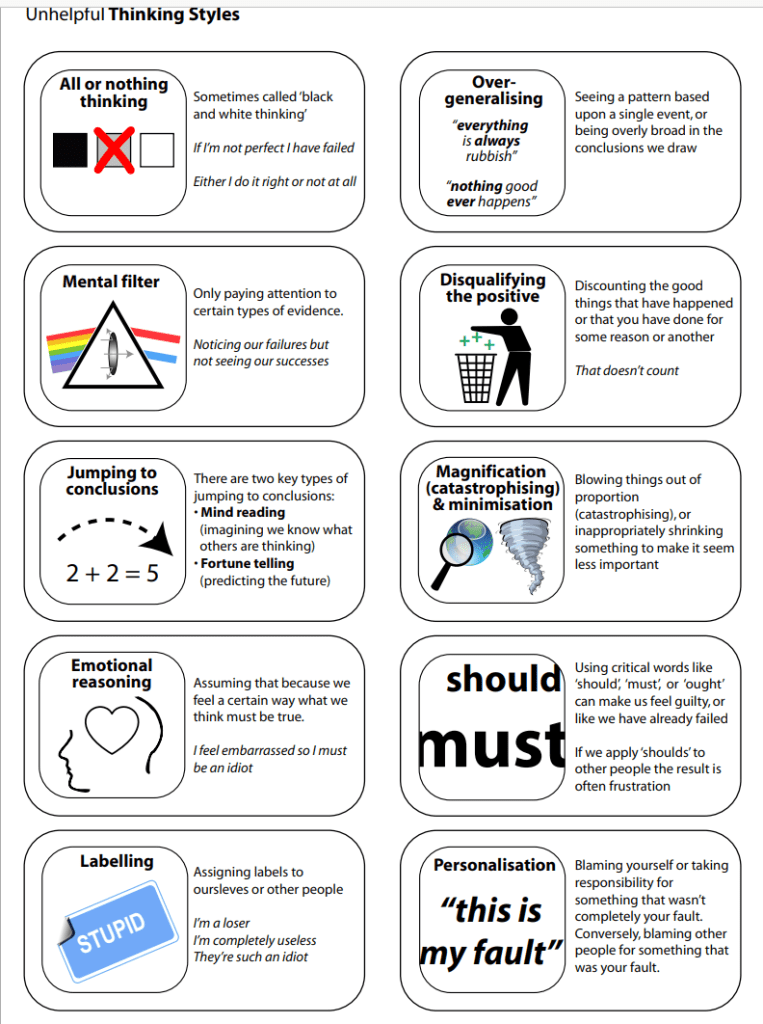
Handout: Unhelpful Thinking Styles

24 Wednesday Aug 2022

Posted by RichardB in Coping Skills, Handout

≈ Comments Off on Handout: Unhelpful Thinking Styles

Tags

handout, Thinking

Another handout to start the conversation in groups. If the group I am working with engages easily I will just use one copy. I have people, one at a time read a thinking style and we talk about it.

If the group does not engage easily I past out copies to everyone and they circle one or two and we discuss.

At the end of group (and most groups I do) I ask if this handout was useful or not, if there is anything that can be done to make it better.

Positive Statements Handout

11 Thursday Aug 2022

Posted by RichardB in Coping Skills, Handout

≈ Comments Off on Positive Statements Handout

Tags

Group Therapy, handout, Self Esteem

About 75% of Psycho-educational groups I have facilitated over the decades have basicly been coping skills. This handout is for a self esteem group and usually generated engagement.

To begin I ask folks to fill out this handout and than we talk about it. Having a handout helps to facilitate interactions with clients, encouraging them to share …. which in ideal situations leads to a more open discussion, moving away from the handout but staying with the theme. If we have all shared and a new discussion does not evolve I ask the group what other questions should we ask …. and than we ask.

Positive Statements about you

1. I like myself because:

2. I’m an expert at:

3. I feel good about:

4. My friends would tell you I have a great:

5. My favorite place is:

6. I’m loved by:

7. People say I am a good:

8. I’ve been told I have:

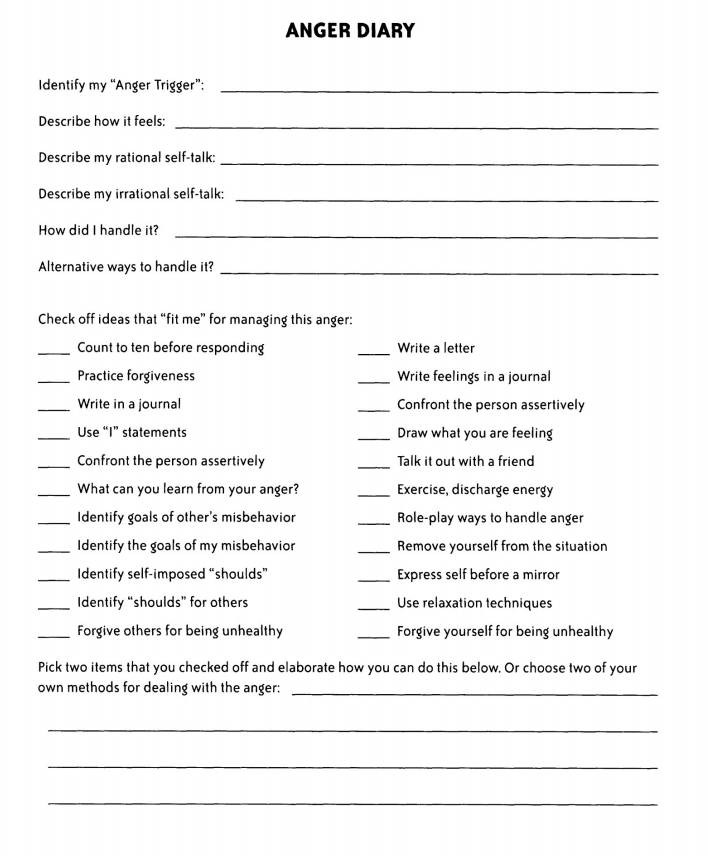
Anger Diary Handout

30 Thursday Jun 2022

Posted by RichardB in Coping Skills, Handout

≈ Comments Off on Anger Diary Handout

Tags

anger, handout

I spent years leading an anger management group and this handout was one I used when groups had difficulty engaging.

As in all groups at the end I asked people if this handout was useful or not and what could be done to make it better. Most said that it was somewhat useful. This handout was not my first choice in working with groups.

Manage stress handout

23 Thursday Jun 2022

Posted by RichardB in Coping Skills, Handout, Stress

≈ Comments Off on Manage stress handout

Tags

Anxiety, handout

If your methods of coping with stress aren’t contributing to your greater emotional and physical health, it’s time to find healthier ones. There are many healthy ways to manage and cope with stress, but they all require change. You can either change the situation or change your reaction. When deciding which option to choose, it’s helpful to think of the four As: avoid, alter, adapt, or accept.

Since everyone has a unique response to stress, there is no “one size fits all” solution to managing it. No single method works for everyone or in every situation, so experiment with different techniques and strategies. Focus on what makes you feel calm and in control.

Dealing with Stressful Situations: The Four A’s

Change the situation: Avoid the stressor. Alter the stressor.Change your reaction: Adapt to the stressor. Accept the stressor.

1. Avoid unnecessary stress

Not all stress can be avoided, and it’s not healthy to avoid a situation that needs to be addressed.

Learn how to say “no” – Know your limits and stick to them.

Avoid people who stress you out –Limit the amount of time you spend with people that cause you stress. 

Take control of your environment – If the evening news makes you anxious, turn the TV off.

Avoid hot-button topics –If you repeatedly argue about the same subject with the same people, stop bringing it up or excuse yourself when it’s the topic of discussion.

Pare down your to-do list –If you’ve got too much on your plate, distinguish between the “shoulds” and the “musts.”

2. Alter the situation

If you can’t avoid a stressful situation, try to alter it. Figure out what you can do to change things so the problem doesn’t present itself in the future.

Express your feelings instead of bottling them up. If something or someone is bothering you, communicate your concerns in an open and respectful way.

Be willing to compromise. When you ask someone to change their behavior, be willing to do the same.

Be more assertive. Deal with problems head on, doing your best to anticipate and prevent them.

Manage your time better. Plan ahead and make sure you don’t overextend yourself.

3. Adapt to the stressor

If you can’t change the stressor, change yourself. You can adapt to stressful situations and regain your sense of control by changing your expectations and attitude.

Reframe problems. Try to view stressful situations from a more positive perspective.

Look at the big picture. Will it matter in a month, or a year?

Adjust your standards. Set reasonable standards for yourself and others, and learn to be okay with “good enough.”

Focus on the positive. When stress is getting you down, take a moment to reflect on all the things you appreciate in your life, including your own positive qualities and gifts.

4. Accept what you can’t change

Some sources of stress are unavoidable, in such cases; the best way to cope with stress is to accept things as they are. Acceptance may be difficult, but in the long run, it’s easier than railing against a situation you can’t change.

Don’t try to control the uncontrollable. Focus on the things you can control such as the way you choose to react to problems.

Look for the upside. As the saying goes, “What doesn’t kill us makes us stronger.” When facing major challenges, try to look at them as opportunities for personal growth.

Share your feelings. Talk to a trusted friend or make an appointment with a therapist.

Learn to forgive. Accept the fact that we live in an imperfect world and that people make mistakes.

5. Make time for fun & relaxation

You can reduce stress in your life by nurturing yourself. If you regularly make time for healthy fun and relaxation, you’ll be in a better place to handle life’s stressors.

Healthy ways to relax and recharge

Go for a walk. Spend time in nature. Call a good friend. Exercise. Write in your journal. Take a long bath. Light scented candlesPlay with a pet. Work in your garden. Get a massage. Curl up with a good book. Listen to music. Watch a comedy

Nurturing yourself is a necessity, not a luxury.

Set aside relaxation time. Include rest and relaxation in your daily schedule..

Connect with others. Spend time with positive people who enhance your life.

Do something you enjoy every day. Make time for leisure activities that bring you joy, whether it be stargazing, playing the piano, or working on your bike.

Keep your sense of humor. This includes the ability to laugh at yourself.

6. Adopt a healthy lifestyle

You can increase your resistance to stress by strengthening your physical health. 

Exercise regularly. Physical activity plays a key role in reducing and preventing the effects of stress.

Eat a healthy diet. Well-nourished bodies are better prepared to cope with stress, so be mindful of what you eat.

Reduce caffeine and sugar. The temporary “highs” caffeine and sugar provide often end in with a crash in mood and energy. By reducing the amount of coffee, soft drinks, chocolate, and sugar snacks in your diet, you’ll feel more relaxed and you’ll sleep better.

Avoid alcohol, cigarettes, and drugs. Self-medicating with alcohol or drugs may provide an easy escape from stress, but the relief is only temporary.

Get enough sleep. Adequate sleep fuels your mind, as well as your body. Feeling tired will increase your stress because it may cause you to think irrationally.

← Older posts

instagram

Follow RichardbBrunner on WordPress.com
  • Tumblr
  • YouTube

Blog at WordPress.com.

Privacy & Cookies: This site uses cookies. By continuing to use this website, you agree to their use.
To find out more, including how to control cookies, see here: Cookie Policy
  • Subscribe Subscribed
    • RichardbBrunner
    • Join 491 other subscribers
    • Already have a WordPress.com account? Log in now.
    • RichardbBrunner
    • Subscribe Subscribed
    • Sign up
    • Log in
    • Report this content
    • View site in Reader
    • Manage subscriptions
    • Collapse this bar
 

Loading Comments...