Kathmandu & Water

Tags

,

Haphazard urbanization and political wrangling are seriously affecting people’s ability to realize their right to water in Nepal’s capital city. According to the Nepalese government’s Central Bureau of Statistics, one in every five Kathmandu households has no access to a domestic water source and two-thirds of its urban households live with an inadequate water supply. waterhands

Estimates show that the city of 4 million has a severe water deficit. The demand is triple the current supply of 106m liters a day , which further reduces to 75m liters a day during the dry season [PDF] . Despite growing demand, little has been done to increase supply. Read the full article at the Guardian.

VOTER REGISTRATION LISTS (and who can see them)

Tags

,

National Conference of State Legislatures has a list of how states provide information about their registered voters. Look up your state if you live in the US.

VOTER REGISTRATION LIST

This page provides 50-state information on access to voter lists. States have varied requirements on who is eligible to request a list of voters, what information the list contains, what information is kept confidential, and how information contained in voter lists may be used. Many states also have specific programs to keep all voter information confidential for certain classes of voters.

PASSAGE OF STRANGE QUARK MATTER THROUGH THE EARTH

Tags

, ,

I read this article a few years ago and it keeps poping up.

SMU RESEARCHERS DESCRIBE TWO SEISMIC EVENTS WITH THE PROPERTIES FOR THE PASSAGE OF STRANGE QUARK MATTER THROUGH THE EARTH

DALLAS (SMUNews) — Researchers from Southern Methodist University have described two seismic events that they believe may offer the first evidence of a previously undetected form of matter passing through the earth.

This form of matter — known as “strange quark matter” — is so dense that a ton-sized nugget would be about the size of a red blood cell. Physicists have suspected since 1984 that this very heavy form of matter might exist, but no one has yet found evidence of it.

In 1984, Harvard physicist and Nobel Laureate Sheldon L. Glashow suggested that one way such matter might be found would be if a physicist teamed up with a seismologist to search for traces of the matter that might have passed through the earth at supersonic speed. In 1993, SMU physicist Vidgor Teplitz asked Eugene Herrin, a seismologist in the Department of Geological Sciences in SMU’s Dedman College, to collaborate with him on the project. The two were assisted by David Anderson, a senior systems analyst in the Department of Geological Sciences, and Ileana Tibuleac, then a Ph.D. student in the Department of Geological Sciences.

In a paper submitted to the Bulletin of the Seismological Society of America and published online at http://xxx.lanl.gov/ (subject area: astrophysics), the SMU researchers describe how they found evidence of strange quark matter by searching through more than a million records of seismic events collected by the U.S. Geological Survey from 1990 to 1993 that were not associated with traditional seismic events such as earthquakes. These records of so-called “unassociated events” were collected from seismic stations set up around the world to monitor earthquakes and nuclear testing.

In a paper previously published in 1995 (available online at http://cornell.mirror.aps.org/abstract/PRD/v53/i12/p6762_1), Herrin and Teplitz had determined that it would be feasible to search for seismic events that might indicate passage of strange quark matter (also known as nuclearites) through the earth because such events would have a distinct seismic signal — a straight line. This would be caused by the large ratio of speed to the speed of sound in the earth. Herrin estimates that strange quark matter might pass through the earth at 250 miles per second, 40 times the speed of seismic waves. The team also determined that the minimum requirement for detection of a nuclearite would be detection of its signal by seven monitoring stations.

In their new paper, the SMU researchers describe two seismic events with the linear pattern they were looking for. One event occurred on Oct. 22, 1993, when something entered the Earth off Antarctica and left it south of India .73 of a second later. The other occurred on Nov. 24, 1993, when an object entered south of Australia and exited the Earth near Antarctica .15 of a second later. The first event was recorded at seven monitoring stations in India, Australia, Bolivia and Turkey, and the second event was recorded at nine monitoring stations in Australia and Bolivia.

“We can’t prove that this was strange quark matter, but that is the only explanation that has been offered so far,” Herrin said.

The SMU team is now trying to determine where the heavy quark matter may have come from. In April 2002, two different teams of scientists reported that they had identified collapsed stars that might be composed of ultradense strange quark matter. Scientists believe that chunks of strange quark matter might be created when stars made of strange quark matter collide.

Unfortunately, Herrin notes, seismologists may not be able to find any more events that suggest the passage of strange quark matter through the Earth. In 1993 the U.S. Geological Survey stopped collecting data from “unassociated events” such as those that the SMU team used in its research.


Related materials:

From the Play List Top songs I have listened to in 2015: Liv Lykke – Like a Rolling Stone

Tags

, ,

I have a 16,000 plus digital audio collection and I use Media Monkey to manage my files. One feature of Media Monkey is you can sort your collection based on the number of times played. This playlist is based on the top music and/or music video files I played/listened/streamed from my server. 2015 Playlist HERE.

What do our feline companions get up to?

Tags

,

Ever wondered what your cat spends its time doing when you’re not around? Where do our purring pets go when they disappear through the cat flap? Armed with GPS tracking devices and micro-cameras, a team from BBC Two’s Horizon programme in collaboration with the Royal Veterinary College set off to a Surrey village to find out. Discover more by clicking this link and selecting a cat.

DogsCats

The 2020 Election and the Future of U.S. Foreign Policy

Tags

, ,

The 2020 Election and the Future of U.S. Foreign Policy Panelists: Johnnie Carson, Assistant Secretary of State for African Affairs (2009-13) and Ambassador to Kenya (1999-2003), Zimbabwe (1995-1997), and Uganda (1991-1994); Chris Savos, Deputy Director of the Weapons Intelligence, Nonproliferation, and Arms Control Center, CIA and Vice President of Special Projects at JTG, Inc. and Director of Proficiency1; Anne Witkowsky, Deputy Assistant Secretary of Defense for Stability and Humanitarian Affairs (2014-16) and Deputy Coordinator for Homeland Security and Multilateral Affairs, Bureau of Counterterrorism, U.S. Department of State (2009-13)

Moderated by: Christianne Hardy, Interim Director, Dickey Center Organized and hosted by the Dickey Center, Dartmouth College.

What we know about habits is wrong

Tags

DESPITE the our intentions the reality is that often our gym memberships will lapse, chocolate will replace carrots and Candy Crush will edge out Moby Dick.Tricep Stretch

It’s not (only) that we’re undisciplined slugs. It’s that much of what we know — or think we know — about habits is wrong. Here’s a primer that might help keep you off the couch and on the treadmill.

MYTH 1 We fail to change our habits — or start good new ones — because we lack willpower.

Not really, said Wendy Wood, a professor of psychology and business at the University of Southern California. Willpower, she said, is more about looking at those yummy chocolate chip cookies and refusing them. A good habit ensures you’re rarely around those chocolate chip cookies in the first place.

To create or change a habit, you have to think much more about altering your environment and patterns of living than work on steeling your mind, Professor Wood said, because “behavior is very much a product of environment.”

Habits — at least good ones — exist so we don’t have to resist temptation all the time. Imagine if every morning you had a debate with yourself about eating cake or cereal for breakfast. Instead, most of us form the habit of eating something relatively healthy for breakfast, which bypasses the lure of the cake altogether.

That’s why it’s sometimes easiest to start or break a habit during a major transition. This may sound counterintuitive, but a new house, job or relationship breaks old patterns, said Gretchen Rubin, author of the forthcoming book, “Better Than Before: Mastering the Habits of Our Everyday Lives.”

“People say wait a few days to get settled, but don’t,” she said. “Start right away.”

MYTH 2 We fall back on bad habits when stressed. In fact, good habits persist even in times of high anxiety, Professor Wood said. A study of which Professor Wood was one of the co-authors found that students who already had unhealthy diets would eat junk food when stressed, but those who already had the habit of eating well — or of reading a newspaper or of going feelings-54to the gym — were just as likely to do that.

MYTH 3 It takes about 21 days to break or make a habit.

That number seems to have cropped up in the 1960s and somehow became “fact” with no real proof. But in 2009, researchers in Britain decided to take a deeper look by studying how long it took participants to learn new habits, such as eating fruit daily or going jogging. The average was 66 days.

But individuals’ times varied greatly, from 18 days to 245 days, depending on temperament and, of course, the task involved. It will most likely take far less time to get into the habit of eating an apple every afternoon than of practicing the piano for an hour a day.

MYTH 4 You need positive thinking to break or make a habit.

“We find positive fantasy is not helpful and may even be hurtful when trying to reach a desired future or fulfill a wish,” said Gabriele Oettingen, a professor of psychology at New York University and the University of Hamburg.

Over years of research, she discovered that people need to pair optimistic daydreams about the future with identifying and imagining the obstacles that prevent them from reaching that goal — something she calls mental contrasting.

Say you want to stop being a procrastinator. The first step is easy. Imagine how it will feel if your work is completed with plenty of time to spare, if you can sleep instead of pulling an all-nighter, said Professor Oettingen, author of “Rethinking Positive Thinking.”

But don’t just resolve to stop procrastinating. The second step is to identify what holds you back from changing yourself. Is it fear that you won’t succeed? Is it the adrenaline rush of frantically working at the last minute? Is it because of negative feelings toward a boss or teacher?

The mental contrasting needs to be in the right order. It’s important to “experience our dreams, then switch gears and mentally face reality,” Professor Oettingen said.

Doing it the opposite way — imagining the obstacles and then fantasizing about changing habits — doesn’t seem to work as well, research shows.

MYTH 5 Doing things by rote, or habit, isn’t good in most cases. It’s better to be mindful of everything we do.

Research shows that most people repeat about 40 percent of their activities almost every day.

“We only have so much room in our brain,” said Ian Newby-Clark, an associate professor of psychology at the University of Guelph in Canada. “It would be incredibly taxing if we had to mindfully plan every step of our day.” Habits free us up so we can think about other things.

And while some habits are objectively bad — smoking, say, or being consistently late — most are subjective. “Habits are only good or bad to the extent they’re consistent or inconsistent with your goals,” Professor Wood of U.S.C. said. It’s a bad habit when “it starts interfering with other goals you have.”Creative minds 'mimic schizophrenia'

For example, many people said their resolution this year was to cut down the time they spend online.

But why? Because it’s an inherently bad thing to do? Or is it an obstacle to spending more time reading books or riding a bike or learning to knit?

After thinking about it, you may choose to spend less time on your computer or phone. Or you might decide it’s not so terrible in limited doses and shed the habit of feeling guilty about it.

MYTH 6 Everything in moderation.

“There’s a real difference among people about how easily they adapt to habits,” Ms. Rubin said. Some see habits as liberating; some see them as a trap. Some prefer to make a huge change all at once; others proceed step by step.

“I’m in the small minority that loves habits,” Ms. Rubin said, adding that she tends to find it easier to abstain from certain things altogether. For example, she eats no carbohydrates.

“People said I was doomed to failure, but it’s not true,” she said. But, she noted, “it’s a mistake to think the abstainer is more disciplined. For me it’s easier to be an abstainer than have to deliberate each time whether I can eat something or not. Others would go nuts if they abstain.”

That’s why you shouldn’t listen to people who tell you you’re doing it wrong if it works for you, she said.

Also, people shouldn’t fear that their habit will dissolve if they don’t practice it daily.

“If you lapse once or twice, you’re not ruined,” Professor Wood said. “That’s a misconception.”

And that leads to …

MYTH 7 Shame and guilt keep you on track.

No. People need to be kinder to themselves, showing self-compassion if they lapse, Ms. Rubin said. But it’s a fine balance between treating yourself kindly and making endless rationalizations and excuses.

“I might mindfully make an exception,” she said, such as choosing to eat a traditional Christmas cake every year. “But I’m not making excuses in the moment: I’ll hurt the hostesses’ feelings. You only live once. It’s the holidays.”

One last piece of advice: If you want to be in better shape, get a dog. Professor Wood said studies show dog owners have lower body mass indexes. But here’s the catch: That’s only true if you walk the animal.

like flowers

The most precious gift we can offer others is our presence. When mindfulness embraces those we love, they will bloom like flowers.Thich Nhat Hanh


Longwood-0052-sm.JPG

Drug addiction is complex

Tags

,

We’re told studies have proven that drugs like heroin and cocaine instantly hook a user. But it isn’t that simple – little-known experiments over 30 years ago tell a very different tale.

Drugs are scary. The words “heroin” and “cocaine” make people flinch. It’s not just the associations with crime and harmful health effects, but also the notion that these substances can undermine the identities of those who take them. One try, we’re told, is enough to get us hooked. This, it would seem, is confirmed by animal experiments. 0312ILIN03-web.jpg

Many studies have shown rats and monkeys will neglect food and drink in favour of pressing levers to obtain morphine (the lab form of heroin). With the right experimental set up, some rats will self-administer drugs until they die. At first glance it looks like a simple case of the laboratory animals losing control of their actions to the drugs they need. It’s easy to see in this a frightening scientific fable about the power of these drugs to rob us of our free will.

But there is more to the real scientific story, even if it isn’t widely talked about. The results of a set of little-known experiments carried out more than 30 years ago paint a very different picture, and illustrate how easy it is for neuroscience to be twisted to pander to popular anxieties. The vital missing evidence is a series of studies carried out in the late 1970s in what has become known as “Rat Park”. Canadian psychologist Bruce Alexander, at the Simon Fraser University in British Columbia, Canada, suspected that the preference of rats to morphine over water in previous experiments might be affected by their housing conditions.

To test his hypothesis he built an enclosure measuring 95 square feet (8.8 square metres) for a colony of rats of both sexes. Not only was this around 200 times the area of standard rodent cages, but Rat Park had decorated walls, running wheels and nesting areas. Inhabitants had access to a plentiful supply of food, perhaps most importantly the rats lived in it together.

Rats are smart, social creatures. Living in a small cage on their own is a form of sensory deprivation. Rat Park was what neuroscientists would call an enriched environment, or – if you prefer to look at it this way – a non-deprived one. In Alexander’s tests, rats reared in cages drank as much as 20 times more morphine than those brought up in Rat Park. 

Inhabitants of Rat Park could be induced to drink more of the morphine if it was mixed with sugar, but a control experiment suggested that this was because they liked the sugar, rather than because the sugar allowed them to ignore the bitter taste of the morphine long enough to get addicted. When naloxone, which blocks the effects of morphine, was added to the morphine-sugar mix, the rats’ consumption didn’t drop. In fact, their consumption increased, suggesting they were actively trying to avoid the effects of morphine, but would put up with it in order to get sugar.

Woefully incomplete’

The results are catastrophic for the simplistic idea that one use of a drug inevitably hooks the user by rewiring their brain. When Alexander’s rats were given something better to do than sit in a bare cage they turned their noses up at morphine because they preferred playing with their friends and exploring their surroundings to getting high.

Further support for his emphasis on living conditions came from another set of tests his team carried out in which rats brought up in ordinary cages were forced to consume morphine for 57 days in a row. If anything should create the conditions for chemical rewiring of their brains, this should be it. But once these rats were moved to Rat Park they chose water over morphine when given the choice, although they did exhibit some minor withdrawal symptoms.

You can read more about Rat Park in the original scientific report. A good summary is in this comic by Stuart McMillen. The results aren’t widely cited in the scientific literature, and the studies were discontinued after a few years because they couldn’t attract funding. There have been criticisms of the study’s design and the few attempts that have been made to replicate the results have been mixed.

Nonetheless the research does demonstrate that the standard “exposure model” of addiction is woefully incomplete. It takes far more than the simple experience of a drug – even drugs as powerful as cocaine and heroin – to make you an addict. The alternatives you have to drug use, which will be influenced by your social and physical environment, play important roles as well as the brute pleasure delivered via the chemical assault on your reward circuits

It suggests that even addictions can be thought of using the same theories we use to think about other choices, there isn’t a special exception for drug-related choices. Rat Park also suggests that when stories about the effects of drugs on the brain are promoted to the neglect of the discussion of the personal and social contexts of addiction, science is servicing our collective anxieties rather than informing us

From the Play List Top songs I have listened to in 2014: Noemi – Don’t Get Me Wrong

Tags

, ,

I have a 16,000 plus digital audio collection and I use Media Monkey to manage my files. One feature of Media Monkey is you can sort your collection based on the number of times played. This playlist is based on the top music and/or music video files I played/listened/streamed from my server in 2014. Top songs I have listened to in 2014

Seeing-eye dogs help blind dog

Tags

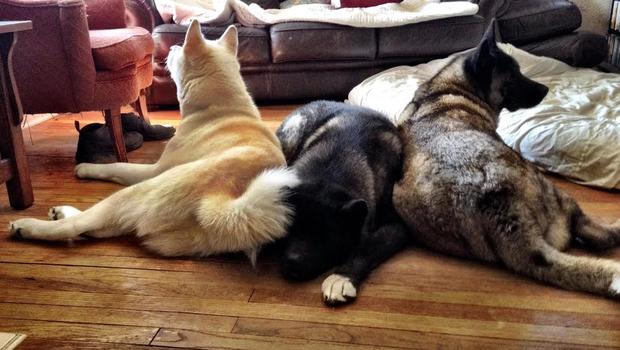
On a rough day, Kiaya collapsed on the cold living room floor, unable to make it to her queen-sized dog bed.doggierure

Within minutes, her two “brothers” snuggled up on each side of her.

The sight brought tears to pet owner Jessica VanHusen’s eyes. That’s because life hasn’t been easy for the 10-year-old Akita, who lost both of her eyes to glaucoma over the course of 15 months.

Not only can the 100-pound dog not see, she also has a hard time walking — that is, without help from her “seeing eye dogs.”

The special needs dog didn’t have too much trouble adjusting to her new normal with 8-year-old Cass and 2-year-old Keller by her side. Without any commands, the dogs decided on their own to be her guides.

“The boys both respect her fully,” VanHusen told CBS News. “[They] allow her to eat first, they lean her up against the side of the car when we are traveling to stabilize her.”

Wherever Kiaya is, “middle-child” Cass is not far behind.

The dog has been by Kiaya’s side ever since her first eye was removed in July 2013. He would constantly follow her around in their backyard, standing next to her “blind side.”

“He became more attentive to her needs, leaning on her and cuddling,” VanHusen explained. “He even cleans her ears and face, where her eyes used to be.”

It took Keller a little longer. At less than 2 years old, the dog wasn’t fully attentive at first, VanHusen said, but he’s getting there.

“It’s amazing to watch,” Blue Pearl Veterinary Partners Ophthalmologist Dr. Gwen Sila, who performed Kiaya’s surgeries, said in a news release. “It’s clear the other dogs are trying to protect her. Their sense of loyalty is really remarkable.”

VanHusen said she has never considered training the pair to be service dogs. For now, they’ll just continue to take care of their sister, Kiaya, who turns 11 next month.

“She may be a special needs dog, but to us she’s just special,” VanHusen said. “When we ask her where her eyeballs went, she replies: ‘They’re in the garbage, I didn’t need them anymore.'”

With her brothers stepping in to assist her, that statement couldn’t be more true.